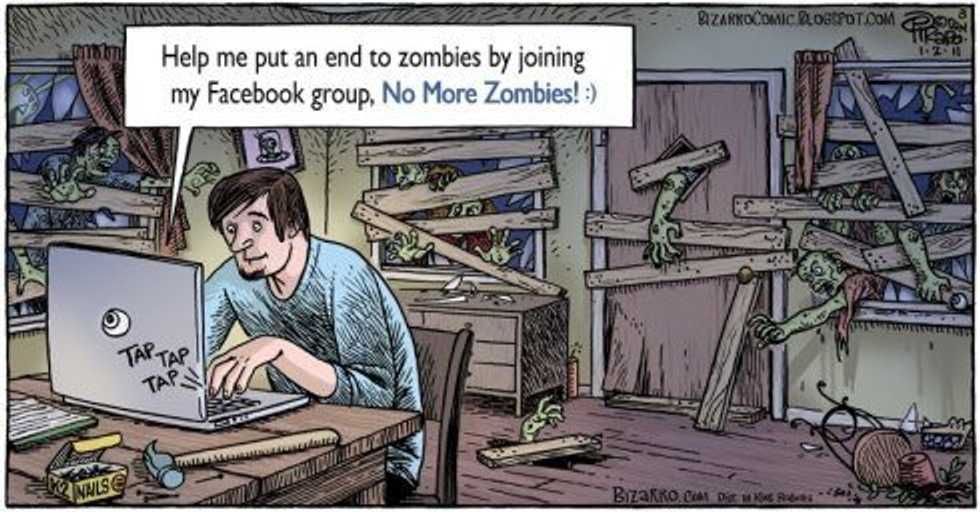
What does it mean to be an activist in our mediated lives of the 21st century? Do you instantly become an activist because you ‘liked’ a photo that said ‘#Blacklivesmatter’? Contrary to popular belief, a million retweets are not going solve our social issues.
With over two billion active users on social media sites such as Facebook, Twitter and Instagram, there is no surprise that the use of this modern platform by activists have skyrocketed in the past few years. The accessibility and simplicity of such sites have provided an excellent network, increasing our ability to communicate on a larger scale 24-7. However, success doesn’t come without consequences. While the number of virtual activists may have grown as a result of social media, unfortunately, it has prevented the growth of real activism.

There are several factors that contribute to the continuous increase in the number of ‘armchair activists’ or 'slacktivists.' The most significant factor is the repetitive and effortless nature of social media sites. For many social media users, the routine checks of notifications and newsfeed have become automatic, with less thought going into double tapping a photo on Instagram than walking. This user- friendliness of the various websites combined with the overwhelming amount of information presented everyday, have greatly affected the interactive culture that social media was originally built upon. Due to social media’s dangerous ability to limit a deeper involvement in informations that are communicated, the online activists’ click is nothing more than a click, and an Instagram ‘like’ is nothing but a daily routine.

Do you remember Myspace and MSN? Well, as with everything else on the Internet, activism through social media has a short lived relevance and is easily forgotten. Unlike the Women’s Liberation Movement and the Anti-Vietnam War Protests of the 1960’s and 70’s, many social activisms today lack passion and true motivation to bring about the desired change. In the past without social media, protests were fueled by anger and created cohesion by bringing together individuals who shared the same perspectives, attitudes and goals. As the protests required them to physically face their opponents and the participants made sure that a step was taken in the right direction. However, slacktivists will move on to the next social issue in a few days, simply leaving the issue unsolved.
Furthermore, since the user is able to see the number of people who are in support of the campaign, each individual’s incentive to contribute, which is low to start off with, is significantly reduced. The concept of social loafing suggested by Alfred Adler is magnified through virtual activism as participants result to passing on the responsibility to the other million people who have also liked the Facebook page. In addition, this human nature that is the cause of slacktivism has been proven by a study conducted by the University of Massachusetts, which asked the blindfolded participants to pull as hard as they can on a rope. The study showed that when the participants were told that 3 other people were also pulling on the rope behind them, they only exerted 82% of the effort as when they were pulling alone.

We are like infants when it comes to activism through social media sites – we are drawn to the shiny new campaign but as something else comes along, we instantly jump onto another. We imitate what others are doing, desperately trying to keep up, and once we know it, we are stuck in the vicious cycle of slacktivism that is simply an empty contribution. The only way to stop this is to keep asking yourself, what can I do after I’ve liked the photo? Because we all know, your meaningless click is not going to save a starving child.