
College attendance is currently at record numbers in the United States, yet a combination of few job prospects, low graduation rates, and increasing debt is causing many to question whether college degrees are overvalued.
Graduation rates
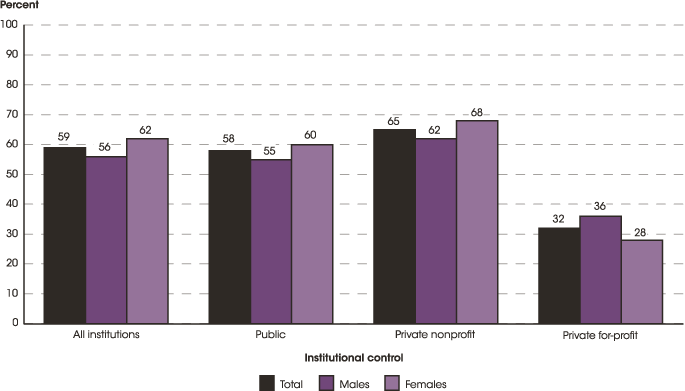
A Harvard study shows that 59 percent of students who enroll in a bachelor’s degree program finish within six years, while 29 percent of those who seek an associate’s degree finish within three years. As many as one in three freshmen don’t return their sophomore year.
Records from the Organization for Economic Co-operation and Development show that the United States is last among 18 other countries tracked by the OECD at a 46 percent completion rate, followed by Slovakia at 63 percent and Poland at 61 percent. There are various factors for this decline, one of which being tuition.
Tuition fees
Many students simply can’t afford to pay for their education. Student loan debt is at record highs, now at $113 billion. Here’s a breakdown on the cost of living on campus and a year of tuition fees at several universities in Michigan:
- Eastern Michigan University at $20,000
- Wayne State University at $24,000
- University of Michigan (Dearborn) at $13,000 (cost estimate is tuition only)
- Henry Ford at $14,000
- University of Michigan (Ann Arbor) at $27,000
- Michigan State at $23,000
- Western Michigan University at $20,000
- Central Michigan University at $23,000
Job prospects
Even after getting a degree, 48 percent of all working alumni were underemployed in 2010. Many take on multiple low paying jobs to pay for expenses and loans without finding a job in their field, despite having a degree.
Outside influences
The added societal burden on students fresh out of high school may also contribute to the low graduation and high dropout rates. Balancing academics with financial responsibilities is extremely difficult, with most students unable to devote enough time to studying while working a part-time or full-time job. Responsibilities also increase for high school graduates as they transition into adulthood, many moving away to live on campus or in apartments. Their time management falters between social life, parties, work, and class.
High school plays a definitive role
High school is an important factor when considering how successful students are in their pursuit of higher education. While some blame is placed on the apathy of students in their studies, high schools have been criticized for not preparing them well enough for college. For some students, transitioning into college can be as simple as moving from 11th to 12th grade, while for others, it’s much more difficult. Even essential skills such as note-taking and synthesizing essays can be overlooked in the curriculum, causing many freshman to falter in their first year in college. High school is very lenient in grading compared to college, causing a rude awakening for students who are content with C letter grades. There has also been an increasing pressure for teachers to have students pass standardized tests which could hinder effective teaching. With over 70 percent of high school students moving on to higher education upon graduation, only 28 percent met the college-readiness benchmarks in all four subjects on the 2015 ACT according to the Iowa City, Iowa testing organization. Students not meeting the benchmarks in any subject on the 2015 ACT totaled 31 percent.
Conclusion
There are a plethora of factors that contribute to students' shortcomings in college, with finances, time management, and previous education the largest ones. Many students go to college ill-prepared, only to learn the hard way just how difficult that endeavor is. Even if students graduate with a degree, it doesn’t guarantee a job, and many are left with crippling debt in the form of student loans.