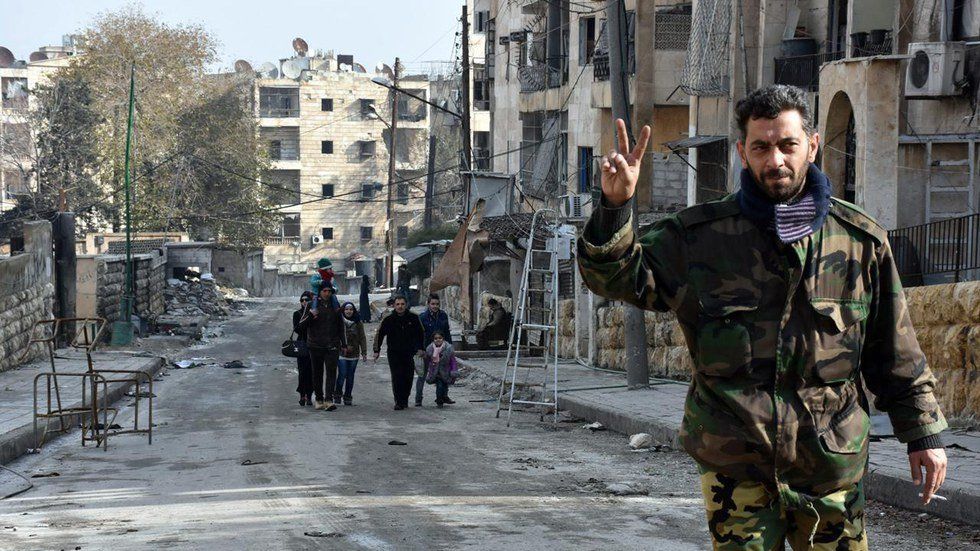
On December 29, 2016, Russian President Vladimir Putin announced that a ceasefire had been brokered between the Syrian government and various rebel groups. The ceasefire itself was brokered by Russia and Turkey, who both pledged to act as guarantors for each side, since Russia supports the Syrian government and Turkey backs various rebel groups. Putin’s announcement shocked several countries around the world for mainly two reasons. The first reason was the exclusion of other countries involved in the conflict, such as the United States, from the ceasefire negotiations. The second reason was the recent assassination of Russia’s ambassador to Turkey, Andrei Karlov, that many assumed would reignite tensions between the two countries. Although Russia-Turkey relations were certainly strained after a Russian Su-24 was shot down by a Turkish F-16 back in December of 2015, both countries have since made considerable efforts to normalize ties. And while this most recent ceasefire could potentially lead to peace talks in Kazakhstan, even Putin himself admitted that the situation is “fragile” and would “need special attention and involvement.”
So how has the ceasefire held up so far? Well, that depends on who you ask. TASS, a media outlet owned by the Russian government, reported that as of January 3rd, Russian officials had registered 27 ceasefire violations, while Turkish officials had only registered 18. On the other hand, Turkish Foreign Minister Mevlüt Çavuşoğlu has claimed that only the Syrian government and its allies were responsible for ceasefire violations. Additionally, Turkey’s Minister of Foreign Affairs voiced his concern that the continued ceasefire violations would thwart any possibility of peace talks. His concerns were later validated when several rebel groups involved in the ceasefire announced that they would “freeze” their plans for peace talks until the Syrian government and its allies stopped violating the ceasefire.
Although the ceasefire is in jeopardy and peace talks are on ice, Russia has already begun to scale back its military presence in Syria. Last Friday, Russia’s Chief of the General Staff Valery Gerasimov disclosed that Russia’s aircraft carrier group would be the first of the country’s armed forces to leave the region. While some may see this as a sign of Russia’s desire to end hostilities, others merely see it as a sign of the country’s renewed confidence in the Syrian government, after the latter captured Aleppo just a few days before the ceasefire was announced. Is it possible that Russia orchestrated this ceasefire to simply give the Syrian government a chance to recover from the Battle of Aleppo and establish a foothold in the area? Sure, it’s a smart move. But when you start guessing others’ intentions, it’s easy to begin acting on those guesses and see them as facts, although they could just as well be pure fiction.