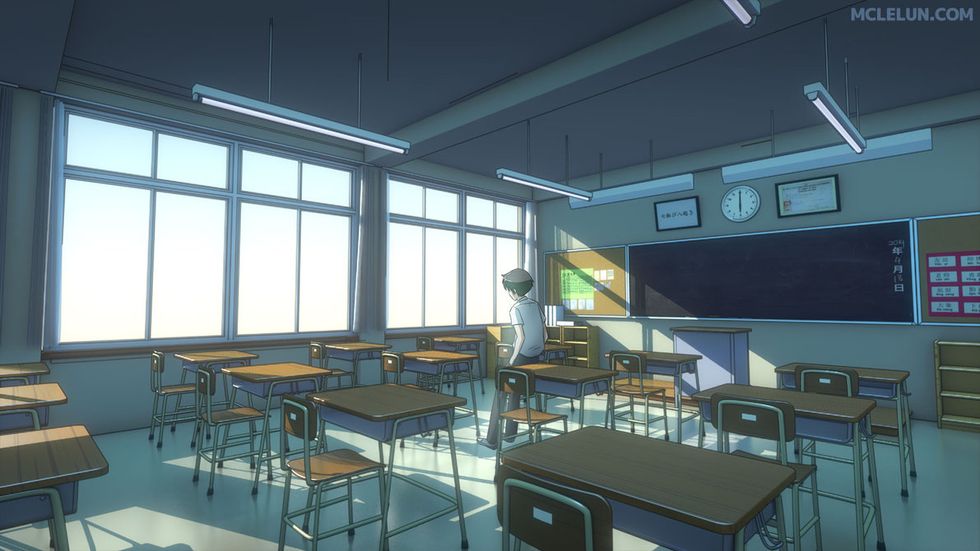
Class is in session! I’m trying this thing where I introduce my regular segment with a witty beginning. Not all heroes wear capes, that was it. Last week, the topic was cultural baggage visualized in anime series and the focus was on “The Devil is a Part-Timer”. This week we will focus on the main plot of a show with a catchy title called “I couldn't become a hero, so I reluctantly decided to get a job” or “Yu-Shibu” for short. In “Yu-Shibu”, overlooking the obvious fan service, the plot has a real deep meaning. I was introduced to this show through recommendations based on similarities to “The Devil is a Part-Timer”. So I said, whatever, it’s only a 13 episode series that I can binge in two days at most. I’m not huge on the whole fan service culture of Japanese anime because it really takes away from the main plot and story of the show, which is the main reason to why studios pick up a series that derive from light novels, manga, or visual novels. Rarely have I seen shows that maintain the ecchi and fan service while still having a strong storyline.
“Yu-Shibu” starts out with our main hero: Raul Chaser who on the top of his class and about to pass his last exam to be a full-fledged hero. Unfortunately for him and his classmates, who sees from time to time after, the Demon Lord (if this was a fantasy game, he would be the last boss), was defeated, omitting the need to have heroes. Raul’s dream of becoming a hero, not only goes up into flames, but he is left with the harsh reality to acquiring a regular job. Although he is reluctant (as it says in the title), he becomes very efficient as his job of being a sales associate at a small magic department shop. His manager notices this and decides to dawn a task upon him in a form of a new employee: Phino Bloodstone.
Phino was at first mistaken as a boy by Raul and is concerned with his cooperation with the young employee. Why? Because of the cultural baggage that we are focused in this class session. As a reminder, cultural baggage is the pre-determined roles that is put upon others based on past experiences, knowledge, or teachings, without ever having any previous interactions with new and different people. This is a commonly a negative perception that people can easily assume a person’s behavior and personality, which is always expected to be wrong. Here, Phino is a victim of cultural baggage perpetrated by her trainer, Raul. He notices Phino’s resume when she is first taken into the manager’s room and sees that she is the child of the Demon Lord! Immediately, he tells his manager that she cannot hire her because she is the daughter of the Demon Lord, sounding like a broken record right now. The manager is not surprised by this and is not affected by the concept of cultural baggage, opening her arms to Phino as an employee.
Very concerned by this, Raul is entirely not on board, but as the top employee for such a small magic department store, he has no say in the matter. Raul, at first, is annoyed by the lack of experience by Phino and assumes that her previous life of lavishness under the Demon Lord has made her sheltered. But it is because of this, she is forced to find a real job in the very world that her father planned to dominate, regardless of the imminent hate from the public; the first being Raul. Raul isn’t the anti-hero that I am making him out the be, Phino sometimes greet customers with very demonic-like introductions such as “How brave you are to enter the very store that the Demon Lord’s daughter dwells”, just things like that would off-put customers. Over time, Raul becomes closer to Phino due to her genuine enthusiasm and effort to her first job. He learns that Phino actually disapproved her father’s actions and did not want to take up his position.
Raul becomes the hero by overcoming his cultural baggage of Phino. Raul even saves her from life-threatening problems in and out of the store. His character shows the consequences of cultural baggage, but he overcomes it and finds there is much more to people when you just look at them with one perspective. He also becomes the visual representation of the benefits of overcoming that cultural baggage while becoming the hero that he desired to be in the beginning of the series. Raul sees that the hero that he wanted to be is not the one who wears a cape while slicing up the demon lord’s minions, but the one who is a role model to his new co-worker. So if you think can’t be a hero like Raul, you could already be one to someone by just being yourself. “I couldn’t become a hero, so I reluctantly decided to get a job” is an award-winning series that was adapted into a 13 episode series, all viewable on www.crunchyroll.com. Class dismissed.