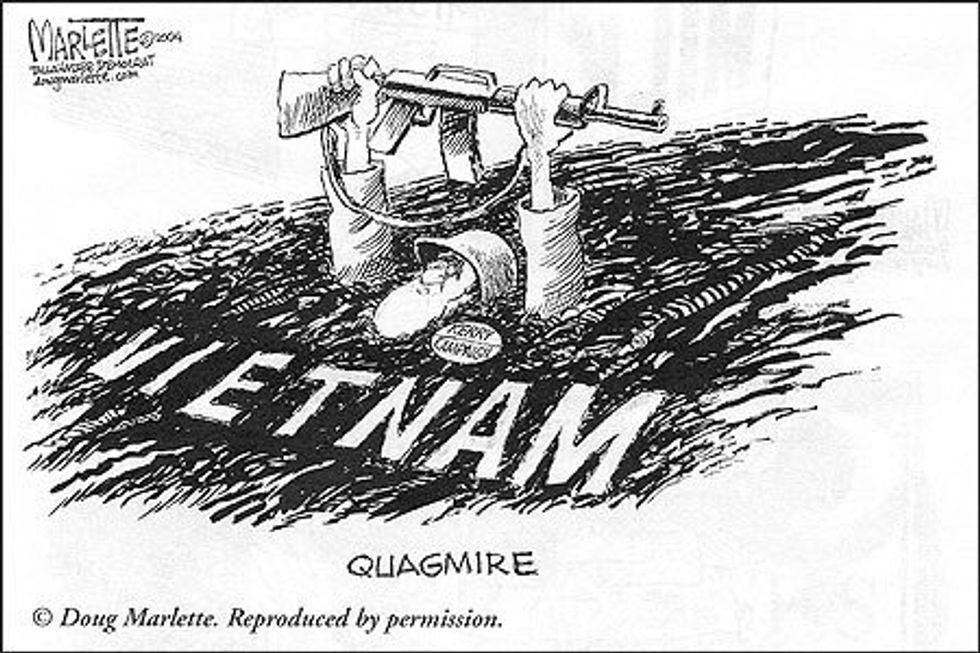
Since World War II, America hasn't won a war it's been involved in. Vietnam and Korea did not turn out to be these capitalist countries we envisioned. While we were able to drive Iraqi forces out of Kuwait during the Gulf War, we reinvaded Iraq almost a decade later. After eight years in Iraq a new and scarier threat to the Middle East has emerged -- ISIS. The Afghanistan War is still going on, the longest American war ever, and Al-Qaeda and the Taliban are still around. The 70 years of losing has brought with it a host of negative consequences that are being felt far from the battlefields.
In order to fund these wars, America has poured an enormous amount of money into the defense budget. The U.S. defense budget is a whopping $601 billion. This budget is larger than the defense budgets of the next seven countries combined. When you look at our long history of involvement abroad it makes sense why we dedicate so much towards this single budget. It's horrifying to think that we alone will spend $360 million on a ship that doesn't work, but veterans have to wait months for an appointment at The Department of Veteran Affairs. Additionally, there are other domestic problems that would benefit from some of these funds being redirected. From schools being shut down in low-income areas of Detroit to paying off the national debt or even certain welfare programs could use even a fraction of this money. Wasted money on forfeited wars is just one of numerous consequences we have to pay for when we can't seem to find victory.
Casualties in war have been, for the most, part declining since World War II. Nonetheless, from Korea to the war on terror there have been nearly 400,000 U.S. military members who have been either killed or injured. The issues don't stop once veterans return home. Currently, the suicide rate among veterans is double that of the civilian population. Recent reports have detailed the deplorable conditions at The Department of Veteran Affairs where veterans have died waiting for care. The death toll continues to rise as our involvement abroad has put many civilians in the crossfire. It's been estimated that over 150,000 Iraqi civilians have died following the invasion of their country. It becomes harder to justify this rising death toll when we can't seem to figure out how to win these conflicts.
An issue that is far harder to quantify is what these decades of lost wars have done to the perception of the United States. In the post-World War II era, where few wars are fought strictly on a battlefield like those of Europe, America has displayed its incompetence at adapting. If people around the world continue to see that we can no longer win our fights, they're less likely to fear us. While some may argue that America shouldn't be feared, there are many benefits about a country having a daunting aspect to it. Enemies are far more hesitant about attacking the homeland, or our interests and allies in other regions. In addition, our threats of action carry much more weight when people understand that we have the abilities to execute them successfully. Sometimes, just the threat of action can invoke change without needing to take other more costly steps. The perception of America should be held in equal concern to other issues regarding foreign policy. Finding ways to salvage our image may help us prevent another hopeless war.
The United States is still a major player, and we will continue to be for the foreseeable future, but we must be smarter about how we involve ourselves abroad. We must decide what we're willing to sacrifice when success is no longer a guarantee. A pattern of lost wars will only continue to hurt us and cause a ripple effect that will reach from the war zone to back home.