It's a statistic that's sweeping social media in the United States -- there have been more mass shootings thus far in 2015 than there has been actual calendar days. To be exact, on the day I am writing this, there have been 337 days this year, and 356 mass shootings, a number updated from
the viral article published by the Washington Post.According to motherjones.com, a mass shooting is defined as an incident where there are multiple victims of gun violence. Whether someone is killed or injured, if someone decides to shoot somewhere and that violence affects more than one person, I'd call it a mass shooting.
Here's a few of the most covered mass shootings this year provided in an extensive article
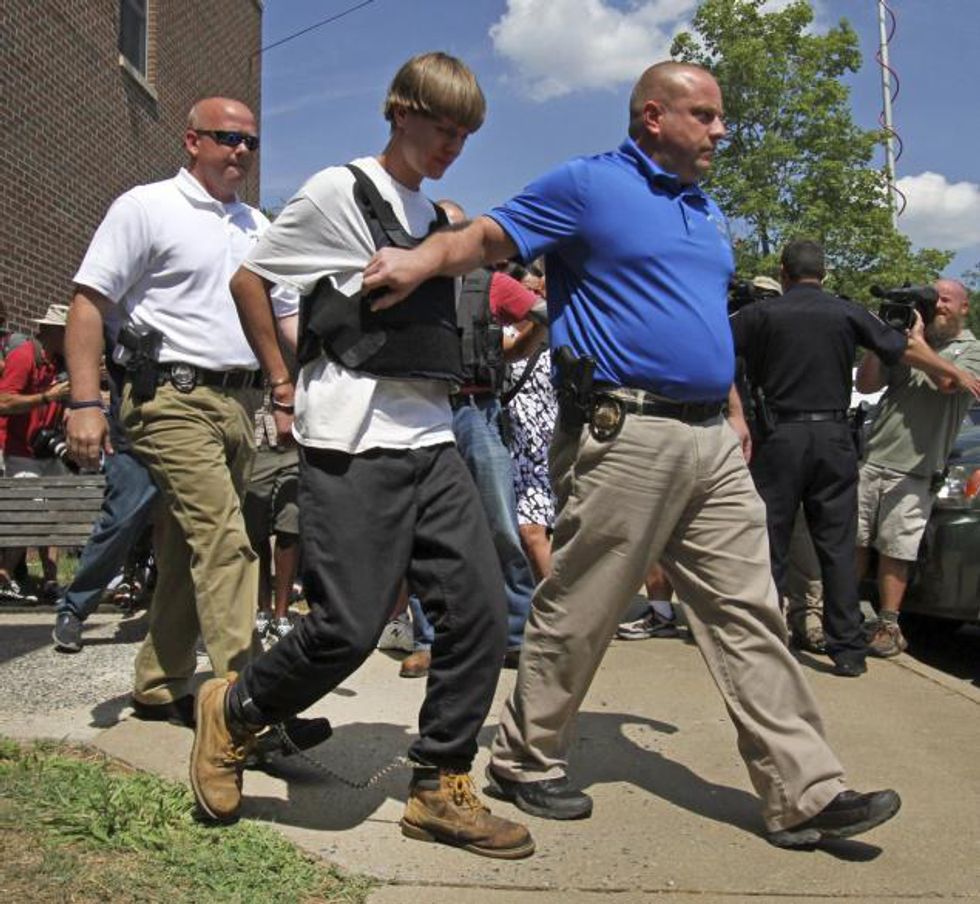
that looks at mass shootings since the 1980s. The majority of the shootings on this list were in this millennium, and several were just this year:June 18, 2015, Charleston, South Carolina: Dylan Storm Roof kills nine and injures three after shooting members of a historically black church. Roof had a white supremacist history and was convicted for several counts of murder and attempted murder. According to the New York Times, Roof bought the gun used that day a couple months before, though after admitting to possession of drugs, he shouldn't have been able to purchase the firearm.
July 16, 2015, Chattanooga, Tennessee: 24 year-old Mohammod Youssuf Abdulazeez opens fire at two separate military bases. He killed a navy sailor and four marines, making this one of the most tragic shootings of the year, due to the justified empathy American's have with the U.S. military. He was killed that same day after taking five lives.
July 23, 2015, Lafayette, Louisiana: John Houser killed two and injured nine at a Louisiana movie theatre. With a history of mental illness and a failed attempt at obtaining a concealed weapons permit, Houser bought his gun legally from an Alabama store.
October 1, 2015, Roseburg, Oregon: A shooter identified as Christopher Sean Harper-Mercer shot several, killing nine and injuring nine, at Umpqua Community College. Struggling with a history of mental health issues and subscribing to white supremacy ideologies, Harper-Mercer also took his own life that day. He owned and bought all 14 firearms that he or family members obtained legally from a dealer, and was armed with six weapons that day.
December 2, 2015, San Bernardino, California: A married couple kill fourteen at a holiday party for a center for young adults with disabilities, and leave over 20 wounded. They later died in a shootout but had stockpiled explosives and guns, though their guns were bought legally by a third party and given to them.
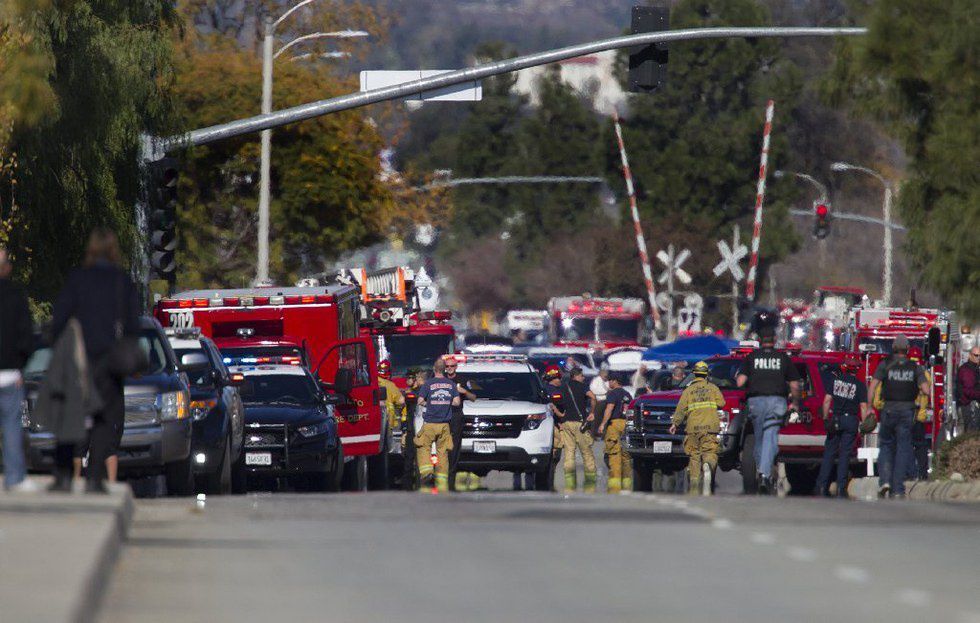
According to the National Rifle Associating (NRA) website, only nine states have the laws making them what the NRA would consider a state with "very limited issue" classification. Considering the aforementioned statistics as well as the tragic stories, in which a total of 39 lives were lost in the fice stories I chose to paraphrase, it makes millions of Americans wonder why Congress is just sitting on the issue of gun control?
The Washington Post used an interesting graphic to show the divide on where Congress sits on gun control. Here are a couple snapshots of the partisan divide:
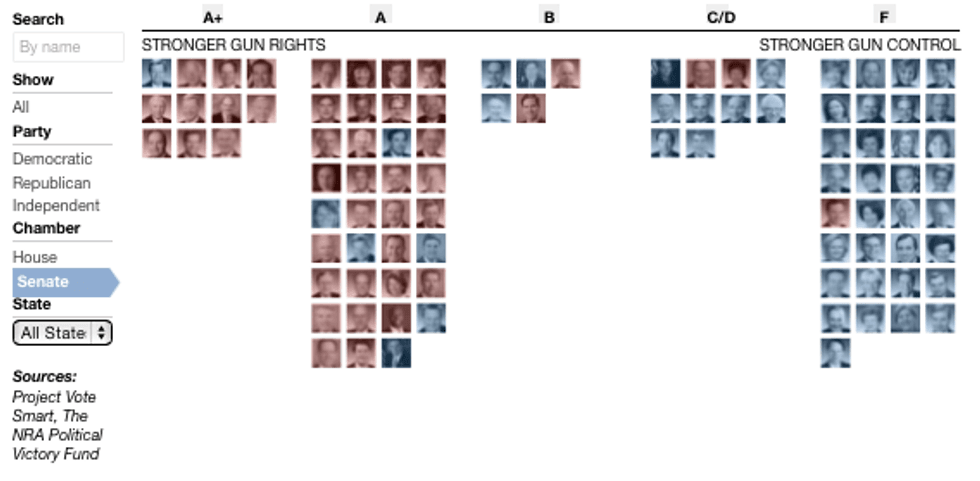
With such a clear divide in Congress, it's hard to pass laws that the majority actually agrees with, and the line on gun control isn't exactly thin; most people fall on one side or the other, with few moderates.
So many U.S. citizens have this misconception that guns amount to safety, which, according to so many studies about the correlation between strict gun laws and "safe" states, is false. One of the states with the most lax gun laws is the top of the list for the most "dangerous" state in America (most crimes per 100,000 people) by 24/7 Wall Street.
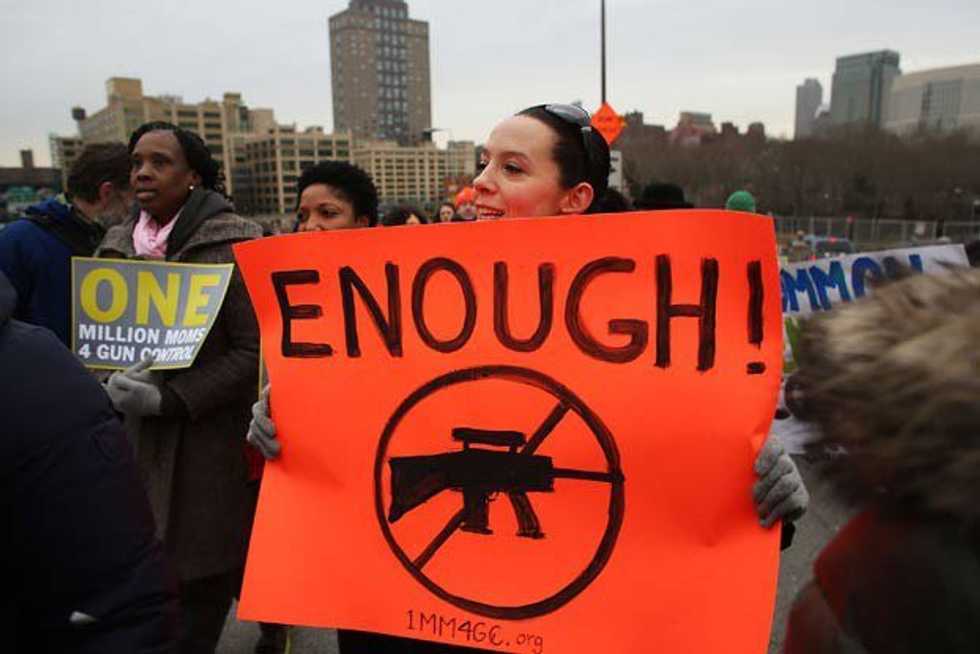
Not to say that ownership of a gun hasn't saved any American lives, but the gun culture in our country has cost so many lives too. With private dealers and gun shows with no background checks, almost anyone can get one, including those who took thousands of lives in 2015 mass shootings.
As a country, we should have started talking about gun control way before now. These statistics are just a mere representation of the United States' problem with the way we see firearms and safety going hand-in-hand.