


If there is one thing Americans love, it’s a hero. Paul Revere's midnight ride to warn the colonies of British attack, Lewis and Clark's adventure into the unknown to fulfill our manifest destiny, the unknown soldiers -- guarded every moment of the hour with solemn reverence. Every American knows these stories and we let generations eat them up as an example of what our country is -- the valiant solider fighting for our rights.
And nothing is wrong with that -- these stories are what makes America so beautiful. We love to stand up for justice and protect our ability to express freedoms whenever we can. We have an image painted of ourselves not unlike a Samaritan or martyr -- fighting for the greater good of the country by whatever means. These aren't bad things to focus on. Everyone wants to be a hero.
But as we enter into the weeks that make up Black History Month, I find that there is one blatant thing wrong with the hero narrative that we all love to embrace -- how do we reconcile with the fact that America was not always the good guy?
Black History Month was created in the 1920's then reestablished in the 1970's as a month in which we honor the accomplishments of African Americans throughout history. As a white person, I have come to translate this month into countless MLK "I had a Dream" quotes and for the edgier sort a Malcolm X quip. This is also the month where I get to beat my head on a desk senselessly as a portion of the white population argues about why we don't have a white history month too.
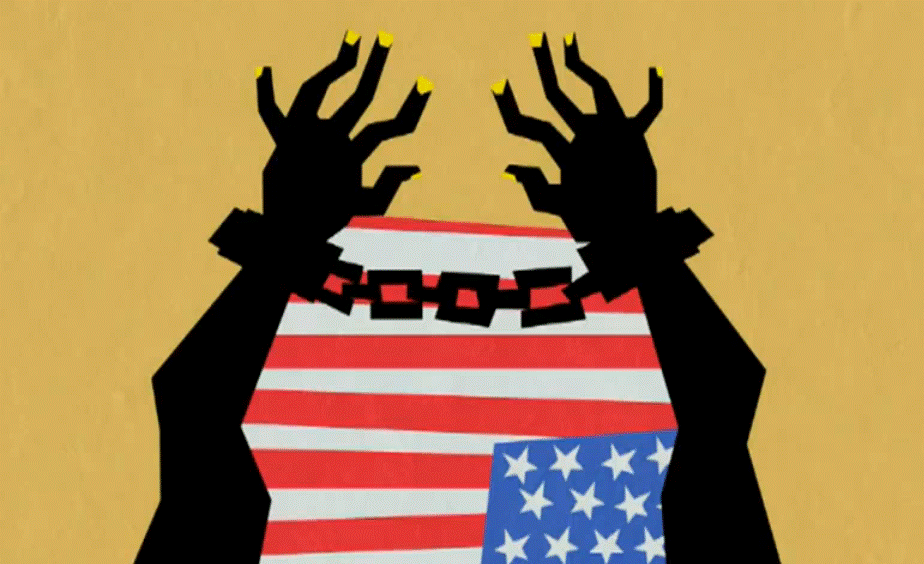
While its awesome that we are giving African American's a month to specifically celebrate their history, I think we are all skirting around one big elephant in the room that, in my opinion, America does not want to address -- American slavery.
When I was in middle school, we took a class trip to the Holocaust Museum in Washington, D.C. It was one of the most terrifying yet telling experiences in my life to the horrors that the world once witnessed. I remember getting on the bus afterwards with about 30 other classmates and we all sat in utter silence -- too horrified to enact our typical harassment on each other for the ride home.
It wasn't until I was much older that it crossed my mind that there is no American Slavery Museum. Of course, we have a ton of Underground Railroad, Frederick Douglass, and plantation life museums scattered around, but not a straight up museum about slavery itself. Just more things skirting around the real issue -- the big issue -- that America, God willing, was the bad guy once.
Now, I know what you are thinking: "No way! I went to that place one time where we talked about slavery an-"
No, you didn't. You went to a place about a person or peoples who were involved in slavery in some way. Trust me. I looked it up. Actually, to be completely accurate, the first ever American slavery museum was built in 2015 with many other attempts for such a museum preceding it with no luck. And even with this new one erected, it does not seem to be getting much hype. It seems, to be candid, that us American's don't like to hang our dirty laundry out to dry.
Which leads me back to my heroism narrative. I've come to the conclusion that, at least until 2015, America has not liked to talk about slavery unless it was in the context of a hero. Frederick Douglass, Harriet Tubman, Olaudah Equiano -- all of these people are considered heroes to the American public, but we like to turn our eyes away to the fact that their nemesis was the very nation we encapsulate them in. We like to forget that the battle these heroes fought was an institution that our country embraced for a very long time. An institution, one could argue, that still rattles American soil in the form of institutional racism today.
With this viewpoint, it does not come to a surprise to me that I can go to a renowned Holocaust museum on U.S. soil any given day, but not a slavery museum of the same stature. The Holocaust and American slavery are comparable in terms of horrific historical moments, but the one thing that makes America rest easy about Nazi Germany was we were the good guys. Even now as I think back to the Holocaust museum in middle school, I remember seeing the faces of American soldiers who went in and eradicated Nazism from Europe. We were valiant in a time where humanity was lacking! We took down a radical racist! We freed a peoples! ... Just don't look behind the curtain at our own injustices to minority groups...
I am not mad at America for making these judgments; although, I find them important. I could sit here for hours and write a novel comparing and contrasting the reconciliation of Germany after Nazism and America after slavery, but obviously I won’t do that either. What I do want to poise is that, as we are entering into Black History Month we start to think about the realities in our nation’s history and how we as modern citizens want to reconcile with that.
Many times in my life I have heard people make the argument that we should stop talking about slavery. Some of the arguments are well formed --explaining that if we keep reminding people of that time we are allowing institutional racism to continue manifesting itself in the present. Others tell me they just don’t want to be held accountable for their ancestor’s misdeeds -- they didn’t keep slaves. I’ll accept these arguments either way although I disagree with both of them.
Vergangenheitsbewaltigung is a German word composed after the Holocaust that roughly means to struggle to overcome the negative actions of the past. This word has remained one of the biggest basis of study for German literature and culture after 1945 because, while its translation could imply different levels of reconciliation, the German’s have taken this word to mean that the past, present, and future must always intertwine in order to make sure that previous injustices will never happen again. It is a tightrope walk -- keep the past in your minds but don’t let it consume you. Never forget, but allow yourself to learn from it and move forward.
Although there is no word to match this one in the English language, I invite you to think about what this word could mean when put into the rhetoric of American Slavery. It’s not good to hold onto our negative actions too closely, but we can take what we can in order to make sure history will not continue the same injustices.
I am not a scholar on racial theory, nor do I pretend to be, but as an American, I like to wonder what our country would be like if we owned up to our misdeeds like the Germans have since 1945. Would MLK had to have made his march on Washington? Would Rosa Parks still be a household name? Would Ferguson be a place of racial warfare? Maybe the answer is yes -- but I like to think that maybe on better moral and cultural grounds. Maybe by owning up to our past we could put forth a better plane for the future.
I am a white American. My ancestor’s probably owned slaves. There is nothing I can do about that fact, but I will try to l reconcile with it. Racism in America will not just go away if we now decide to talk openly about slavery, but at least it will be a start to show the basis of our faults. If we bury our ties to slavery without eradicating them we are allowing them to manifest, slowly and surely, back into our modern lives. Don’t let the past haunt you, but most importantly, don’t let the past continue to the future.

















