
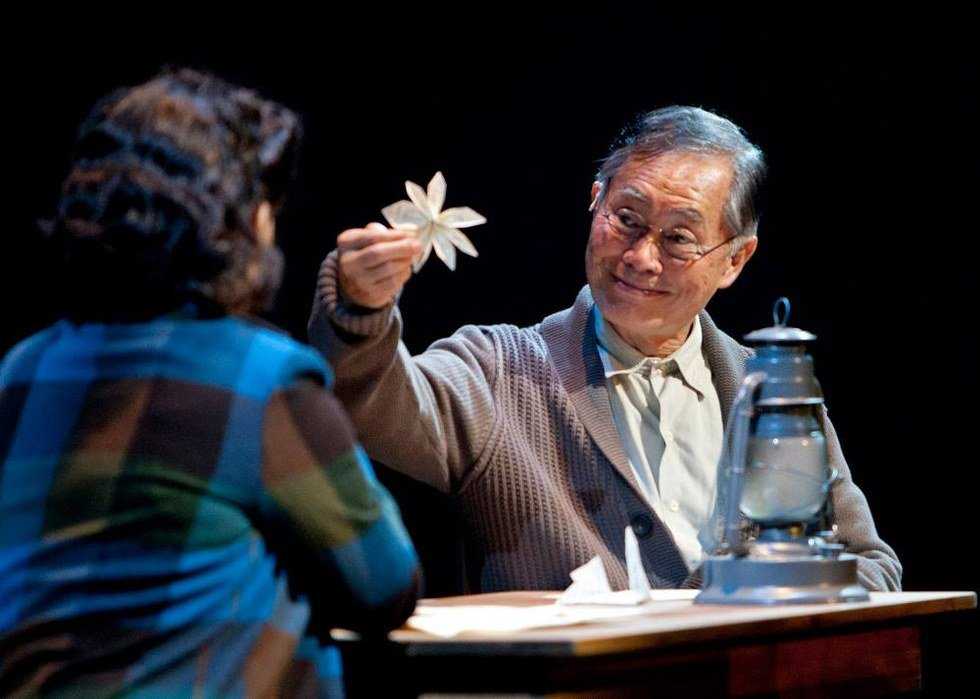
When I think of travesties committed against Americans by Americans, the internment of Japanese Americans is always an event in our history that hollers from the back of my mind. I remember when I first learned about Japanese internment. I believe it was some time in the third grade, and, under my own self-guidance, I happened to pick up a fictionalized recounting of events. The book was vague at best. All I could really understand at that time was that the forced relocation of hundreds of thousands of Japanese Americans was, at the least, an unjust inconvenience. No one can deny that the ordeal was a sickening abuse of government power, but today, it is seldom discussed or reflected on. Therefore, when I learned of "Allegiance," a Broadway musical centered on the experiences of Japanese Americans in internment camps, I made up my mind that I would go and see it in some form. When I did find my way into a crowded movie theater that was streaming a recording from an earlier performance of the show, I was struck by two things.
Firstly, I was utterly moved by the visceral turmoil the actors and actresses displayed as they reenacted the inhumane conditions of the Heart Mountain relocation facility. This musical, in stark contrast to whatever trivial information a children's novel or textbook will spit at you, is anything but discreet. It may be an act of drama, but every line, scene, and action is deeply rooted in personal accounts and testimony, many having been contributed by actor and internment survivor George Takei, who was sent to an internment camp at the age of five. The real story of internment is one of intense human struggle, humiliation, isolation, death, and dignity, and this musical captures that with pristine accuracy. Not only does is vividly depict the despicable acts of racism and oppression brought to bear against first and second generation Japanese immigrants, but it highlights an internal conflict I had not thought of before. The musical brings to light a social divide between two distinct groups of Japanese Americans at this time-- those that chose to serve in military, knowingly assigned to missions of suicidal proportions in an attempt to prove their loyalty to the nation, and those that remained behind in the internment camps, who fought against the draft and interrogations of their own personal loyalties. Needless to say, the emotional gravity of the situation could be felt by any who were present in the audience. I will happily fight tooth and nail against those that might say art is not educational; I guarantee you, there has never been a more educational or worthwhile musical than "Allegiance."
The other facet of my viewing experience, which hit me as soon as I entered the theater, was the demographics of the audience. The room was completely packed, with barely a handful of seats left open by the time I arrived. The overwhelming majority of those present were representatives of the previous generation of Japanese Americans that resided in my hometown of Fresno. Some of them had brought their family members or spouses, but for the most part, my age group was a blatant outlier. I was certainly humbled by their presence, but at the same time, a disquiet grew in me. Where were their children and their children's children? Why was I one of only a handful young people, not of Japanese ancestry, that had come to witness this retelling of a historically vital tale of American injustice? No more than four days later, as I sit writing this, I am still vehemently concerned by this fact. Everyone benefits from hearing this story, and though it may be unpleasant, we can learn a great deal by looking the unfiltered prejudices of the past in the face. In this modern time, where we as a people must fight against ideas of persecuting people based on race and culture, we need to remember and hear these stories more than ever. If we choose to forget them, if we choose to look away, then we actively participate in the indifference that will give way to the same atrocities befalling socially oppressed people yet again. Thus I urge you all, if you have the means, see this musical. I assure you, you will most certainly be better for it.














