

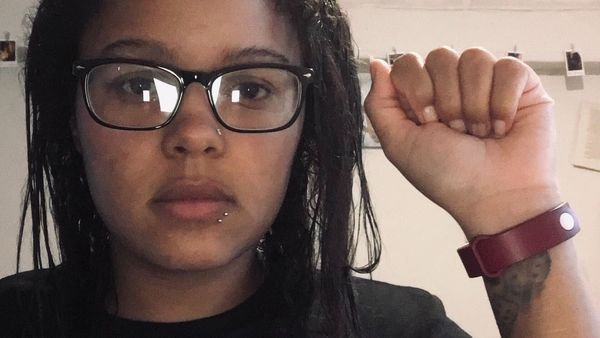

All Lives Matter.
Unless you’re black, gay, trans, a woman, or an immigrant, obviously.
Police brutality and 21st-century racism has finally become a salient issue in the news, not because police brutality is a new thing, but because people are finally fighting back and trying to redress the horrific power imbalance in our society. Unfortunately, these demonstrations are often met with negative feedback, imploring them to “ask nicely” and make their demands "less radical."
Acknowledging the goals of some activist groups can admittedly be disconcerting. Out of the Flames of Ferguson, a primarily non-male, black activist group, seeks to dismantle the institution of the police in its entirety. Subsets of the Black Lives Matter group engage in more militant actions to further their agenda. However, before anyone launches into a critique on how inherently problematic it is to employ violence as a social movement tactic, two things must be understood.
First, we who experience white privilege have to consider the efficacy of the legal system. Trayvon Martin’s shooter escaped conviction, and the cases of Sandra Bland, Eric Garner, Mike Brown, and many others have been left without an indictment. When our courts repeatedly fail to deliver justice, it’s absurd for us to expect victims of police brutality and white supremacy to work within the system.
Second, it’s absolutely imperative to recognize that in a country perverted by systemic racism, white people cannot assume their experiences are universal, and hold others to some farcical standard we’ve invented. There’s this idea proliferating among white people that in order for people of color to voice their dissatisfaction with the system, they have to adhere to the idea of politeness we’ve constructed. Indeed, when riots erupt following the murder of an unarmed black people, white people like to turn up their noses and say, “Well, violence isn’t the answer!” Tamir Rice was my brother’s age when he was killed, and I can attest firsthand that 12-year-old boys are complete idiots. To think that our system has criminalized 12-year-olds for just being 12-year-olds — so long as they’re black — is disgusting.
Where are the white people claiming “violence isn’t the answer” when black children are murdered?
When we examine the implications of such attitudes, I’m forced to understand that, to me, the police are a symbol of protection. Girls who look like me can wield rifles in their Facebook profiles, pictures, and walk the streets without fear of being targeted. For people of color in America, the same reality does not apply. The police are a symbol of oppression, violence, and a perpetuation of the institutionalized racism pervasive throughout America. Would I suggest dismantling the police force as a pragmatic and feasible solution to the issue of police brutality in America? Not necessarily. However, this issue doesn't affect me firsthand; thus, I do not have the authority to judge the merits of a solution. Moreover, when we observe patterns of oppression in the United States, two things become apparent. First, although we perceive our society as becoming gradually less discriminatory over time, in reality, one system of oppression replaces another. After the formal abolition of slavery, Jim Crow laws and black codes became manifest. Following that, we see the war on drugs, the rise of the prison-industrial complex, voter ID laws, and many other perverted policies arising to continue the oppression of people of color in America.
Second and more importantly, when we observe these cycles of oppression, they are broken by instances of rebellion. The abolition of slavery did not come about because slaves asked nicely to be freed. The Civil Rights Movement didn’t involve Martin Luther King Jr. politely requesting white people to stop and occasionally sharing a Buzzfeed article on Facebook — "12 Reasons Why Racism is Bad!" Rosa Parks was not just tired; she deliberately broke precedent and surrendered herself to make a point. While we like to perceive the Civil Rights Movement as peaceful and filled with passionate speeches, the role of groups like the Black Panther Party cannot and should not be overlooked.
At this point, it’s clear that while the idea of dismantling the police, or engaging in any other radical movement might be unsettling and disruptive to the status quo, our ability to work within the system to dismantle systemic racism is extremely stifled. As implied in the name, you have to dismantle the system to eradicate a systemic problem. The idea of employing body cameras as a safeguard against brutality may seem preferable to a complete overhaul of our current system, but to what extent are cameras going to be effective in breaking a system of oppression that has been manifest for centuries? They certainly didn’t do much for Eric Garner, and that’s appalling.
I have to be cognizant of how my privilege informs my perception of institutions like the police. While not everyone may agree with the methods employed by social movements like Black Lives Matter, we cannot delegitimize their goals and grievances, and we cannot stigmatize their attempts to speak out.
Following Beyoncé’s Superbowl performance, there was public outburst, labeling her as “anti-police” and “racist against white people.” While the idea of a woman dancing on TV being analogous to the brutal racism that has been pervasive throughout America for centuries is laughably ignorant, we have to consider the deeper implications of this claim. I implore everyone criticizing Beyoncé to ask themselves, "Why is the idea of Beyoncé being anti-police so bad?" So what if she is anti-police? When people of color have been systematically targeted by the police, what is so inherently wrong with a person with influence protesting that? I’m pretty sure white people riot if their choice sports team loses, and we can’t forget that our entire country was built on a bunch of guys in awful wigs throwing tea into the harbor because they were pissed at the government. At least Beyoncé is spilling the tea figuratively.
Furthermore, why are we as white people so threatened by this demonstration of black power? Are we annoyed that it takes the attention off the very important football game?
Does it make us feel like we no longer have the power? It’s almost like marginalized groups in society have it worse off or something.
I write this as a white person, acknowledging my privilege. I don’t want my voice to usurp that of those for whom this is a reality. Rather, I write this to implore my peers to reconsider the implications of their critiques when they comment on a riot, or a popularized news story. Just as I cannot speak for people of color when I assert my perspective, so too can I not police their reaction to police brutality. I firmly believe that #BlackLivesMatter, and that the movement is deserving of our respect, recognition, and action. We as a society are failing to do what’s right in upholding the rights of all people. Maybe the idea of #AllLivesMatter wouldn’t be as absurd if everyone screaming that actually believed it.

















