
Afghanistan, a land of fallen friendships, the burial ground of colossal empires, has tested the tenacity of all major powers, a phenomenon as fatiguing, remorseful for the locales as it has been for foreigners. The terrific terrain of Afghanistan has demonstrated fidelity to its natives and proved treacherous to the outsiders. No major international player can claim to have understood Afghanistan, her terrain, the norms, the alliances, and most significantly her complicated ethnic equations, with one exception - Pakistan. The regime of Pakistan has devoted its superior understanding of Afghan tribal politics, contrary to the objectives of Afghans and the west, toward causing instability in Afghanistan. Through its effective, notorious intelligence services, the ISI, the Pakistan Army, the primary decision making body in the country, has diligently demolished all effective peace building measures in Afghanistan ever since the withdrawal of the Soviets. Pakistan’s strategy of keeping Afghanistan unstable, an objective at which they continue to succeed, has costed billions for the West, and, claimed the lives of thousands of Afghans. The lesson is simple, Pakistan has proved a deceiving friend to the West, and, an ill intentioned neighbor to the Afghans.
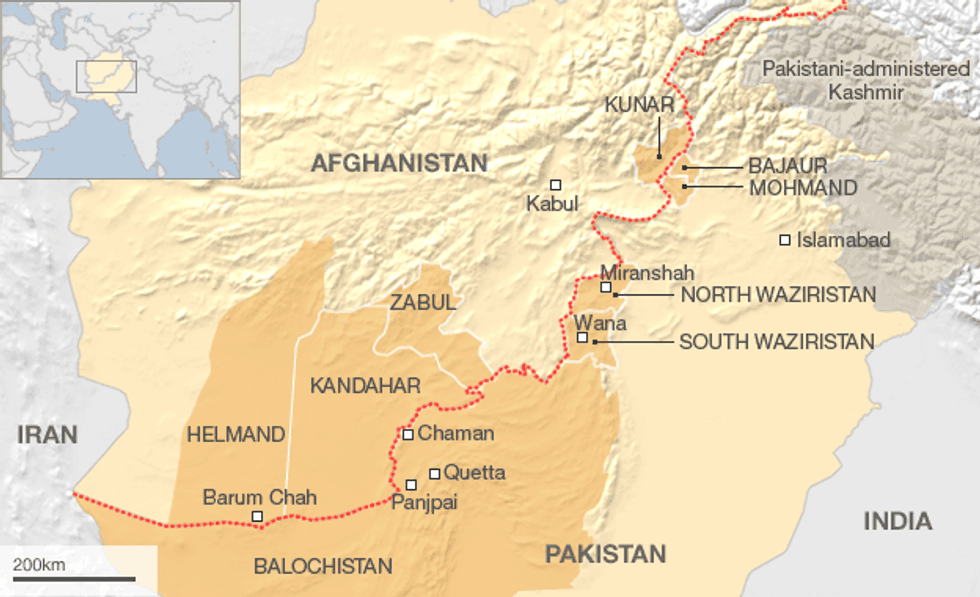
Afghanistan shares a lengthy border with Pakistan, a convenient transit used, first by the refugees fleeing civil war in the 1990's, later by the belligerent elements backed by Pakistan, to take temporary refuge. Escaping civil war and the subsequent Taliban rule, the influx of largely Pashtun community into Pakistan populated an entire region in North Western Pakistan, later named "Khyber Pakhtunkhwa." These refugee camps were to later become the lucrative recruitment grounds for the insurgency. Funded by Saudi Arabia, orchestrated by Pakistan, the Wahhabi madrassas lured in young Afghan men, and churned out fiercely religious fighters, an outcome with a tragic irony - introducing them to an overwhelmingly Arab sense of history, politics and religion, the Afghan identity was systematically prevented from taking root. Completely dissected of their rich Afghan history and of their local tribal norms, these fighters, unknowingly, were to serve as disposable pawns, who would move, attack, surrender as told by those in control, Pakistan and Saudi Arabia.
The doctrine of an unstable Afghanistan is a modified version of the original objective of the Pakistani Army - a Pashtun, Islamist government in Afghanistan. Drafted during the infamous reign of General Zia-ul-Haq, an Islamofascist military dictator of Pakistan, this strategy was aimed at providing "strategic depth" in the event of a military confrontation with the neighbor on her east, India. The seven decade long standoff between the two nuclear giants over Kashmir, a dispute as old as the two republics, exerts considerable influence over the foreign policies on both sides, Afghanistan was yet another manifestation of it.
The nexus of Saudi Arabia and Pakistan strategically orchestrated the birth of one of the most repressive regimes in the modern world - The Taliban. Through its unrequited financial endorsements for madrases, Saudi Arabia viewed Afghanistan strategically significant in two ways, as the brooding ground for the Wahhabi school of Islam, previously alien to Afghan society, and, as a deportation alternative where the local Saudi extremists could be expelled to. Saudi Arabia, therefore, donated the worst of its possessions to Afghanistan, an archaically, unsuitable radical ideology and the most extreme elements, even by Saudi Arabian standards, to implement it. Pakistan, under General Zia, viewed the anti Soviet war endorsed by the CIA, as an opportune moment to materialize his own war. Having died in a mysterious plane crash, General Zia's vision for a Pashtun dominated Islamist Government in Kabul had already found a devoted audience to carry the baton, both in the army and the ISI. It would only take another decade for Kabul to fall to the Taliban, a Pashtun, Islamist, staunchly anti western Government. The scenery of an eerie white flag swirling all across Kabul, a memory dreaded by Afghans, sent a wave of accomplishment across the ranks of the Pakistani Army and the headquarters of the ISI. It, therefore, must not be a matter of surprise but that of grief that Saudi Arabia and Pakistan became two of the three Governments, the United Arab Emirates being the third, to recognize Taliban as the legitimate Government of Afghanistan.
While the United States must duly admit the gross mistake of neglecting Afghanistan post the withdrawal of the Soviets, the escalating violence in Afghanistan has been more due to Pakistan's action than America's inaction. The United States administration, the CIA and the State department, indulged in a strange sense of complacency failed to recognize the ghosts Pakistan and Saudi Arabia were conjuring during the Anti Soviet War, and it would take less than a decade for those ghosts to haunt America.