
Young people have always naturally been drawn to social activism, and in 2015, this remains true as ever. However, has our desire to participate in social movements mirrored trends in social media too much and become vapid and meaningless? Or can “Hashtag Activism” really be a way to bring about meaningful social change?
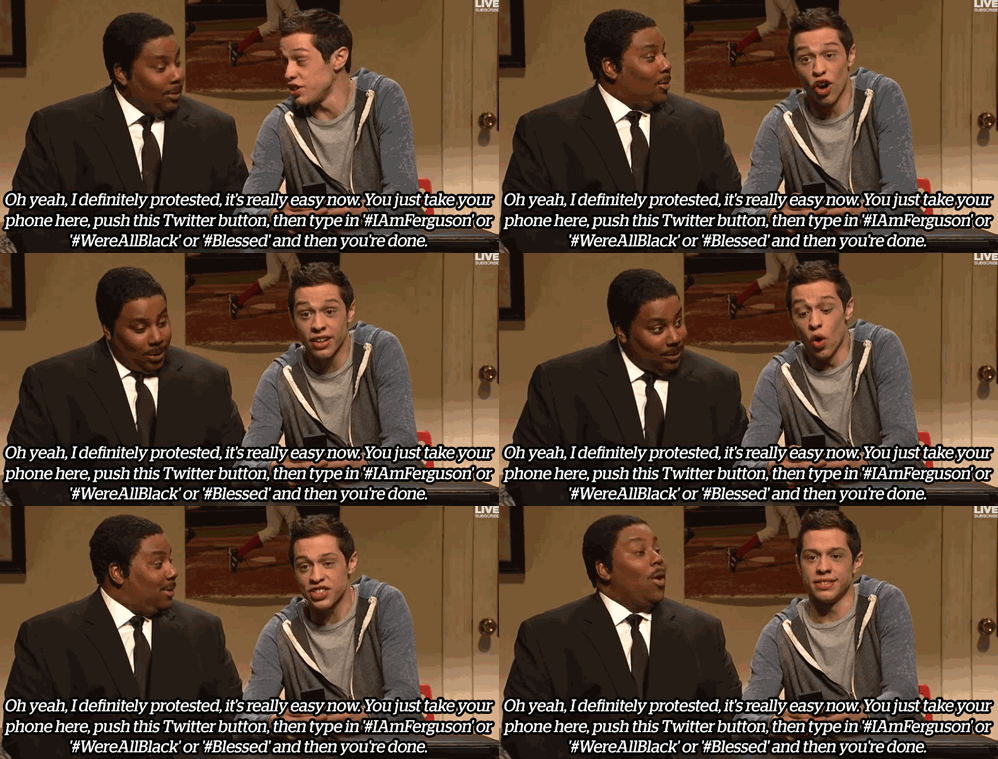
It started innocently enough: I was watching an old SNL cold open on YouTube from January about a teenager who doesn’t know what to write for his paper on Martin Luther King Jr., causing the spirit of the civil rights leader to pay him a visit. The teen then proceeds to explain to Dr. King that though some things may have changed, young people continue to fight for equality and draw upon his teachings for inspiration.
He subsequently pulls out his phone and proclaims, “It [protesting] is really easy now. You just take your phone here, push this twitter button, and then type in ‘#IAmFerguson’ or ‘#WereAllBlack’ or ‘#Blessed’, and then you’re done”. Laughter ensues, and eventually the characters, played by Pete Davidson and Kenan Thompson, announce, “Live from New York, it’s Saturday Night!” and then the show’s theme plays. Great, right?
Except not really. I’ll admit, I found the sketch funny, yet something about it had irritated the young whippersnapper in me. After all, young people have historically always been drawn to social justice movements. And regardless of whether you consider yourself an activist, we all have at least one friend on social media who is constantly posting links to op-eds, blogs, and research studies using various hashtags. And while these may be annoying at times, they can’t be totally useless, right?
Well, it’s important to keep the context in mind. Before the social media age, engaging with social movements required a lot more effort than it does today. Information seemed to be trapped within the minds of a few leaders, who hoped, through word of mouth, desperate letter writing, and contacts at newspapers, to educate the populace about their cause. Compare this to today, where even your run-of-the-mill college junior can find a voice and people willing to listen on the internet.
Because many of today’s social campaigns lack a central, founding figure, it becomes more evident that these causes are due to the will of the masses, rather than just the few. Furthermore, more space is provided for average people to contribute their ideas to these causes, becoming small-scale leaders within their own communities. In this way, modern social activism has become more inclusive and innovative than that of older generations.
But this leaves one question still unanswered: is the younger generation simply “copping out” by using social media and hashtags as a form of activism? Here, it becomes more complex: of course attending protests, organizing rallies, and filling out petitions is extremely important. But the ability to share content to hundreds of people at our fingertips is also important in that it has significantly lowered the barrier for entry to social activism.
No longer does being “part of the movement” require going out door-to-door or holding up signs; because, in essence, sharing articles and using hashtags is the same thing. This has also made it much easier for influential people such as celebrities and politicians to offer their input, exposing thousands and even millions of people to new issues.
Whereas in previous generations, forming communities within movements required physical get-togethers, today, one can simply search hashtags online to learn people’s opinions on subjects, facilitating a simpler and faster means of discussion and exchange. Additionally, "hashtag activism" has made it easier for people to be exposed to new ideas. People of every generation are constantly scrolling through their social media anyway, and it is a lot easier to click on a link than to attend a meeting, especially when the ideas presented contradict the ones you already hold.
So, how should we react to hashtag activism? Well, don’t feel so bad the next time you’re about to post a link or use a hashtag. After all, it can be a great starting place to get a great conversation started within your circle of friends. But if you really want to show you care, try to do more: attend an event, write an article, or sign a petition. Hashtag activism is not the magical solution to the world’s social justice woes. But, in today’s society, it is a vital tool and method of social engagement.