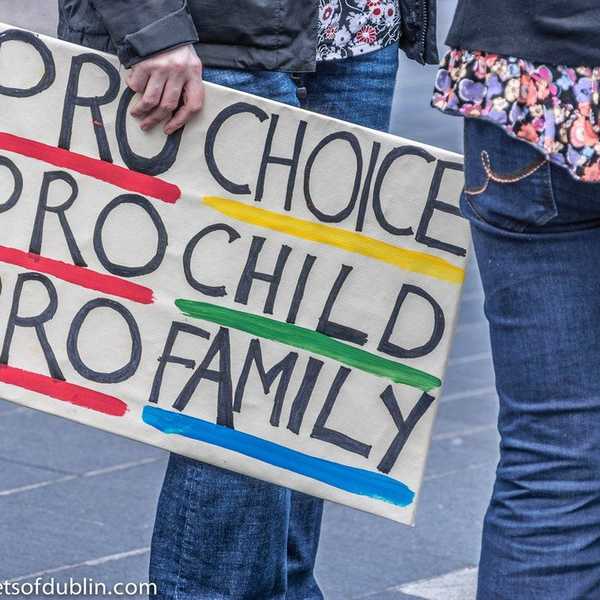
The year 2016 saw the fewest abortions on record since the passing of Roe v. Wade. And yet it seems that the discussion between pro-life and pro-choice has become even more polarized and incensed. So, what are the arguments on each side of this debate? And which side is morally right?
It may be that there is simply not enough information to answer all the questions that need to be answered. For instance, many of the claims by the pro-life camp are that life begins at conception, and terminating that life at any point after conception is morally wrong. Many of these claims stem from religious beliefs which are somewhat rooted in the Bible.
However, the fact of the matter is that there is no instance in which the Bible discusses when life begins in the gestation period or any mention of abortion at all. Therefore, all the passages that are cited must undergo interpretation (which is then up to interpretation itself) to support the pro-life movement. Furthermore, there is no way of knowing for certain if life does begin at conception.
Scientifically, it is generally understood that there is something about humans that makes us quite different from other animals. Now, no one knows what that "something" is, but it is generally acknowledged to exist. The fact of the matter is that there is no way of knowing when this “thing” is activated, separating a human embryo from the embryo of another organism.
I think it needs to be understood that there will be, in our generation at least, no definitive information that will satisfy either side of the debate. We will never know whether or not the “thing” that separates us from ordinary animals appears the moment the sperm meets the egg or if it comes later in pregnancy.
However, I think that the pro-choice movement often over-simplifies the very complex issues that surround abortion. Yes, it is completely understandable that women are frustrated that nearly all restrictions on abortion (which are typically viewed as restrictions on their bodily autonomy) are made primarily by men. Women are frustrated that the responsibility often falls completely onto their shoulders when it takes two to tango. But the pro-choice movement tends to avoid discussing when a fetus becomes a child or the rights of fathers in this situation (although most of the time, fathers offer to accept full responsibility for the child if the mother carries it to term).
On the flip side, the goals of the pro-life movement are rather unrealistic. Trying to prevent abortion in all forms is impractical. Making abortion illegal usually does nothing to prevent or lower the number of abortions; it instead often endangers the life of the mother as well. A faction of the pro-life movement advocates for making abortion in cases of rape illegal, as well as blocking abortions to save the mothers life. While neither of these instances are a majority reason why abortions take place, they still need to be recognized as extremely legitimate reasons that require legalized abortion.
I think both sides of this debate need to realize some key things. First, the pro-life movement needs to realize they will never (yes, never) be able to completely eradicate abortion. Abortion and birth control have been in existence for as long as sentient humans have been having sex. The pro-choice movement needs to realize that abortion is likely morally wrong. Even if the spark that makes us human doesn’t appear at conception, stopping its formation is arguably immoral. However, something can be morally wrong but completely understandable, and this is an instance of that.
Women confronted with an unplanned pregnancy resulting from rape or perhaps a from a drunken night of lust, with no father and no support system but with great dreams that would be deterred by taking the role of a single mother, are forced to make a very difficult decision. They could give up the plan they created for their entire life and become a single mother. Or they could try – I say "try" because the adoption system is rather flawed – to find other people willing to adopt the child. Or they could undergo serious emotional trauma but be able to live their life the way they choose to.
It is not the job of the government to ensure that its citizens only operate in the realm of what is morally right. If something is understandable and does not infringe on other citizens' rights, then it is the role of the government to allow what is understandable but not necessarily morally right.