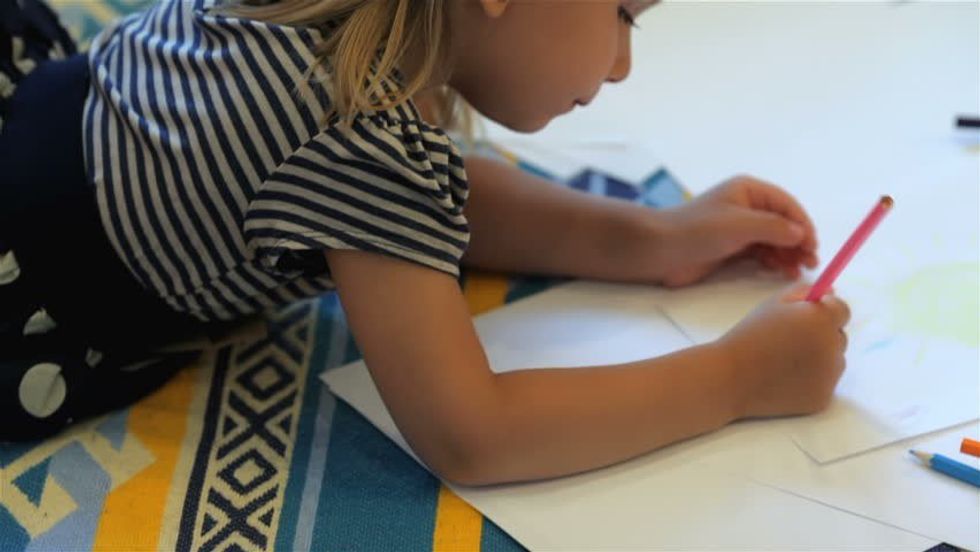
I have been drawing all of my life. I started with disproportionate, overweight stick figures with fat Crayola markers in my room at 5 years old. Today, I can draw proportionate human models with charcoal, conté crayon or pencil in my figure drawing class at 18 years old. Needless to say, my drawings have come a long way since my Crayola days. I still struggle with proportion, hands, feet, and faces but every day I get a little bit better. One of the most destructive phrases that I believe that a person, especially a budding artist, can say is “I can’t draw." Yes, you can draw. If you can hold a pencil and write, you can draw. If someone continues to tell themselves or others this phrase, then it might as well be true. The fact of the matter is that you can draw. Your drawings are not going to be amazing right away and you have to accept that not every drawing is going to be successful. With that being said, here are 5 things that drawing has taught me.
1. Don't be afraid to jump in.
There are only so many thumbnail sketches that one can draw before having to commit to drawing their chosen composition on the big paper. Drawing the first line is stressful and I often feel as if that first line determines the success of the whole drawing. I have learned through many minutes of sitting and staring at the paper than the best thing to do is to press the graphite to the paper and just go for it. There are often times in life where I would like to sit and think about a decision for a very long time but too often doing that leads to missed opportunities so I have learned that as long as the decision is not openly stupid or dangerous, it is best to just jump in.
2. Be open to new perspectives.
In all of my classes, I can sit wherever I choose but I always sit in the exact same spot. The same is true in my figure drawing class. Twice a week I walk in a set up my stool and easel in the same exact spot. During breaks, I walk around the room and observes the drawing of my classmates. They are all completely unique, not because of individual style or skill set but because of perspective. They each see the model from a different perspective. Coming to college, I have met people from many different places and walks of life. This being so, they all have different perspectives on many different things. Sometimes they are stupid things. For example, whether an icy, sugary treat is called a “snowball” or a “snowcone” depends on whether or not you are from the state of Louisiana. It may sound weird to you but it is their perspective and it makes an everyday conversation more interesting.
3. Keep trying even when you have convinced yourself that you will fail.
For one of my final drawings, I was allowed to select a portion of the model to draw rather than draw her whole figure. I chose her chest until right before her midsection. My art professor walked past my easel and encouraged me to include her face which, as I stated earlier, is one of the hardest features for me to draw. I wrinkled my nose at her and she said, “ I know you don’t want to draw it but this is class. It’s okay if you fail, you can cut it out if it turns out really bad but I want you to at least try”. So, reluctantly, I drew the model's face and it turned out to be the most successful part of the drawing. You never have the chance to achieve success if you’re too afraid to even try.
4. Take time for yourself.
Drawing is very therapeutic. I love coming to class, putting in my earbuds and drowning out the rest of the world. When I’m drawing, nothing else matters. Stress-free time such as this is hard to come by and it is very important for everyone to find a stress-free activity to devote some time to each day.
5. Appreciate the little details, but to not overlook the big picture.
My art professor always says “draw general to specific.” Most people want to immediately start work on the most detailed part of the drawing but it is important to get the structure correct first. If the structure is incorrect then the detailed portions of the drawing are irrelevant. The little details in life are important but it is also important to not overlook the bigger picture in which they are a part of.
If you have not taken a drawing class, I strongly encourage you to do so. Do not expect to be amazing when you first start. Accept criticisms from your professor, your peers as well as yourself. Harness the criticism and use them to propel you into a new level of drawing skill. I also encourage you to save every drawing. Yes, even the horrible, awful drawing because one day, you will be able to look back on them and you will be able to see exactly how far you have come.