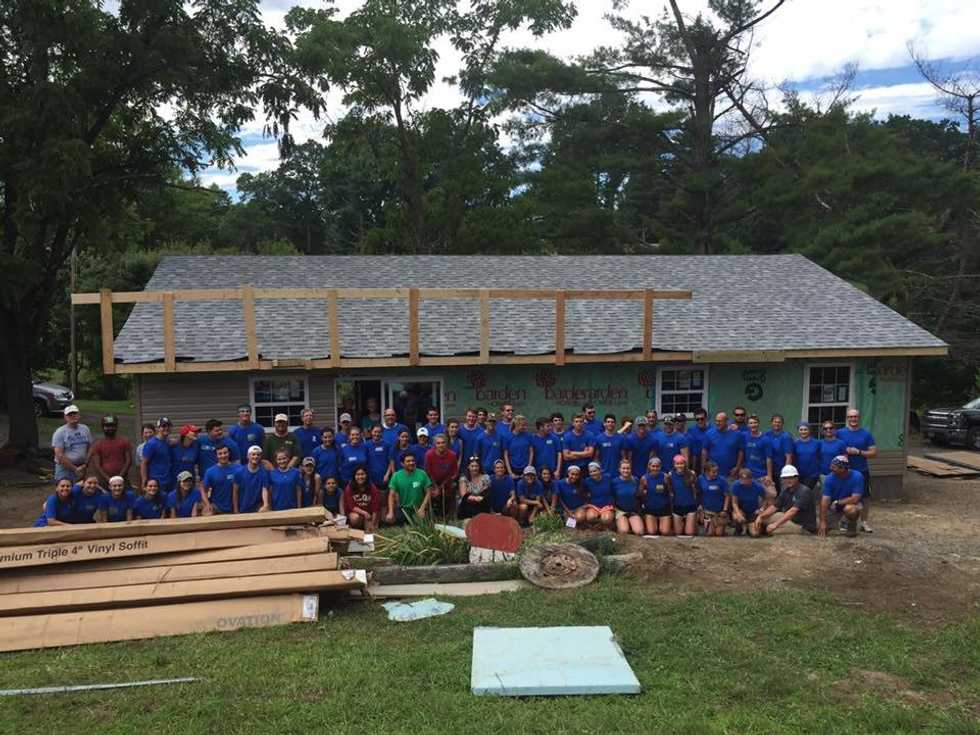
For those who aren’t familiar with the esteemed Appalachia service trip pursued by churches across North Jersey (probably other places, too, but I’m just familiar with its popularity in Jersey), it consists of a group of adolescent parishioners traveling to the impoverished communities of the Appalachian region of the United States to build a home for a family in need. This year, I was lucky enough to go on behalf of my local church, as 56 of us made the trek down to Ronceverte, West Virginia to build a home for a retired veteran, her daughter and their collection of absolutely adorable and wonderful pets without which the trip would certainly have lost some of its vitality.
I spent five days on Muddy Creek Mountain with Habitat for Humanity building the home, and I spent six nights in a local church on a cot that looked and felt like sleeping on a miniature trampoline. Despite the fact that I am not exactly the outdoorsy type, and while I am one of the lightest sleepers you might ever meet, the week I spent in Ronceverte was one of the best spent weeks of my life. I expected the trip to be a humbling, however I did not expect to leave with the sense of both spiritual and ethical enlightenment with which I returned to Morristown. Appalachia taught me several lessons.
Community service is not for me.
As I once read in an exemplar college essay on the Johns Hopkins University website, it is instead for those who I’m servicing. I left for this trip under the notion that I was doing a good thing that good people do, and from that I would receive the ethical justification I sought. However, seeing the woman and her daughter cry tears of gratitude on the first day in front of a blank concrete platform, and then again on the last day in front of a shingled and sided house, I realized that I didn’t care about my own ethical convictions. Just knowing that these people finally have a nice, safe house to call their home -- regardless of my assistance in making it happen -- was what ultimately gave me the ethical conviction I sought. I went to Appalachia wanting to make myself feel good, and I left feeling good because someone else felt good -- someone who needed it more than me.
Lack of cell service may actually be the best thing to happen to you, not the worst.
Not only does it force you to actually talk and interact with the people you’re working with, but it also allows you to appreciate the simple things, as cliche as that sounds. For example, I spent the 30-minute drive to and from the site each morning admiring the tumbling hills of farmland instead of scrolling through my Twitter feed. With the Red Hot Chili Peppers playing in the background (I’ll admit to using my phone for music as I have Spotify Premium and don’t need signal to listen to music) I took in the clusters of grazing cows and wild horses amidst the fog cloaked hills each morning, and I gawked at the aura cast over the hills by dusk during each ride home which, in my opinion, was more beautiful than any Instagram filter.
The bonds you make with the people you work with are just as crucial as the drills and nails in building the house.
Communication holds the house together just as much as the caulk and screws that actually hold the house together! The building process takes teamwork, and teamwork is best executed with people you trust and are comfortable with. While I attend school with a majority of the individuals who accompanied me in Appalachia, I came to find that I didn’t really know quite a few of them. However, as we chatted over our peanut butter and jelly sandwiches while we worked together to fasten the supports for the porch, and as we giggled while pushing the trusses up to the roof, I came to form bonds with these people that are unlike any I share with anyone outside of the trip. And as these bonds evolved throughout the week, so did the aptitude of our handiwork.
You don’t need to be religious to have a spiritual experience.
While I did travel to Appalachia with my church, the experience was not necessarily spiritual in a religious sense. I found spiritual enlightenment in working towards something greater than myself that I could not have impacted alone: local poverty and natural disaster (there was a devastating flood in the town at the bottom of Muddy Creek Mountain a couple weeks before our arrival). However, many people on the trip found their spiritual enlightenment in doing the work of God. In terms of spirituality, the trip is what you make of it, but I am certain of one thing: we did much more than simply build a house.
Community service is fun!
I honestly had a blast every day on site, not only goofing around with my fellow workers and the construction coordinator (Chris, obviously), but actually doing the work. I had fun getting up on the roof to hammer in shingles and slowly assembling the front porch, but it was even more fun to see the product evolve as we crawled closer and closer to finishing it. It reminded me of playing legos as a kid, except this time it was in real life.
I strongly recommend taking the opportunity to experience this trip if it is ever presented to you. I’ll certainly make a point to get more involved in my school’s Habitat for Humanity club this upcoming school year, and just maybe I’ll get lucky enough to get to return to continue to help the people of Ronceverte, next year.