
Abstract: This document is both an analysis and personal interpretation of the hydroponics industry to date. My name is Hank LaValley and I am studying Mechanical Engineering at the University of Toledo. I am writing this article to further augment my perspective on the potential of the project I have been blessed to be a part of. A lot of people, particularly my friends ask me what I do, so I thought I'd publish this.
Imagine earth without world hunger. No really, take a second and think about what it would actually be like if there were no one person starving on the entire planet. Imagine if you had the opportunity to literally change society not only for the better, but forever? Imagine if you had the right resources at your disposal to create something that is potentially both extremely profitable and charitable at the same time. Would you let it go to waste without giving it a try? Essentially what I'm talking about is the impact that fresh, whole, and healthy food can have on a society on an aggregate scale, even if you're not a health nut. By now you're probably thinking, this all sounds great, but it is impossible... Not exactly!
To give some perspective before delving into the "how's" and "why's" of things, I am currently on my second Co-Op rotation through the University of Toledo. I work on a collaborative project for two separate companies. One is called Optimal LED, which is a LED lighting company, the other being Comfort Line Ltd., a fiberglass parts manufacturer. Both are based in Toledo, Ohio. The startup company that derives from this project, however is called 40 Mile Farms. The scope of the project entails the design and build of a small scale working model of a Nutrient Film Technology (NFT) growing rack. This includes design and assembly of mechanical and electrical components to meet predetermined criteria. The intent of this design is a proof of concept working model that can be scaled for large commercial indoor farms.
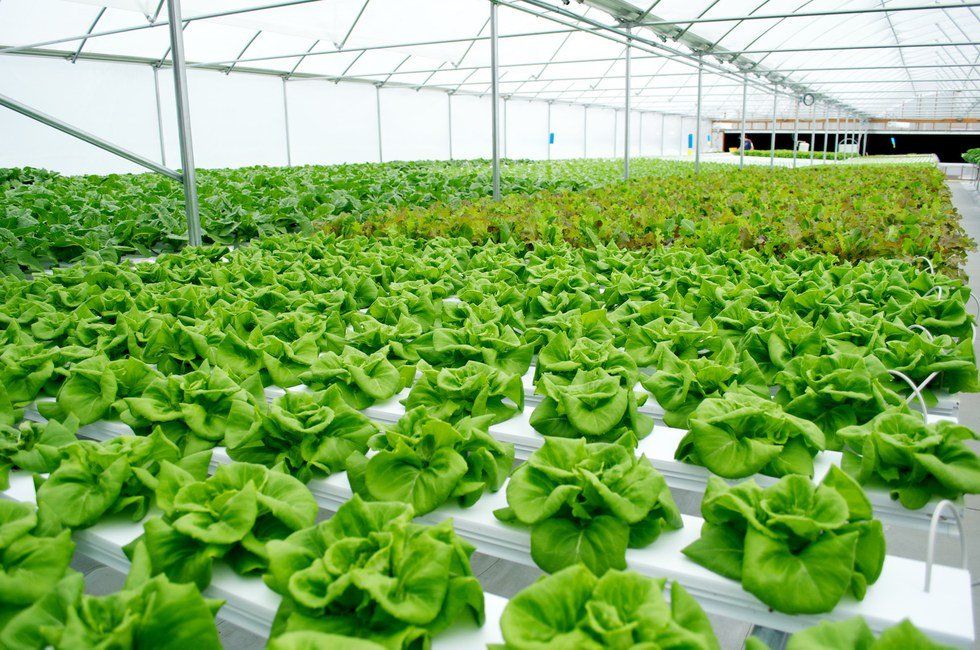
Now, what does that all mean? Hydroponics is described as "the process of growing plants in sand, gravel, or liquid, with added nutrients but without soil." Your initial reaction is "Yea cool hydroponics, they've been using that stuff to grow cannabis for years now... Nothing new here Hank." Although you're not completely wrong, you are also not completely right, (this seems to be the story of my life.) There are literally endless ways to grow crops hydroponically. People are still perfecting the use of hydro for growing what we refer to as "micro greens," meaning small vegetables like tomatoes, lettuce, peppers, cucumbers, cabbage, etc. The use of an NFT (Nutrient Film Technology) system is proposed in this particular project. NFT is a hydroponic growing system wherein a nutrient enriched water supply is dispersed through channels that run past the bare roots of plants. So basically I, along with a team consisting of a few technical advisers, one other engineer, a grow expert, and of course, a few lawyers/business associates, are working on perfecting a small scale model of an NFT growing system. Our target market is for the cheap and efficient cultivation of micro greens.
The main appeal to this entire thing is that you can literally grow anything, anywhere, at any time. Yes, you heard me right, we could grow vegetables in metropolitan upstate New York during the middle of winter if we wanted to. We could literally build a plane with an indoor farm inside of it that travels the world and drops care packages to third world countries and make a dent in the journey to end world hunger. I am not an unreasonable person. I realize the plane, if even possible, is something that is way down the line if it would ever even happen. But the point of me sharing the thought and this entire article really is to showcase the kind of potential this idea really has.
The term "food desert" is used to describe communities with little or no access to healthy food, including fresh fruits, vegetables, meats, and dairy products. In fact, the United States Department of Agriculture reports about 24 million people that currently live in a food desert, 6 million of which are children. What are the main causes for food deserts? Well first is the lack of a sufficient source of fresh produce, like a supermarket. Second is the typical low-income populations that live in these areas that can't always afford what is available to them. Furthermore, could you guess what is usually available to them that they can afford? My dad always says I'll give you three guesses and the first two don't count... Well if you guessed: fast food, fast food, and fast food, congratulations! We could put indoor farming facilities in every major food desert in the United states and immediately see an impact on the health of these communities and therefore the lives of those residing in it.
Now, as far as the project goes, we have designed and built a small scale model of an NFT growing system. It has been tested and approved for every regulatory aspect of being introduced to a legitimate industrial scene. By this I mean it meets all safety standards and regulations, (the boring stuff engineers spend time doing math on so consumers and laborers don't kill themselves.) We are now in the phase of understanding what the product really is to us and what it could be to society. It could be just a product we sell to residential consumers so you can grow crops easily all year round in your kitchen. We may target supermarkets and grocery stores who are now thinking of ways to integrate indoor farming right there inside their stores. We may facilitate the creation of major indoor farming facilities all across the United States and maybe even across the world someday. We could even open up our own chain of healthy restaurants using the crops from our facilities so we can provide fresh meals at an affordable price.
The main reason I ever even thought about publishing this article is that no matter what this idea ends up being, it calls for a mandatory social reform. Sure we can throw a massive indoor farming facility in a major city that pumps out a surplus of fresh produce on a daily basis, but how do we really get people to choose that instead of a Wendy's 4 4 4? This is just me trying my hardest to help at least one person before I die and if I can put my career choice to use, that is an added bonus to me.
Lastly, I want to give a special thanks to everyone who makes what we do possible at 40 Mile Farms.