
With recent attacks by the Islamic state and by various insurgencies, terrorism is an extremely relevant topic, yet its definition remains elusive. There are very limited data sources, and it is very difficult to measure and differentiate between what kinds of events count as terrorist events-- after all, one man’s terrorist is another man’s freedom fighter. The U.S. Department of State defines terrorism as “premeditated, politically motivated violence perpetrated against noncombatant targets by subnational groups or clandestine agents” (Section 2656f(b) of Title 22 of U.S. Code) while the FBI defines terrorism as “the unlawful use of force or violence against persons or property to intimidate or coerce a government, the civilian population, or any segment thereof, in furtherance of political or social objectives” (Section 2331 of U.S. Code). There are numerous official definitions written with varying degrees of specificity at the national, state, and institutional level. Perhaps, then, in order to better understand what terrorism is, it may be helpful to identify what terrorism is not.
1. Myth: Terrorism is mostly caused by ideological conflicts.
This first myth probably exists because for many people today, the world “terrorist” conjures up images of Al Qaeda or ISIS, religious extremist groups and proponents for global jihad (Muslim concept for striving to abide by religious concepts by any means possible, including violence and force). Religion and ideology are often catalysts for conflict and terrorism. However, religion is not the main cause for terrorism. According to the Global Terrorism Index of 2014 national separatist movements have been a more prominent motivation for terrorist groups than religious ideologies. One of the most active ethno-nationalist terrorist groups today is known as Hamas, and it is a group that uses attacks against the state of Israel to create a Palestinian state.
2. Myth: Most terrorist attacks are transnational.
Transnational terrorism is a form of terrorism in which the attacker and the attacked are of different nationalities. We often think of terrorists as being foreign due to attacks like the infamous World Trade Center attack in 2001 that stirred xenophobia. However, most terrorism is actually domestic. According to data from the New America Foundation there have been 26 deadly terrorist attacks since the 9/11 World Trade Center attack, but none of them were foreign attacks. Domestic terrorism is associated with violent acts committed by citizens or residents of a state that have an agenda within their own state. Whether the motives are political, ideological, or social, there is a goal of instilling fear on a group in the state or on the government.
3. Myth: Terrorists rely on sophisticated weapons.
Most terrorist attacks are not carried out by holders of nuclear bombs or radioactive weapons. According to the Global Terrorism Index of 2014, terrorist groups lack the capacity to build nuclear or heavy weapons because materials are not easily obtained. Weapons-usable nuclear materials (plutonium and uranium/ HEU) are scattered across 25 different countries, and the Nuclear Security Summits is taking measures to secure the materials. More and more terrorist groups are turning to simple guns rather than explosives to carry out their attacks, and many of the explosives that are used are known as IEDs, or Improvised Explosive Devices — aka, makeshift or homemade bombs.The damage done to the civilians of Paris in November 2015 was caused by simple rifles and assault weapons.
4. Myth: Terrorist groups are long-lasting.
Terrorist campaigns are usually very short-lived.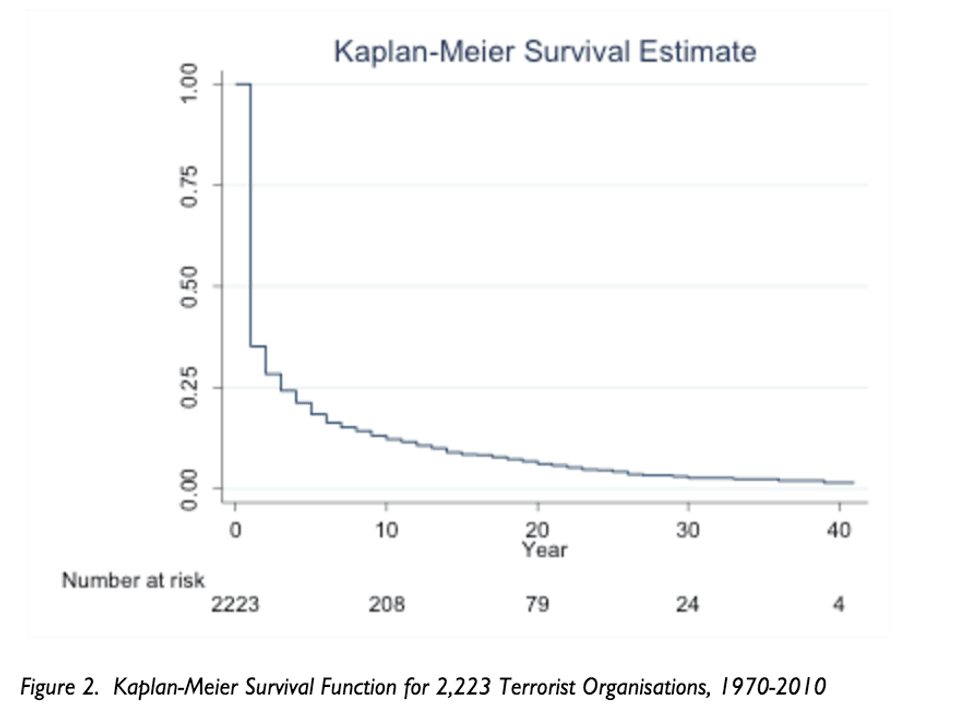
According to the chart above from the Terrorism Research Initiative, only about 30 percent of terrorist groups survive past their first year. After about five years, only 20 percent of the groups survive. The left-wing Red Brigades of Italy was one of the strongest and longest-lasting terrorist groups and it lasted for 11 years before it split into two factions as a result of conflict in 1981. ISIS, the Islamic State of Iraq and Syria, was officially established by leader Abu Bakr al-Baghdadi in 2013, but according to predictions by researcher Olivier Roy in his recent NY Times article, this terrorist group’s days are numbered.