
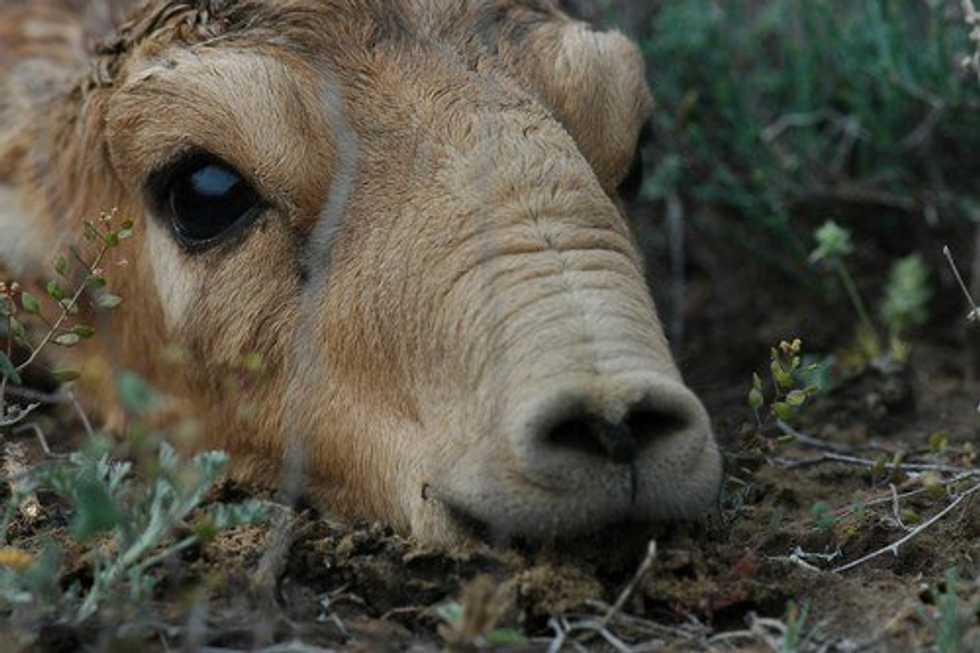
In the Central Asian country of Kazakhstan, there is a strange, critically endangered species of antelope called the Saiga antelope. This species is noted for its strange snout structure, which is used in the winter as a way of warming up air before it is taken to the lungs, and in the summer, it is used to cool the blood of the animal and filter dust kicked up by the herd.

Its horn is prized for its worth in traditional Chinese medicine (150$ a pop), which has caused it to be extinct in China. Today, its only known range (shown below) is in Kazakhstan, with small populations located in Russia and Mongolia.

This spring, the beginning of calving season, over 134,000 of this amazing creature had mysteriously died. This is about half of the surviving population of the antelope, according to E.J Milner-Guland, a conservation biologist at Imperial College London and chair of the Saiga Conservation Alliance.

Mass die-offs have actually happened before with Saiga, reports Henry Nicholls of Nature; 1987, more than 100,000 animals had died in the Ural Mountains. The difference between then and now? Entire herds have died off at once. What could possibly be the culprit? Scientists first thought that maybe these animals have died of severe bloat from eating different, easily-decaying flora because they have recently been moving further north, with different, more lush pastures. But scientists quickly moved on from this idea as they had noticed that females died first, and then after that, their young calves had died at their sides, either from starvation because they cannot eat the surrounding plants as of yet, or, from a more likely, more deadly culprit: Bacteria. But, how could a specific, deadly bacteria be able to contact multiple herds miles apart? Richard Kock, a wildlife veterinarian at the Royal Veterinary College in the U.K. stated:
“Epidemiologically, you cannot get a directly transmitted disease to kill a whole population in seven days,” says Kock. “I’d say it’s a polymicrobial disease,” he says. This involves pathogens such as pasteurella and clostridia that are often present in the body but have seized an opportunity to run riot."Seeing that two separate populations of the species had suffered similar effects at the same rate, an environmental factor must be accounted for.
Hopefully, this strange and magnificent species will recover from this devastating loss, as the species is on the IUCN's red list. External funding for the protection against rural development and poaching is greatly needed for this species, as it's numbers are sadly declining. In order for their population to increase, total elimination of the legality of the trade of Saiga horn and meat needs to happen. Hopefully, we can bring this animal out of the red list, and if nothing is done now to protect them, we will surely lose them.