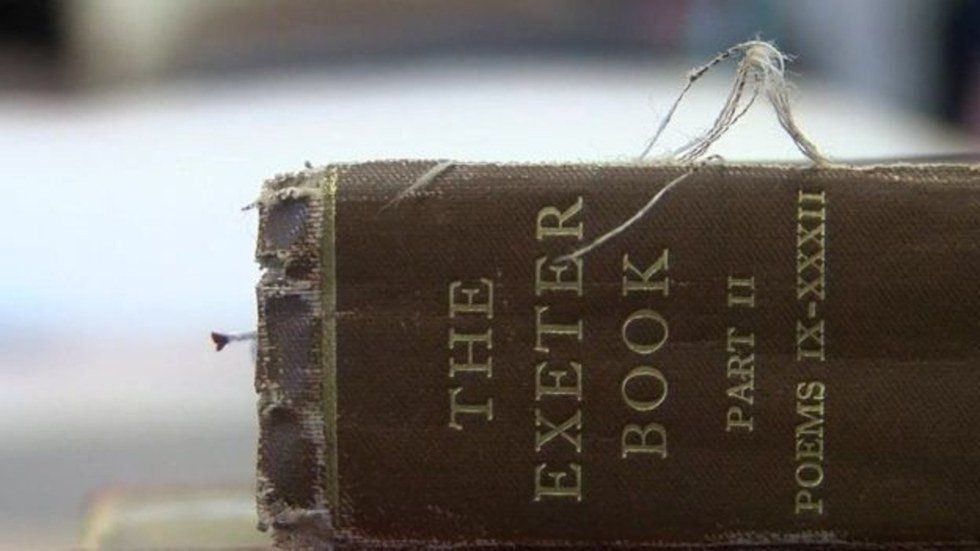
As some of you know, I major in English here at the University of Montana. And for those of you who wonder what it is that I actually study, here is a sample paper from my British Literature: Medieval through Renaissance class, contextually analyzing a poem from the 10th Century.
The Exeter Book is the only known compilation of Old English Anglo-Saxon poetry, riddles, and other writings. Written in the city of Exeter between 950 - 975, The Exeter Book is an important connection to our roots of English literature. These writings were considered great works of their time; and have withstood the test of time to be studied today, some 1000 odd years later.
One such poem is “Wulf and Eadwacer." While it is categorized as a love poem by Michael Alexander’s The First Poems in English, it maintains the air of a lament, the tone of wistfulness and longing. “Wulf and Eadwacer” tells the story of a woman who is torn between Wulf, her presumed lover, and Eadwacer, her presumed husband. The poem is solemn and melancholy, as the narrator of the poem reflects on her separation from Wulf but her commitment to Eadwacer. The narrator has borne a child, though the father of the child is Wulf, not her husband Eadwacer. The narrator warns that should Wulf ever set foot into her tribe’s camp, the men would kill him without a second, though.
The primary way the poem sets its dark tone is through carefully chosen word choice. Granted, the version of the poem we are reading is a translation to Modern English, but it can be assumed that the meaning of the words stays the same from the Old English version to the Modern English translation. For example, the word “kill” appears twice in the first two sentences, very clearly outlining that Wulf’s death would be imminent should he set foot in her camp. The narrator also provides a very clear and perhaps literal image of the separation between herself and Wulf. In line 4 the narrator says “Wulf is on one island, I on another.” The distance between islands is a vast and almost insurmountable isolation, so whether meant figuratively or literally the line portrays the very depth of the narrator's isolation.
The third stanza in its entirety contributes to the overall tone and mood of the poem. “It was rainy weather, and I wept by the hearth,/thinking of my Wulf’s far wanderings;/one of the captains caught me in his arms./It gladdened me then; but it grieved me too.” (lines 9-12). The use of alliteration (weather, wept, Wulf’s, wanderings; captains, caught; gladdened, grieved) gives this stanza a lyric feel, yet the word choice helps maintain the mournful undertones.
Finally, in the last stanza, the narrator delivers a final, scornful blow to Eadwacer: “What was never together is broken easily,/our song together.” (lines 18-19). The narrator is clearly unsatisfied with her unfeeling union to Eadwacer, however, she is still in isolation and separation from her lover Wulf, so she must be content with scorning her husband.
While the rest of the poem is important to the story, and I appreciate the poem in its entirety, the singular line that spoke most to me was “Our fate is forked.” (lines 3 & 8). Firstly, the consonance of the “f” sound is unusual, which pulls one from the more lyrical, narrative space that the rest of the poem inhabits and causes the reader to really focus on that specific line.
This line contributes to the overall theme of loss and isolation but by blaming those feelings on “fate”, the loss and isolation becomes instantly more relatable to any reader. Two people torn apart by a forked fate is a tale as old as time itself, and one that has been written about for centuries. The theme portrayed in this poem is one common to the human condition. We all face moments of isolation, longing, and wistfulness. I find this poem the most relatable, and therefore my favorite, because it speaks very clearly of what it means to be human.