


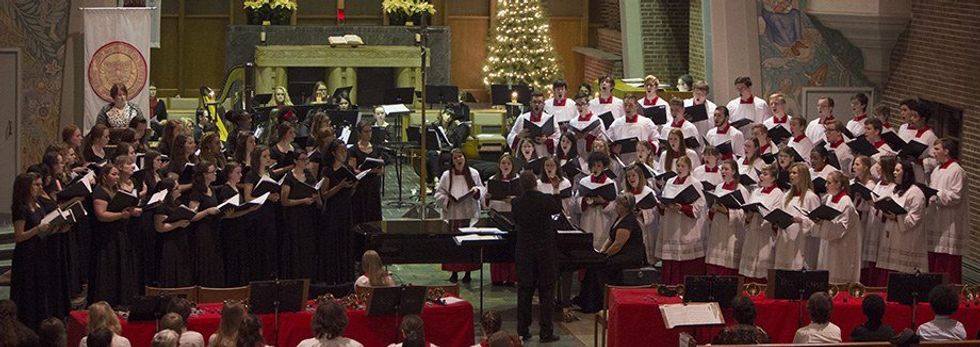
We live in an age where music and art programs are being cut from schools in favor of giving that funding over to sports. Here are 10 reasons why being in a music ensemble makes you just as good of a person (if not a better one) than any sports team.
1. You learn teamwork.
Just as you would on any team, whether it's sports related, creative, or academic, being in a music ensemble teaches you how to work with others. You learn to listen to what’s going on around you and to not overpower your other team members. All of you have the same goal, but you have to work together in order to accomplish it.
2. Nobody sits out.
Every member is equally important to the overall success of the group. Nobody gets pulled out if they’re deemed “not good enough” and, for many groups, no one gets cut. Now, there are some more elite groups out there who do cut people, but these people typically still have the opportunity to perform in a different music ensemble. This also helps to prevent self-esteem issues that can arise from constantly having to sit out games and not getting any playing time.
3. You learn not to be selfish.
In the best ensembles, one person will never get all of the solos. Sure, there may be a woman who sings with a beautiful operatic style, but if a ballad solo appears, it won’t be going to her. Likewise, the first chair flutist might always get the first pick for any flute solos, but the trumpet solo doesn’t belong to her.
4. You learn time management.
In high school, my band director always used the phrase, “To be early is to be on time, to be on time is to be late, and to be late is to be left,” meaning we needed to arrive early in order to set up our instruments, warm up, and be ready to go at the start time. If you arrived at the exact time that practice was to begin, you were already 5-10 minutes behind everybody else and the band wasn’t going to wait on you. Similarly, if you showed up late to travel to a competition, you had better have found another way to get there because the bus left on time. This philosophy teaches students to realize that other members of the ensemble are depending on them and that an error on their part hurts the group as a whole.
5. It relieves stress.
After sitting in classes all day that may or may not have kept your eyelids open, singing or playing an instrument is a healthy release of pent up frustration, energy, and anger.
6. You gain a mentor (or two, or ten).
Your director wants what is best for you, as well as everyone else in the ensemble. Everyone is striving to get a one at a contest or to give an excellent performance at your next concert. The director paves the way, showing you how to be a leader, how to push through the difficult times, and how to never give up on your dreams. They aren’t there for the salary. They’re there because they love what they do.
7. You gain leadership opportunities.
Whether that means being a section leader, a teacher’s aid, or a field commander, you have opportunities to learn new skills and to further develop the ones that you have with your ensemble there to back you up.
8. You’re not afraid to be yourself.
If you’ve ever been to a band camp, choir retreat, or an ensemble competition, you know the car or bus rides there and back are only half the fun. Significant bonding happens on these journeys and people’s true colors really shine. While we may not enjoy everyone’s true colors (because liking everyone is just impossible), we learn to respect them and to appreciate them for being genuine.
9. You become a mentor.
Even if you don’t take one of the leadership positions previously mentioned, underclassmen look up to you by the time that you’re getting ready to graduate. You’ve been there since day one and they can’t imagine the group without you.
10. You appreciate music even more than you did before.
You know Rutter, Whitacre, Mozart, Beethoven, and Bach, in addition to Beyoncé, Lady Gaga, and Kanye West. Some people may think that you’re a nerd, but the rest of us know that you just have a well-defined palate that should not be subjected to underdeveloped “noise.”















