


It's been a rough few weeks for the world--and rough actually doesn't even begin to cover it. Alton Sterling, Philando Castile, the Dallas police officers, the victims of the Iraq bombing--that's just this week. Of course, Orlando. On top of all of it, there's the political contention that's been going on for much longer than the past few weeks among Democrats and Republicans, even among Bernie Sanders and Hillary Clinton supporters. And as a white person who has it really good, I have wanted to say something, do something, anything, that could help during this horrible time, but I just didn't know how. Finally, I decided to turn to the medium that has comforted me my whole life: musical theatre. Strangely enough (or maybe not strangely at all), the "golden age musicals," those that, according to the Broadway Musical Home, "were written and premiered between 1920 and 1959," have a lot of ideas that helped me start to grapple with what is going on and where to go next. I truly believe that theater and the arts can save us, and I think the fact that these legendary composers, lyricists, librettists and above all, artists, figured out how we needed to fix ourselves so long ago is only more proof of our need to turn to art now.
As a privileged white individual, I know I can't offer as much as I would like to. But as a theatre enthusiast and artist, I can offer a list of my favorite quotes from the lyrics of classic musicals that I find still resonate now, more than ever.
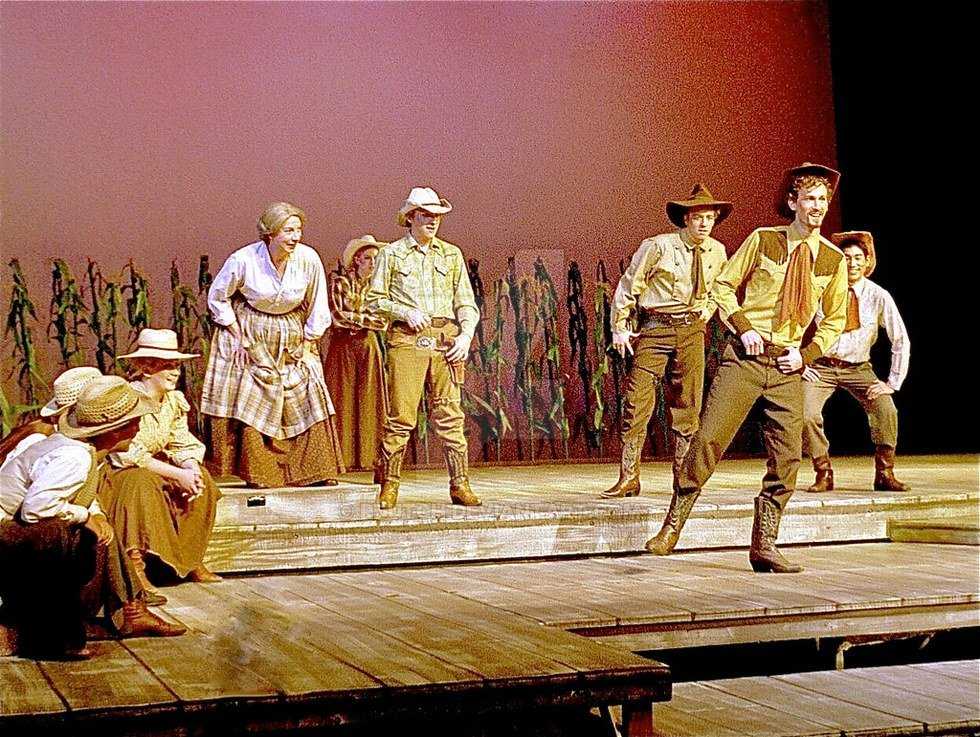
"Oh, the farmer and the cowman should be friends.
One man likes to push a plough, the other likes to chase a cow,
But that's no reason why they cain't be friends."
"The Farmer And The Cowman," Oklahoma! (1943), music by Richard Rodgers, book and lyrics by Oscar Hammerstein II.
"Walk on through the wind,
Walk on through the rain ...
Walk on, walk on with hope in your heart
And you'll never walk alone."
"You'll Never Walk Alone," Carousel (1945), music by Richard Rodgers, book and lyrics by Oscar Hammerstein II.
"Got no mansion, got no yacht,
Still I'm happy with what I got.
I've got the sun in the morning
And the moon at night."
"I Got The Sun In The Morning," Annie Get Your Gun (1946), music and lyrics by Irving Berlin, book by Dorothy and Herbert Fields.
"There's a smile on my face for the whole human race!"
"Almost Like Being In Love," Brigadoon (1947), music by Frederick Loewe, book and lyrics by Alan Jay Lerner.
"When the idle poor become the idle rich
You'll never know just who is who or who is which."
"When The Idle Poor Become The Idle Rich," Finian's Rainbow (1947), music by Burton Lane, lyrics by E.Y. Harburg, book by E.Y. Harburg and Fred Saidy.
"You've got to be taught to be afraid
Of people whose eyes are oddly made,
And people whose skin is a different shade,
You've got to be carefully taught."
"You've Got To Be Carefully Taught," South Pacific (1949), music by Richard Rodgers, lyrics by Oscar Hammerstein II, book by Oscar Hammerstein II and Joshua Logan.
"They think they civilize us
Whenever they advise us
To learn to make the same mistake that they are making too!
They make quite a few!"
"Western People Funny," The King and I (1951), music by Richard Rodgers, book and lyrics by Oscar Hammerstein II.
"There's a place for us,
Somewhere a place for us.
Peace and quiet and open air
Wait for us,
Somewhere."
"Somewhere," West Side Story (1957), music by Leonard Bernstein, lyrics by Stephen Sondheim, book by Arthur Laurents.
"What are we going to do about me and you, the Other Generation?
How will we ever communicate without communication?
You can't account for what they'll say or do.
And what peculiar thoughts they think they never reveal to you.
A very discouraging problem is the Other Generation."
"The Other Generation," Flower Drum Song (1958), music by Richard Rodgers, lyrics by Oscar Hammerstein II, book by Oscar Hammerstein II and Joseph Fields.
"You've got to howl at the top of your voice!
Holler and howl at the top of your voice!
Keep yelling 'foul' at the top of your voice!
Unfair!"
"Unfair," Fiorello! (1959), music by Jerry Bock, lyrics by Sheldon Harnick, book by Jerome Weidman and George Abbott.
Some of these use humor to get their point across, and some are deadly serious. But if people can't understand when their society needs a mentality overhaul simply from others calling for one, sometimes a song can help do the job.















