The Zone System is a method of both in-camera, processing, and darkroom manipulation, that was developed by Fred Archer and Ansel Adams in the early 20th century. The Zone System is used in many different ways, however the main point of all Zone System techniques is to create a perfectly exposed negative, no matter the lighting situation. I plan on demonstrating the usefulness of the Zone System in two distinct situations that, without this System, would be nearly impossible to get a correctly exposed negative: high contrast environments, and low contrast environments.
To begin, it is important to understand a few major expectations for fine art photographers. Next to creating unique compositions, dust-free negatives, and engaging subject matter, possibly the most important part of every photograph is its exposure. When we see a photograph that has a wide range of values, the viewer is able to move throughout the composition easier; wider ranges of value also create more points of interest that will keep the viewer engaged. So, what exactly is the “correct exposure”? How do we know when our shadows are just dark enough, and our highlights just bright enough? This is where the Zone System comes in handy.
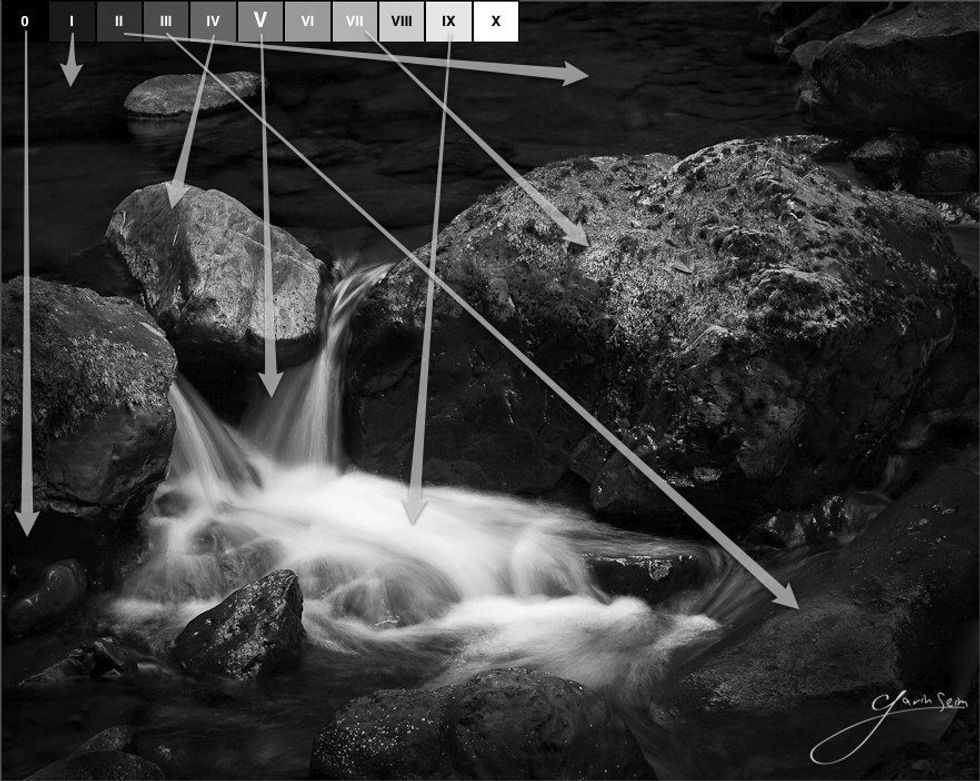
The Zone System is composed of Zones 0-10, from a pure black to a pure white. Zones 0 and 10 represent the absolute extremes that your paper is able to print: there is no texture in either of these Zones (meaning that the 0 represents a true, unchanging black; and that 10 represents a true, unchanging white). Once we get into Zones 1-2 and 8-9, the texture of the object starts to come back, and we can begin to see details again: this is very, very light texture though (we can see a bit of variety of value inside the shadows/highlights: it is no longer tonally pure). Unless there is a thought-out reason for it, the Zones that we aim for our negatives to occupy are from Zone 1 to Zone 9: Zone 0 and 10 should be reached only if the photographer is consciously seeking an overly high-contrast image, or in very small places of the image area (so as not to distract with the weight of a pure black, or pure white.). Too much black or white with no detail is, unless purposeful, unappealing to most viewers; so when we process our negatives, we try to keep them in the range of 1-9, as opposed to 0-10.
Zone 5 represents a middle gray, and is also the value that your in-camera light meter uses to judge the amount of light in a given scene. This is an important point for amateur photographers: essentially, an in-camera, reflected light meter will take an overall reading of a scene and measure the light that is being reflected back at your lens, giving you an exposure based on the assumption that the scene is mostly middle gray. The problem with a reflected-light meter is that the meter assumes that all of the light in the scene will end up equalizing to a Zone 5 middle grey: this is not always the case.
For example, in a high contrast scene, let’s say a pile of white snow next to some black coal, the best way to have a brilliant negative spanning Zones 1-9 would be first to realize that you are going to expose for the shadows first. If you know that between the shadows and the highlights there should be eight Zones of difference (shadow should be Z-1, highlights should be Z-9), then you can estimate what percentage of over-exposure you should give the shadows. Let’s say the speed of your film is ISO 100: the speed of a film indicates what ratio of light is needed to properly expose each grain of silver on the negative. What we know right off the bat is that our highlights are going to be overexposed (Zone 10) and our shadows are going to be underexposed (Zone 1). If we know that our shadows are going to be overexposed, and we pair this with the knowledge that, during development, the shadows are processed quickest, then we can adjust the exposure to get the shadows exposed correctly. To do this, we rate our ISO 100 film at a lower ISO: somewhere between ISO50 and ISO 80 (depending on how high-contrast the scene is. What this does, is it changes the film to think that it is receiving a smaller amount of light than it is, and therefore increases the amount of light that is given to the shadows. We are able to take care of the overexposed shadows, bringing them to a slightly textured Zone 1: but then you may ask, what about the highlights? Well, during film processing, you would reduce the amount of time that the negatives bath in the developer, using thirty seconds for every half-stop of light taken out of the ISO setting: by doing this, your highlights, which process slower, will not turn into middle gray, but will instead be a perfectly exposed Zone 9 highlight. So, by correctly exposing for shadows, and developing at shorter times for highlights, we are able to produce negatives where our snow is white but not blown out, and our shadows are dark but not completely black.
On the other hand, if most of a scene is middle gray — let’s say an overcast day in a field — you would then want to make different choices, but base them on the same principles. On a day where the light is very even, we end up with flat, boring, gray negatives. In order to combat this, we can rate our film higher than normal: if we have ISO 100 film, we would rate it to 200. This would make it so that our shadows become a little bit darker than they would be without an adjustment: instead of Zone 2-3 shadows, they would move to occupy Zone 1, giving us a perfect exposure for the shadows. So, by having a perfect exposure in the shadows, and knowing that the shadows process quickly and remain in the Zone they reach, we know that by processing the film for a little bit longer we will get have more diverse values in our highlights. Basically, all we have to do during processing is leave the negatives in 30 seconds longer for every half-stop of light we changed for our ISO, and our highlights will all be perfect Zone 9 highlights. Again, despite the situation, we are metering for our shadows, and developing for our highlights.
The first step to working with the Zone System is to go out and get yourself either an incident light meter (which measures the amount of ambient light in a scene), or to go out and get yourself a Zone 5 grey card. Either one of these will help you get more accurate readings on the scenes you are shooting. Another tip would be to make sure you have read over the different processing requirements for your specific piece of film, and make sure to take into consideration the type of developer you plan on using.
Obviously the Zone System plays a different role in every black and white photographer’s life, or sometimes no role at all. The most important thing about knowing how to use the Zone System, is knowing when to use it. Not all photographs were made using this technique, and those that do not use this System may still yield powerful emotions; the most important characteristic of any black and white photograph is whether or not the style of exposure, the composition, and the textures all work in a meaningful dialogue with the subject matter. If the style/vision calls for a blown out figure, so that the lighting seems surreal or angelic, so be it; if the blacks should reside entirely in Zone 0 for the effect of awe or grandeur, so be it. These are all stylistic and artistic choices that only the artist can know the “right” answer to: that being said, knowing the Zone System gives you one more tool to add to your box of photographic knowledge, and has personally helped me out of countless tricky photography situations.