
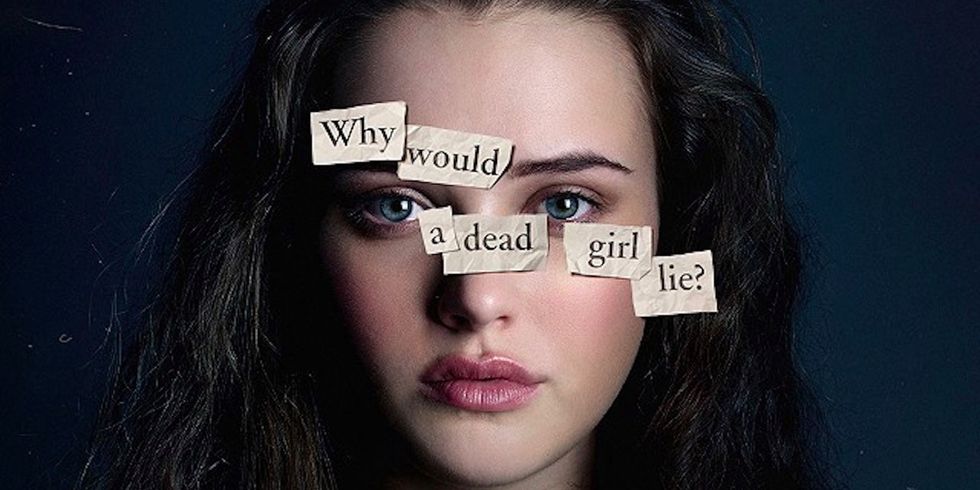
A lot of people are saying that Hannah Baker from Netflix's 13 Reasons Why is totally dramatic. She makes a big deal out of things that would not have nearly the same impact on other people. Certainly, she experienced bullying--but then again, everyone does, right? Everyone has been treated poorly at some point in their lives. So why is she making a big deal out of what happened to her? And why should we care?
These are all valid, understandable questions. So, really: why should we care?
Because Hannah Baker committed suicide.
Hannah Baker committed suicide because she could no longer face the sadness that she felt paraded itself around her life. She felt like she was to blame. She believed that she was a failure, and she was weighed down by what she conceived as a target on her back. So she slit her wrists in a bathtub, and her mother found her there, soaked in her own blood. Her only child. Dead by choice.
When Robin Williams committed suicide in 2014, no one blamed him. Everyone called his depression a "disease," and wrote lovely memoir-like quotes such as "Genie, you're free" on their Facebook walls and Twitter accounts. I did the same thing. Why did we respond in this way? Because we saw a man whom we universally loved attempt to give back to the world and provide a semblance of humor--a light within the darkness. But even the light he provided could not permeate through his own darkness. He succumbed, and we called it a disease.
I think it is a disease. I'll agree with you. I am in no way pointing the finger at Robin Williams. He was the victim of a perpetual sadness that haunted him, and he chose to end his life. It was a tragedy that shook the world, and we miss him to this day. I know I do.
So why don't we give Hannah Baker the same understanding?
I recognize that Hannah Baker is a fictional character, but she represents the plights of millions of people who are dealing with the same trouble in their lives right now. These people need understanding. They need someone to, for once, stop projecting pain onto them. They need someone to listen and understand. But instead, we call them "dramatic."
Will we call them dramatic after we find their bodies?
Hannah's tragedies were often the result of her poor decisions, paired with the poor and selfish decisions of other people. Just like Hannah, those other people were hurting. They were making decisions with only themselves in mind. They were trying to fill a void; to feel adequate, important. They were trying to desensitize themselves and mute their own pain. The problem is, they believed that muting their own pain came in the form of amplifying someone else's. In this case, Hannah Baker.
But Hannah did the same thing. She amplified Clay Jensen's pain by partially faulting him for her suicide. Clay Jensen amplified Tyler Down's pain by sending a naked picture of him around the school to "punish" him. And Tyler Down amplified...well, Alex Standall's pain, by shooting him, or everyone's pain by planning the school shooting--whichever one occurred. The show kind of ends on a cliffhanger.
Pain is a chain reaction. Sometimes, one of the chain links decides to explode. It damages all the links around it, but in the process it removes itself from the chain. That chain is usually thinking one of two things, or both:
1. I'm in too much pain, and the world is a worse place because of me. I'm leaving. No one will miss me.
2. I want to punish those who have hurt me by showing them exactly what they drove me to.
Both of these are decisions that are fueled out of a self-centered mentality. Note that I did not define them as selfish. It's quite condemning to refer to someone who is hurting as selfish. Self-centered behavior is a different thing altogether, because it implies that this person cannot look outside of themselves for various reasons. They could be in too much pain to look outside of themselves or they could be too angry. Whatever the case, they are victims of themselves. They are trapped inside their home, and some sort of emotion is keeping them locked inside.
What you don't see is how hard they're trying to get out, but they can't. So they set the house on fire instead. Do not condemn the arsonist before you study the locksmith.
People are trapped. It is a cruel, cruel world that we live in. Sometimes, people just aren't strong enough to fight their battle. Remember that their lack of strength does not mean that you could encounter the same battle and prevail where they have lost. We are all fighting wars that those around us have not faced. The enemy may look similar, but it is never the same. To put it into perspective, here's a baseball analogy: you might be batting 1.000%, but you're swinging at a ball on a tee. They're batting .200%, and they're facing 90 mph fastballs. Which battle is harder? Sometimes, the statistics don't tell the whole story. And just like statistics, sometimes the view you have of a person's story or struggle doesn't give you a full picture.
Is there a time to tell people to toughen up? Certainly, but gently. And you better make sure that you're listening to what someone is trying to say, and their cry for help, before you give them any sort of tough love. Some people need tough love. And some people just need someone to understand. To fight for them. To hear them.
Sure, Hannah Baker was dramatic. But then she took her own life. Can we call her dramatic now? The pain she was going through was obviously serious enough for her to die over.
I think it's fair to say 13 Reasons Why is "romanticizing" suicide. I think it's fair to say Hannah Baker is over-dramatic. Your opinions are valid and reasonable. Just make sure they're not coming from a place of judgment and lack of love. Make sure you're really concerned about this. If you're not, and you don't really care...then it's not really fair for you to place judgments that could affect other people, simply because you don't identify with their "drama."
Because they might die for that drama one day.
Help people while you can. Don't condemn them.
Soli Deo Gloria.

















