April 24th marks the fourth year anniversary of the Rana Plaza Collapse in Savar, Bangladesh. More than 1100 garments workers were killed in this deadliest disaster in the history of garments industry.
The labor scenario has not changed much in Bangladesh, with the formidable labor laws, low wages, murders of labor organizers and leaders. The situation is perpetuated by marring worker’s rights, and simultaneously empowering the factory owner’s association against slim opportunities for unionization.
The majority of the workers working in the garment industry which is the largest export base for Bangladesh, are women. On that inauspicious day of April, it was mostly women, mothers, daughters, sisters and wives under the rubbles of the collapse. Death is the final result for expulsion, discrimination and disenfranchisement of women and workers. The magnitude of oppression against women were candidly expressed through the treatment of workers, opportunities for compensation and future possibilities for ones who barely avoided death.
Discrimination is manifested through various manifolds by integrating and normalizing violence. Women are either hyper-visible or invisible and are erased from the narratives of workplace struggle and labor organizing in many countries not just Bangladesh. Susan Moir, director of a labor resource center at University of Massachusetts Boston reiterated that women’s movement is a cross-class struggle, and to create mobility and understanding of how women and worker’s rights are intertwined it is important to address the issues at our own proximity.
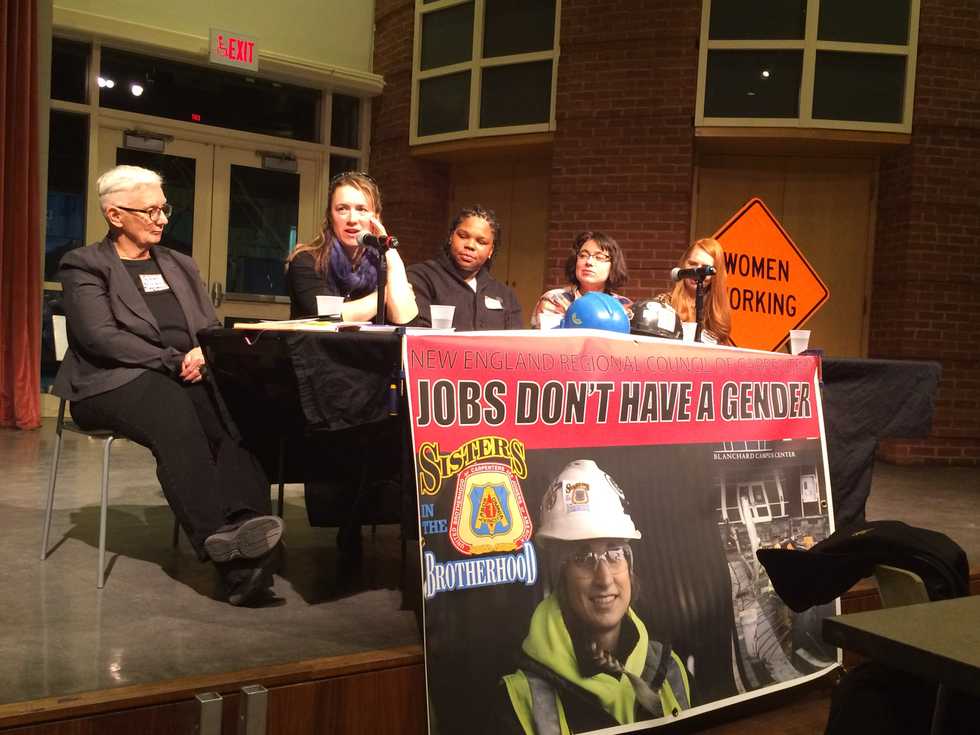
On March 23rd, the New England Regional Council of Carpenter Local 107 & 108 hosted a panel on Women in Construction. These women were part of the construction project at Mount Holyoke College to build 'Super Blanch' which will be the central community space of Mount Holyoke and embody the core social culture of the institution. Lily Thompson, Tyeka Robinson and Theresa Copeland were among the constructors involved in making Blanchard in the panel and they are highly invested in creating a community space for Mount Holyoke students and for other women in construction which is currently male-dominated.The crux of the event was to present a multi-faceted understanding of diversity and how issues such as workers’ rights and women’s rights can be protected and advanced through union organizing and recognition of women and women of color.
The common thread that ties to women workers in the US and Bangladesh is the point of erasure. The US 1976 executive order set a bar of 6.9% nationwide goal for women’s participation in construction, however the participation rate has been below the benchmark until recently, just this year the target was met for Massachusetts. According to the US Department of Labor, women are a minority in the construction industry. 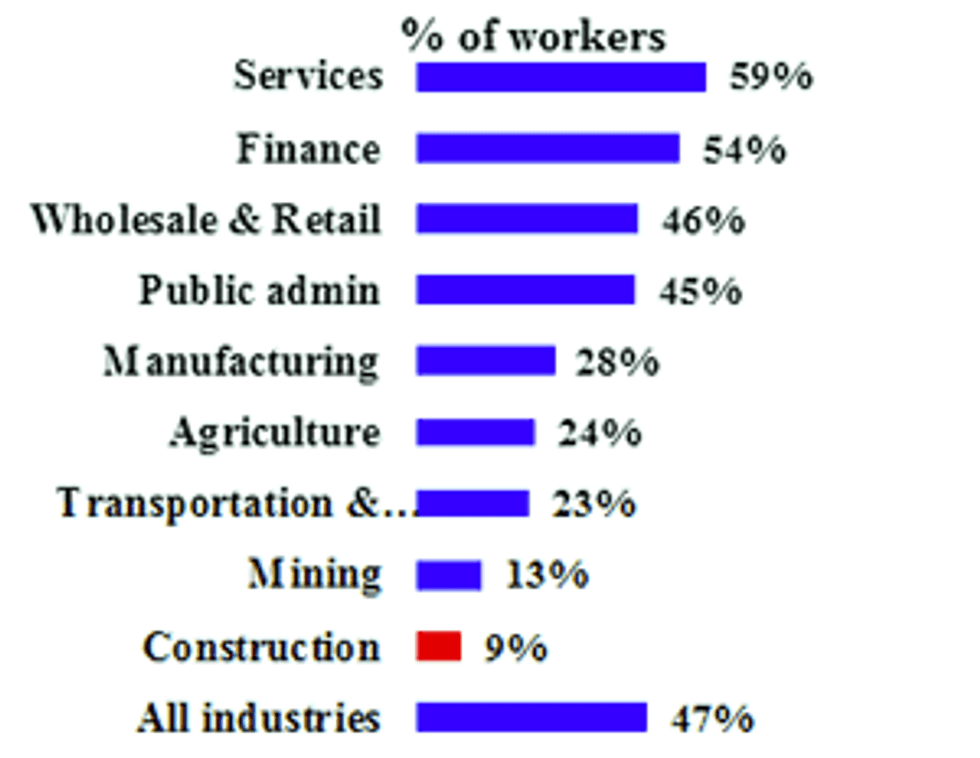
Percentage of Women Workers, by Industry in 2010 (All types of employment)- Occupational Safety and Health Administration, US Department of Labor.
However there have been recent improvements in the women workforce participation rate in Massachusetts due to the organizing works of unions, policy groups on trade and women’s issues and training and apprenticeship programs that allow women to get skill training and facilitate occupational mobility. The Carpenters' Union assists with sensitivity and anti-harassment training and provides representation and ensures health care for the workers. For self-driven workers like Theresa, construction work is more sustainable. She graduated from UMASS Amherst in 2012 with a bachelor’s in sustainable food and farming and worked for several of the bigger organic vegetable farms in western Massachusetts and making $11.25 an hour. She says,“When I turned 25 and was like “wow, I wanna buy a house and probably have kids someday, sure can’t do that on THIS wage."
The bigger picture is that farm workers are not covered by some very important labor laws in the US. Agricultural workers are not entitled to overtime pay or the minimum wage, although the state of Massachusetts has established a minimum wage for farm workers, "it was $8 the last time I checked so, still a crummy wage”. For Theresa, even though construction is a viable profession, she has experienced alienation as she is most of the times the only woman working at the site. She recalls, “the harassment I experience in the construction industry isn’t so much a dude hitting on me, it’s more like hostile work environment. I hear derogatory comments about women all the time. And there’s no easier way to way to insult a man than by saying he’s like a woman.”
Theresa would like to see issues of sexual harassment and maternity and parental leave codified into union contracts. Issues of sexual harassment and pregnancy at work are contentious all around the world and without union organizing and workers’ movements these issues are seldom addressed, let alone be part of employee contracts. The lead organizer for the Carpenters Labor Management Program Lisa Clauson who visited Mount Holyoke to support these women in the construction of Super Blanch said that, “I’d love to have MHC continue to demonstrate this leadership and commitment to helping diversify construction through requiring their future construction projects to also create work opportunities for women and people of color in their construction projects. MHC could also promote what they are doing on diversity in construction which would help encourage other similar institutions to follow their example.” She also mentioned the prospects of livelihood and living wages for women in the construction industry to support their families and themselves. Clauson believes that the carpenters’ program is a broader movement to address income inequality and ensure accessibility.
Transformational advocacy and solidarity is only possible through recognizing multi-dimensional subornation and institutionalization of victimhood and discrimination. Tyeka’s struggle in between jobs and life in the foster care system, and Lily’s relentless struggle and determination at work amidst her pregnancy and family-work balance tell us about the intersectional inequality that presides in the white male dominated industry where work situation is only suited for a singular group. The goal is to ensure inclusivity for women and women of color in particular who have great possibilities in construction trades. Increasing women's workforce would also address the imbalance of social and economic power in and out of the industry.
Though in Bangladesh, workers and women are struggling to have a dialogue, and are bereft of basic rights, social justice projects like the ones initiated by the Carpenters Labor Management Program at Mount Holyoke could support in facilitating dialogue and educating on organizing strategies and women’s mobility beyond borders.