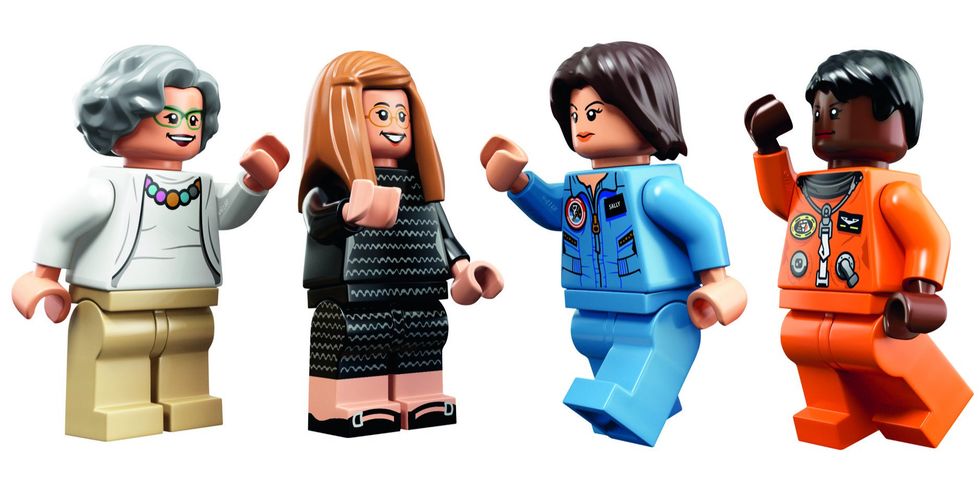
On November 1st, the toy powerhouse Lego released a highly anticipated Women of NASA set that features four influential women who have played a key role in the space organization. The ground-breaking women featured include:
Sally Ride - The first American woman in space (1983). She received a BS in Physics and a BA in English from Stanford University, followed by a Master of Science and Doctorate in Physics in 1975 and 1978, respectively.
Mae Jemison - The first African American woman in space (1992). After enrolling at Stanford at age 16, she graduated with degrees in Chemical Engineering and Afro-American Studies. She later received a Doctor of Medicine degree from Cornell.
Nancy Grace Roman - An American astronomer. She served as the Chief of Astronomy in the Office of Space Science and was the first woman to hold an executive position at NASA. She is widely known for her contributions to the Hubble Space Telescope.
Margaret Hamilton - An American computer scientist. She was the director of the Software Engineering Division at the MIT Instrumentation Laboratory, which developed software for the Apollo space program. She was recently given the Presidential Medal of Freedom by President Barack Obama for her contributions.
Lego's decision to create this set came last March, and since then has been creating a lot of buzz. It is a 231-piece set selling for $24.99 on Lego's website, and is marketed as allowing children to "Explore the professions of some of the groundbreaking women in science, technology, engineering and mathematics (STEM)".
The creation will no doubt bring joy to many future scientists and engineers, but the implications of this set go far beyond the playroom.
Taking a traditionally masculine toy and introducing empowered women as the center, not just as supplemental figures, is a huge step in the right direction for the toy industry. Beyond breaking down the expectation that girls can only play with things that are pink and sparkly, it teaches and encourages young girls to follow their dreams and pursue their interests, whatever they may be.
Seeing empowered women in a field like science or math makes it easier for young girls to see themselves in that role. More than that, the set also encourages young boys to accept women in STEM professions from a young age.
Representation matters, and when the next generation grows up in a world where women in previously men-dominated fields are accepted and respected instead of marginalized, progress will follow. Normalizing women in STEM fields is an uphill battle, and even seemingly small feats and notions like this one make a world of difference.
The importance of this message cannot be overstated; many of our future computer engineers, scientists, and mathematicians are female. Maybe soon we'll see figures like Jane Goodall, Marie Curie, and Rosalind Franklin starring in their own kits.
I think I've found the "it" toy for Christmas this year. Good for you, Lego.







 man running in forestPhoto by