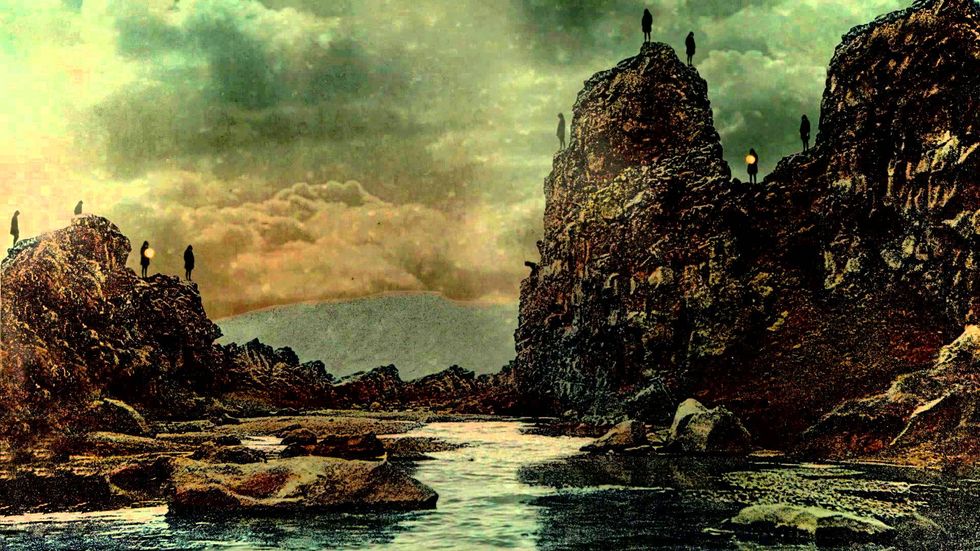
The simplest definition of creativity is the act of using one’s imagination in order to produce a desired result or project. Humanistic psychologists including but not limited to Carl Rogers and Abraham Maslow go beyond this definition and explore the particular challenges a creative person faces such as pressures to conform and anxiety about the quality of the finished product. More importantly, they explore the ways in which the creative individual can overcome these challenges and achieve self-actualization, or one’s fullest potential. Similarly, in the autobiographical poemThe Prelude, William Wordsworth recounts the events that led up to his self-actualization as a poet. Throughout The Prelude, Wordsworth uses his poetic imagination to explore his sense of self through nature. Nature is the setting where Wordsworth wanders while poetically daydreaming. In short, The Prelude highlights the humanistic ideas of what allows the creative person to achieve self-actualization.
What Motivates Creativity?
The Need to Self-Actualize
The easiest assumption regarding why people create is that they simply enjoy the act of it. Carl Rogers (1961) agrees, but he also asserts that there is so much more to the process of creativity than just valuing it. He adds that creativity meets the human need to mature, expand, and actualize one’s potential. More importantly, he believes that creativity is one of the characteristics of the fully-functioning individual. Comparatively, in Book One of The Prelude, Wordsworth (1850) narrates,
Nature, oftentimes, when she would frame
A favored Being, from his earliest dawn
Of infancy doth open out the clouds (p. 384).
The image of the opening of the clouds is metaphorical of the opening of Wordsworth’s imaginative mind to original ideas for nature poems. Wordsworth uses a similar metaphor in his line, “[Nature] Peopled my mind with beauteous forms or grand” (p. 389). The words “beauteous forms” emphasize the inspiration for poetic imagery Wordsworth is receiving from being in nature. Furthermore, the personification of nature reinforces how the expansion of his imagination, in turn, facilitates his growth and maturation as an individual. That being said, Wordsworth cannot become self-actualized as a poet without having imagination as a personality trait. Hence, Wordsworth does not just take pleasure in nature, he is deeply passionate and expresses strong gratitude, a characteristic Maslow (1963) believed was essential for creative self-actualization. After all, Wordsworth would not daydream in nature and write about the beauty of it if he were not so grateful to be in its presence.
Therapeutic Writing and Stress Relief
One of the most common assumptions about why people write is that it is therapeutic. Maslow’s (1971) theory of creativity and meta motivation, however, points out how there are two types of creativity, D (deficiency) and B (being) creativity. D-creativity is when one creates in order to meet unmet needs or to gain value from others. When Wordsworth is at school in Cambridge, he compares himself to the classic poets he reads because he wants to be valued in the way they are. He writes that he “laughed with Chaucer” and “Sweet Spenser” (p. 411). However, this only makes him feel “envy, jealousy, pride, shame/Ambition, emulation, fear, or hope” (p. 418). Wordsworth later calls his striving to be like other poets a “dangerous craft of picking phrases out” (p. 453). Therefore, Wordsworth is experiencing D-creativity rather than B-creativity because focusing on the poet he is not makes him forget about the poet he truly is.
Worrying so much about whether or not the quality of his poetry is in line with the greats such as Milton, Chaucer, and Spenser takes him away from enjoying his imagination in the natural setting. Under these circumstances, he is literally and metaphorically not writing what comes naturally to him. Moreover, nature in The Prelude is reflective of Wordsworth’s “natural” creative talent. Therefore, Wordsworth cannot be self-actualized as a creative poet if he copies one who already existed. If Wordsworth were to copy one of the classical poets, then he would not be writing in such an authentic, unique voice.
Certainly, Wordsworth does not feel free to be his imaginative self when he is at school in Cambridge. Positive psychologist Mihaly Csikszentmihalyi argues that academic settings often limit their students in terms of creative activity and expression (Csikszentmihalyi, 1993). Similarly, it is at school when Wordsworth’s “imagination slept” (p. 411). This metaphor illustrates the hindering of his creative expression. In addition, Wordsworth says he had “A feeling that I was not for that hour/Nor for that place” (p. 406). When looking in the Rogerian perspective, Wordsworth’s repetition of “not for that” emphasizes how his self-image is incongruent with his ideal image of himself as a nature poet (Rogers, 1959). Clearly, he does not have positive self-worth when he feels jealousy, shame, and fear while reading the classic poets at school. Furthermore, it makes sense when he mentions,
Oft did I leave
My Comrades, and the Crowd, Buildings, and Groves,
And walked along the fields (p. 407).
The words “Crowd” and “Buildings” contrast with the imagery of the open fields. The crowds and buildings, at least for Wordsworth, are places of enclosure rather than imaginative expansion. That being said, Wordsworth cannot become self-actualized if he conforms to the expectations of academic life. Thus, trying to model after the classical poets is not therapeutic for Wordsworth.
Peak Experiences and Therapeutic Creativity
By contrast, when Wordsworth travels the Alps on one of his summer vacations, he does not worry about his studies nor the quality of his poem. He is mindful in the moment. Maslow viewed the here-and-now attitude as an important component of both peak experiences and creative self-actualization. Comparatively, transpersonal psychologist Diana Raab (2014) conducted a study modelled after Maslow’s theory of creativity and metamotivation in which memoirists were interviewed about their creative writing process. She found that autobiographical writing helped the memoirists transcend from D to B-creativity in that it helped them improve their mindfulness and self-awareness. Simply stated, Wordsworth has more of an opportunity to use his poetic imagination when his mind is not overwhelmed with other conflicting thoughts.
To exemplify, when Wordsworth crosses the Alps, he narrates,
Imagination! Lifting itself up...
Like an unfathered vapor; here that Power...
[Came] Athwart me: I was lost as in a cloud,
Halted, without a struggle to break through.
And now recovering (p. 463).
Wordsworth is transcending from D-creativity to B-creativity. His lyrics “without a struggle” and “recovering” indicate how daydreaming on the Alps provides positive relief from the pressures of his studies. In addition, the phrase “I was lost as in a cloud” emphasizes his engagement with his natural imagination in that moment. Since Wordsworth uses clouds as a metaphor for his expanding mind, the reader can infer the same here. This relief is what makes his imaginatory activity therapeutic. Ultimately, he is describing a transcendent, out-of-body experience as illustrated by the simile “Like an unfathered vapor.” The imagery of Wordsworth rising up the mountain is reflective of him reaching high for his goal of writing his epic poem (Foakes 1958). Moreover, the phrase “Imagination! Lifting itself up” highlights his strengthened confidence as a poet. That being said, travelling the Alps is literally and metaphorically a peak experience for him. However, Wordsworth is not yet self-actualized. In fact, this excerpt is immediately followed by Wordsworth trying to conform to the sociopolitical norms of London and France. Nonetheless, his climbing of Mount Blanc is indicative of his climbing towards self-actualization.
Wordsworth’s climbing of Mount Snowdon when he returns home from France at the end of the narrative is a higher form of B-realm creativity (Mudge, 1985). The view he gets of his surroundings at Mount Snowdon is more expansive than when he travels the Alps. Wordsworth writes, “The Moon stood naked in the Heavens.../A hundred hills” (p. 579). This is the most expansive view he gets throughout the narrative, thereby demonstrating the highest expansion of his imaginative mind. Again, he is living in the present moment and not worried about the French Revolution nor if he is as great as other poets. Wordsworth continues, “Far, far beyond, the vapours shot themselves/In headlands, tongues, and promontory shapes” (p. 579). The repetition of “beyond” indicates that Wordsworth is looking beyond the peak. Metaphorically speaking, he is moving beyond a peak experience. Maslow would interpret this moment as a plateau experience, or the peak experience one goes through right before transcending into self-actualization (Gruel, 2015; Krippner, 1972). Wordsworth being on the highest point of the mountain symbolizes his highest confidence as a poet.
Not only is Wordsworth’s climbing of Mount Snowdon more transcendent than his trip to the Alps but also more therapeutic because this is the strongest gratitude he experiences in the narrative. In summary, the imagery of Mount Snowdon not only symbolizes Wordsworth’s self-actualization as a poet but also his creative imagination reaching its highest therapeutic capacity. More importantly, Wordsworth’s ability to conquer worry and gain confidence in himself is what allows him self-actualize.
The Dichotomy of Conformity and Creativity
The Metaphorical Meaning of Crowds
Wordsworth’s metaphors for the barriers to self-actualization are just as notable as his metaphors for self-actualization. For example, the settings in London and France play a critical role. Similar to when he is school in Cambridge, London and Paris are crowded cities where Wordsworth does not have as much freedom to wander in nature and use his poetic imagination. When Wordsworth returns home in Book One, he describes urban life in London and France as “A prison” (p. 375). Likewise, he provides a claustrophobic image of the streets of London in Book Seven. Wordsworth narrates, “Above the press and danger of the Crowd.../Inviting; with buffoons against buffoons” (p. 484-485). These lyrics create the image of people following or conforming to the crowd. Several humanistic psychologists view conformity as the opposite of creativity. When an individual conforms to the expectations of others rather than follow his or her own intrinsic creative motivations, he or she loses a sense of his or her inner identity (Moustakas, 1967; Rogers, 1961). Thus, Wordsworth being distant from nature while in city life is reflective of him being distant from his true, creative self. Essentially, just as conforming to other poetic styles takes away from Wordsworth enjoyment of creativity, conforming to urban life produces the same effect.
Wordsworth’s True and Social Self
Another important reason why Wordsworth feels self-actualized at the end of The Prelude is that he decides to be his natural, creative self rather than conform to the societal roles of London and France. In Book One when Wordsworth comes back from France, he states that he has “shaken off/That burthen of my own unnatural self”(p. 376). By comparison, Carl Rogers believes that individuals have their true selves and their social selves, or the false self one constructs in order to receive positive regard from others. Likewise, Wordsworth constructs a false identity for himself when he resides in London and France. Rather than writing nature poetry, he tries to become the ideal “political hero.” He provides a description of this ideal man in Book Five, “He knows the policies of the foreign Lands.../Can string you names of districts, cities, towns” (p. 442). He interprets this as a “life of lies” and “conceit” (p. 443). In comparison to Rogers, Wordsworth states that when one tries to conform to this lifestyle, he “forgets himself,” or his true identity (p. 433). Ironically, these lyrics foreshadow his conforming to this lifestyle during the French Revolution. Wordsworth writes, “[I] became a Patriot, and my heart was all/Given to the people, and my love was theirs” (p. 512). These lyrics indicate that Wordsworth’s attempt to become a political hero is for purposes of conditional positive regard. Hence, this lifestyle is incongruent with his intrinsic motivation to be a poet. That being said, not only does conformity take away from Wordsworth’s enjoyment of creativity but also his integrity and self-worth.
Wordsworth uses the motif of the soul to depict his intrinsic creative motivation. When Wordsworth is in London, he says that his imagination was “No longer a mute Influence of the soul/An element of nature’s inner self” (p. 499). Again, Wordsworth associates nature with his natural self. This sad tone contrasts with the grateful tone Wordsworth uses to describe the restoration of his creativity when he goes on his way home in Book Eight. He narrates, “Oh! Soul of Nature, excellent and fair/That didst rejoice in me” (p. 565). Similar to Wordsworth’s creative motivation, the soul is internal. This use of personification illustrates the unconditional positive regard Wordsworth receives from nature. Nature does not judge Wordsworth, and she accepts him for who he is. The title of Book Eight of The Prelude is “Imagination: How Impaired and Restored.” This parallels the name of the last stage of Rogers’ theory of personality development, “The Process of Reintegration” (Rogers, 1959). Rogers states that the individual reintegrates as a result of unconditional positive regard along with positive self-regard. In the conclusion of The Prelude, Wordsworth expresses his revived love for nature as well as his own soul. This is demonstrated by the proud tone in his lyrics, “Nature lodged/The Soul, the Imagination of the whole” (p. 580). The word “whole” illustrates how Wordsworth feels more holistically in touch with himself (Anderson, 2001). In short, it is not only nature’s acceptance which allows Wordsworth’s poetic creativity to reintegrate but also his own positive self-regard he develops throughout the poem. After all, nature in the poem is reflective of his natural, creative soul. Simply stated, Wordsworth cannot have any confidence in himself as a poet if he does not have respect for himself first.
Learning from the Obstacles
This is not to say that Wordsworth does not at all benefit from travelling to London and France. If Wordsworth did not go through his poetic crisis, he would not have learned that a life of political conformity was not fit for him. By comparison, Mihaly Csikszentmihalyi (1993) claims that finding out what one does not like about life is an important step for enhancing personal creativity in that it helps clarify motivations. In other words, an individual cannot have a clear understanding of what he or she values in life without knowing what he or she does not value. Ultimately, Wordsworth’s experiences in London and France help him creatively in the long run because they end up serving as major conflict plot points in his narrative. This is Wordsworth’s clever use of metapoetic elements. The reader is reminded while reading the poem that this is one in progress. The metapoetry also ties back to Diana Raab’s (2014) conclusion that creative writing facilitates self-awareness because as Wordsworth writes his poem, he has a deeper insight into his past. Beyond everything, one of Wordsworth’s motivations in writing The Prelude is to discover himself.
Despite the fact he does not continue living in London and France, Wordsworth does not regret doing so. In fact, Wordsworth mentions that it helped him become more sympathetic to human beings and gain a deeper understanding of the human mind. If Wordsworth has the goal to find out the meaning of life, it would make sense for him to learn by observing other individuals. Thus, it would make sense for Wordsworth to take the risk of being open to the experience of city life. Nevertheless, nature is still a more inspiring setting for Wordsworth’s poetry. All in all, his imagination cannot be restored without being impaired first.
Wordsworth’s Courage to Create
Furthermore, it is not Wordsworth’s creativity alone that helps him self-actualize as a poet but also his perseverance and willingness to take risks. Carl Rogers and Rollo May see these traits as important components of the enhancement of creativity (May, 1975; Rogers, 1961). Wordsworth demonstrates his social courage to create when he leaves the political scene of France to return to poetry. He takes the risk of being judged by his fellow officers for no longer conforming to the role of the ideal political hero. Wordsworth does not explicitly state their reactions. The absence of this detail illustrates a character shift in Wordsworth in that it does not matter what his officers will think of him. Instead, what matters is his creative poetic expression.
Wordsworth’s willingness to take risks traces back to Book One when he rides the boat on the river. Wordsworth narrates,
With trembling hands I turned,
And through the silent water stole my way
Back to the Cavern of the Willow Tree (p. 385).
These lyrics depict how riding the boat is intimidating at first but rewarding in the end. The words “trembling hands” indicate his fear. The image of the tree signifies Wordsworth’s future growth as a poet. Moreover, moving along the river is reflective of Wordsworth moving towards his creative goal. This is the inciting peak experience which influences his motivation to become a nature poet. Therefore, without taking this risk, Wordsworth would not be the poet he is. Above all, writing the epic poem is a risk alone. Wordsworth states at the beginning, “For such a glorious work, I through myself/Make rigorous inquisition” (p. 379). This statement is echoed at the end when Wordsworth concludes as a self-actualized poet, “the history of a Poet’s mind/Is labor not unworthy of regard” (p. 588). These lyrics illustrate how writing the poem is worth the risk. Overall, Wordsworth’s courage to create is not only highlighted by his self-determination but also his patience.
Conclusion: What The Prelude States About Creativity
When reading in the humanistic lens, it is clear that The Prelude as a whole is a metaphor for the creative process. In the beginning of the narrative, the reader sees Wordsworth’s motivation to write a great poem. His next step is to figure out how to accomplish the poetic task. When Wordsworth goes to school at Cambridge, his struggle between creative individuality and positive regard begins. When Wordsworth conforms, he is dependent on others for self-worth. He relies on the work of the classic poets to gain confidence in his creativity. Likewise, he depends on the political crowd of France for is self-worth as a man in general. When he returns home to his natural setting, on the other hand, he demonstrates independence. No other classic poet, schoolteacher, nor political officer can save Wordsworth from his poetic crisis. Only Wordsworth can write his poem. Essentially, Wordsworth experimenting with different identities as a poet, student and patriot is metaphorical of him experimenting between different ideas for his poem. Ultimately, Wordsworth depicts creativity as a process of trial and error. In closing, William Wordsworth and the humanistic psychologists illustrate how the creative individual achieves self-actualization when he or se creates based on intrinsic rather than extrinsic motivations. Nevertheless, intrinsic motivation alone is not enough. Risk-taking and positive self-regard are the two most important steps in achieving creative self-actualization.