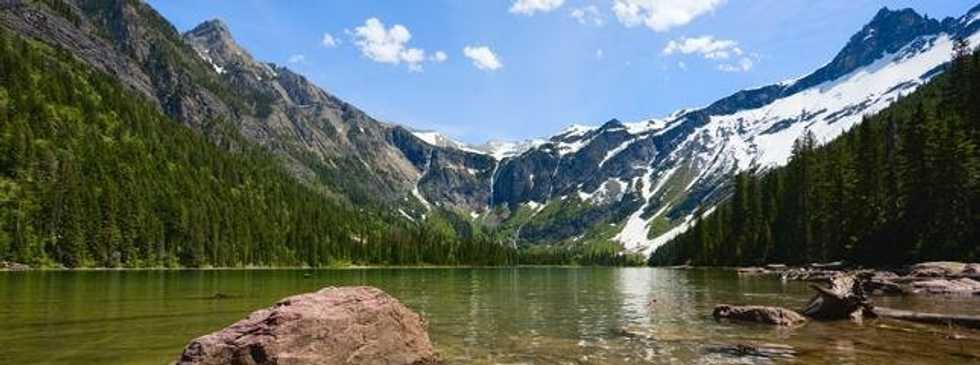
I would like to speak a word about wilderness, both what it is and how we think of it. The word itself, “wild,” comes down to us from the old Anglo-Saxon cognate "willed," referring to areas that were self-willed, or had a will of their own; that is, a non-human will. Aristotle defines a thing’s nature as that which contains its own principle of motion and rest, an innate impulse of movement. A natural thing is a thing that moves itself. A flame, for example, moves upward on its own. It seems that most notions humans have of wilderness have something to do with things having a will of their own. We call one area a capital “W” Wilderness if it is vast enough to be considered beyond the dominion of human subordination. While we have the potential to subjugate practically any wilderness area, we reserve as much as the caring few can preserve for us, for not everyone is of the opinion, thankfully, that the entirety of the Earth should be under human control. Wilderness areas are not necessarily wilderness, however. The weeds growing in the cracks of a sidewalk move and grow on their own, beyond the need of human intervention, and they certainly are not there by intentional human decision, but quite the contrary, for so many urbanites come to hate and destroy them. What exactly should we call wilderness then?
Wilderness, as a term, is different from nature, or as an adjective, what is natural. We say something is natural so far as it acts or behaves in accordance with some self-willed principle. A sidewalk is not natural, so far as humans put it there, but a muddied path might be natural so far as the will of the earth moved dirt and water to make it so. A tree, by this understanding, is natural as it grows by itself, and a plastic Christmas tree is unnatural as it requires a different source, a human being, to move everything into place, the plastic, the mold, and the blueprint. The growth of a natural tree, however, can’t simply be described as growing on its own. It needs water, nutrients, certain soil and climate conditions. It may have within itself both the potential for and activity of growing, for it indeed grows, but it cannot grow without the aforementioned conditions.
To continue along this line of inquiry, searching for causal and material connections, we may very well go on forever finding only that everything is in some way, directly or indirectly, connected. While humans have a limited scope of understanding, we constrain ourselves to the closest connections. The tree does not need to constrain itself at all, for its will, at least to our understanding, is far too simple to reach beyond what it needs for its more basic function. Here is the point at which humans become rather meddlesome.
We have apparently the most complex of all functions of nature, though to be sure we are in fact parts of the same nature that the tree is. If our functions fall under the same unity of connections we earlier called nature, then just what is it that allows us to consider our own creations as something apart from wilderness altogether? The tree wills itself and so do we. The tree creates things – fruit. In turn, we create fruits of labor as well. We are, however, far more complex in our functioning, and further the fruit of the tree is consumed by us and not the other way around. The tree is for all intents and purposes, subordinate to us, so far as the tree’s products are consumed in our activity. We may very well potentially consume all other parts of nature, being what is most complex in nature, however; does that make us by necessity greater? Perhaps it does, but regardless we need to adhere to some responsibility to what is subordinate to us. A king is only as powerful as his kingdom, and for the king to flourish, so must his holdings. In like manner, humans can only flourish if their environment can sustain them in the very act of flourishing. If the environment, the whole of natural things around us that we rely on, is not functioning properly, then we cannot continue to flourish without it. In light of this logic, how shall we consider the wild world and ourselves? Are we not a part of the same whole as natural things?
Perhaps we have different natures, different means of movement, and our functioning is so complex as to grant us our own category. Whatever falls under our domain, or at least our subordination, must also fall under the domain of the Earth itself. We, humans and all things on Earth, are all contained within the same physical sphere. We become bound, however, to our love of understanding, and to the applications of the understanding. We make art out of materials from the Earth, physically turning once natural things into human-moved things. If we examine our function from afar, it may look as if we are instruments of order, arranging what is natural into what is preternatural. Perhaps this is some clockwork function of ours, to be a force of preternatural creation on this sphere; the way the wind or fire has its function to shape things through their own nature.
One might say that it could be otherwise – some humans, like those in remote areas untouched by modernity, remain in an animalistic, appetitive state. It was only ever inevitable, however, that humanity should arrive at the state we are in now, for we cannot help what we love, and we indeed love creating things in our own image by arranging natural things according to the concepts of the human understanding. A perfect circle, for instance, cannot be observed in nature; however, we create them all the time. Geometry is present in practically all we do, for the reason that it is necessarily the way we experience the world, and our actions are reflective of our perception.
In their accounts of how one ought to live, philosophers typically come to the conclusion that theoretical study, what Plato calls “contemplation of the Forms,” is what we do when we are at our best – at the highest human function. But just as the brain depends on the health of the body to be able to flourish, by extension, so must the natural environment be in a healthy condition in order for our body and mind to function. What shall we study if everything around us becomes toxic? A person who is ill will have difficulty flourishing in their studies and human civilization will have difficulty flourishing if the greater body that holds our bodies is ill. We have a perfect duty, then, to ensure the health of the natural world.