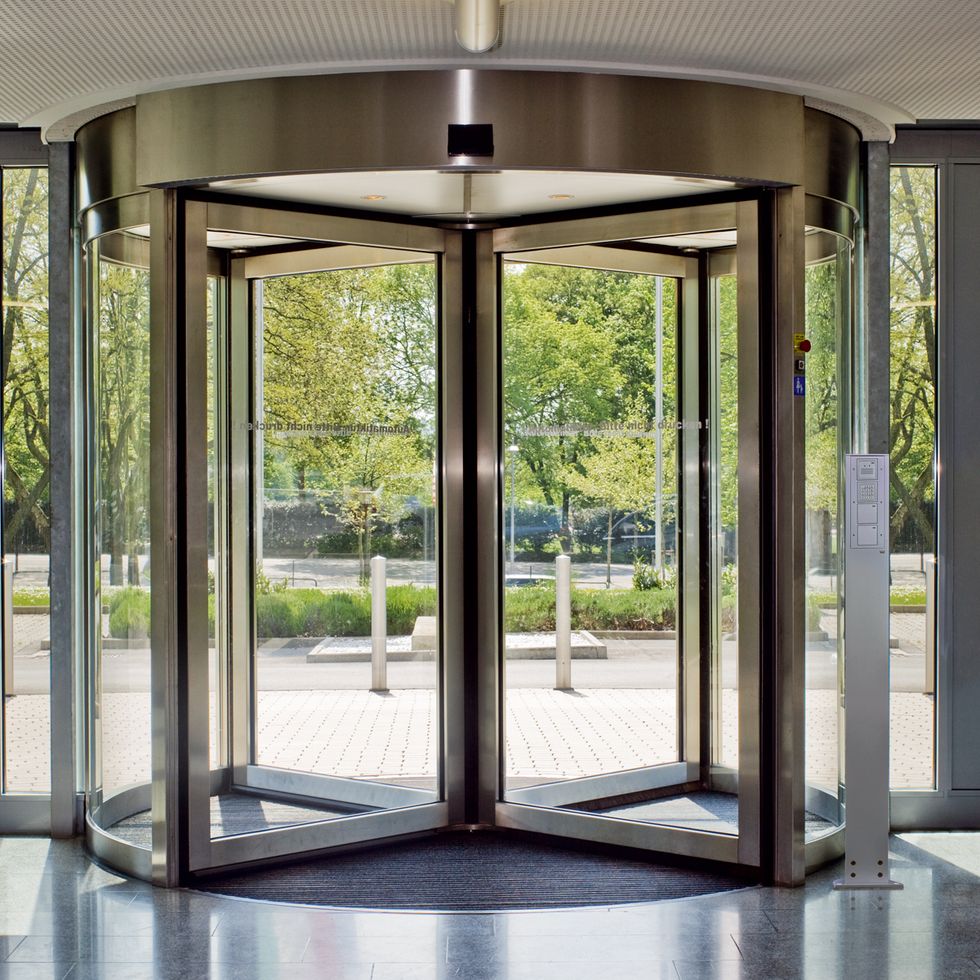
We have all seen the sign above the revolving door at Library West: "Revolve to Save Energy."
The revolving door is placed at the center of the main entrance of the largest library on University of Florida's campus with one conventional door on each side. Although the straight path leads directly to the revolving door, most students choose to stray off course and enter through one of the conventional doors. I understand that revolving doors are not "the norm," but have you ever considered why you should use them?
Just about every day in Florida, it is close to a fiery ninety degrees. Most buildings on campus keep their thermostats set to 70-75 degrees which means that, at any given time, air conditioning units across campus are cooling buildings up to fifteen degrees. This enormous amount of energy used to cool buildings is lost every time someone opens a conventional door rather than a revolving door which exchanges eight times less air. With energy consumption leading the conversation of sustainability these days, revolving doors seem like a simple solution to massive amount of energy used in large, air-conditioned buildings.
The innovation that comes from revolving doors eliminates a number of issues not just for the building, but for those who use the entrance and exit. Do you know the feeling of entering a large building that is heated in the winter? On a hot day, opening a door to a cool building and cold air hits your face so quickly that the sweat on your forehead actually turns to an icicle. Have you ever though about why that happens or how the air that hits you also speeds behind you to the outside world?
The way it works is this: With a multi-storied building, hot air rises and cool air stagnates at the base. When it is hot outside and a conventional door is opened, air pressure causes the cool air that is sitting at the base of the building to rush outside. In cold weather, cool air seeks the inside of the building to replace the hot air at the top of the building.
Revolving doors prevent air pressure on the outside from affected air pressure on the inside, which keeps the air separate and more easily controlled. While revolving doors are not air tight, they do prevent eight times less air to escape, saving eight times more money. To put this another way, the average conventional door loses enough energy to power a 60 watt bulb for 23 minutes every time it is opened. That is a tremendous amount of energy.
Because the University of Florida is a state institution, state funds and student tuition go toward the upkeep of our beautiful campus; yet, every day students choose to waste that money by ignoring revolving doors. Revolving doors prevent air, rain, dust, and noise from reaching the inside of a building. This keeps our library clean, quiet and climate controlled. Those are serious commodities on a campus where summer is a yearlong season.
So, the next time you are at Library West, please use the revolving door. It is just as easy as a regular door and will save our university money every time you do. Like my Momma used to say, "Shut that door! I'm not trying to cool down the entire state of Georgia!" She knows and now I know: in the south, air conditioning is a precious thing. Don't waste it.