
On July 4, 1776, America’s founding fathers signed a document that solidified every American’s right to life, liberty, and the pursuit of happiness. This Declaration of Independence has continued to be a staple of American democracy for more than 200 years. Over the course of those 200 years, America has seen great change. This change, however, did not come easy. From the women’s suffrage movement in the 1920s to the Civil Rights Movement of the 1960s, America has seen dozens of struggles against all kinds of oppression. Today, these struggles against oppression and inequality are no less prevalent.
Americans, unlike many other less fortunate people, live in a democracy where freedom of speech and freedom to assemble are considered basic human rights. On top of these unalienable rights, Americans are given the right to vote and have the privilege of their voice being heard. So why is it then, when asked if they are registered to vote, only 66 percent of American Millennials (age 18-29) answered yes?
With the upcoming presidential election in 2016 these results are jarring to say the least. The lack of interest, however, is not surprising. In every election since 1964, young voter participation was significantly lower than other age groups.
It is estimated that by 2015, Millennials will represent one-third of eligible voters. If this downward trend is to continue, a significant portion of the American electorate will be severely underrepresented. Considering the growing millennial voting eligibility, and their potential political weight over other age groups, why are less than two thirds registered with an even smaller number actually casting ballots? The answer is multifaceted.
In a Harvard University Institute of Politics Survey conducted in fall of 2014, 80 percent of millennials responded that they were not politically active. When asked the reason, 23 percent declined to answer. Those who did answer listed the following reasons:
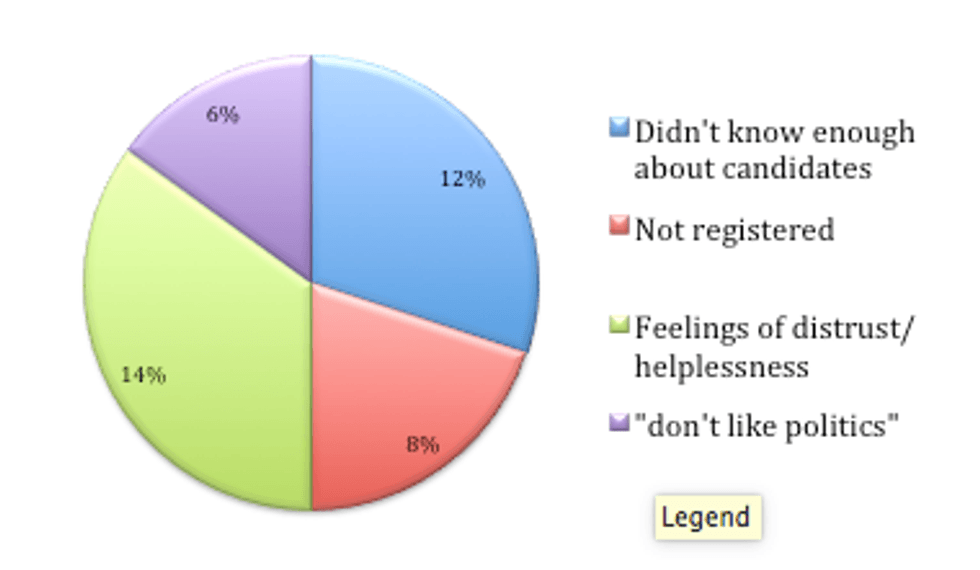
From these statistics, a conclusion can be drawn: Lack of political understanding and feelings of helplessness are causing a decline in Millennial voter participation.
One proposed solution to this problem is social media. Of the 2,029 Millennials that participated in the 2014 Harvard survey, 80 percent were Facebook users. A 2013 Harvard Public Opinion poll shows that the use social media positively influences voter registration. It reports 73 percent of people with three or more social media accounts were also registered voters.
This solution, however, does not come easy. While social media can be used to promote voter registration and spread knowledge about candidates, it can also provide a plethora of false information and misinformed opinions.
Another shortcoming of social media is the amount of actual action taken (or lack thereof). It is easy for users of social media to “like” a Facebook post or retweet an image to support their cause, but afterwards the positive action ends there. This has been commonly referred to as, “slactivism”.
Being a part of this generation, I understand feelings of helplessness or feeling under informed. It is so easy for signals to get crossed with the abundance of media we consume daily whether it be through social media, television or innocent web browsing. It seems that this information seems to find you whether you were seeking it out or not. It is easier than ever before for rumors to populate and distribute themselves like rabbits into our back pockets.
With the potential political weight we have as Millennials, we must be active in informing ourselves. We must be active in coming together to bring about the change we'd like to see. We must realize the power in numbers and the power of social media in our lives. While most of us turn to social media for a break from reality, we must also realize that it is an enormously useful tool in bringing people from all over the world together.
So let's stop misusing our resources. Let's stop using these tools for the mass distribution of cat videos and start using them to bring about change. When Dr. Martin Luther King gave his 'I Have A Dream Speech' in 1963 to 250,000 people, he didn't have a the power of the internet to spread the word. There was no "event page," yet it was one of the largest political rallies in American history.
Shoot forward 50 or so years to 2015 and we have the ability to communicate with anyone at any time. Ten years ago having a cell phone was a luxury, now not having one is almost debilitating. This is especially apparent on college campuses. We all browse the internet aimlessly while we're waiting for our next class, text our friends to find out where they are (locate them via GPS even) and stay up to date with all of those people from high school that we never liked in the first place. So why is it that we can't band together to bring about a positive change in our world?
We have the resources. We have the ability. We have the numbers.
Let's start using them.