
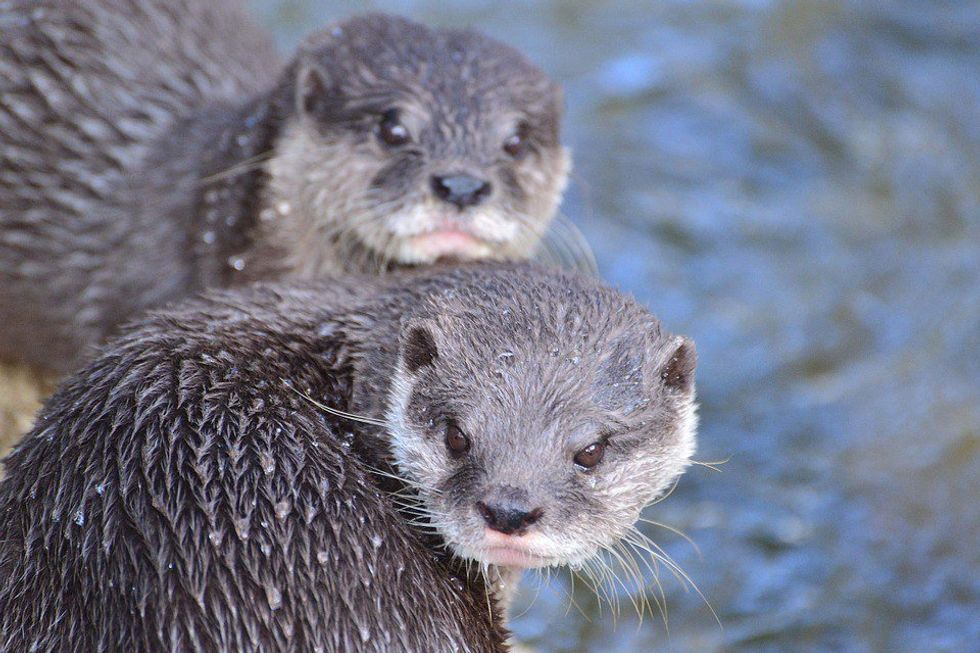
I love otters.
The funny thing is, until recently, I never had much close contact with any river otters. There had been plenty of sea otters at Monterey Bay Aquarium and Sea World San Diego, but the extent of river otters I had seen were some at the National Zoo, where they had a couple North American in a spacious pit and several Oriental Small-clawed behind Plexiglas, but they didn’t get that close. However, I went to the aquarium in Salt Lake City as my family and I were passing through, where they too were behind Plexiglas, though the otters came much closer to the separating barrier. There were three total in that pen, but one was asleep the entire time, another seemed only interested in getting his swimming workouts, while the third seemed to be the superstar of the group. It became obvious how much attention he was looking for when he posed for pictures, in and out of water.
This aquarium was different from other places I had been, in that there was a crawl box that people could get into, so they were practically in the otter pen while surrounded on five sides by more Plexiglas. I only got to see the napping otters next to it, but when a younger visitor brought his iPad into the observation box, the superstar otter went right up to the box and paused every couple seconds as though posing for a picture. He even hopped on top of the box, posed, and then he dove right back into the water. As I watched him and observed the two sleeping otters, it was fascinating to think about what life as an otter must be like.
Fun facts about otters: besides being universally recognized as incredibly cute and playful, there are about thirteen species of otter found worldwide, except for Australia (and I assume the Antarctic, as I have yet to hear of a sighting there). Two species have been observed using tools such as rocks or sticks to get food, the sea otter being the more famous of the two, which is a sign of great intelligence (although I have heard that psychologists have stated that play is a common learning form in creatures with higher intelligence, which also speaks volumes about the otter, as they are perhaps the physical embodiment of play). Yes, otters do eat fish, but contrary to some popular opinion, otters don’t go for the faster fish that fisherman love; instead, they go for the easier fish. Despite their enormous energy, otters cannot spend it all on hunting, so they will spend less effort if they can. Some otters eat frogs, bugs and even small rodents, depending on the species and circumstance. Some otters have relatively healthy populations, some are increasing thanks to efforts from certain organizations and some are facing challenges, either from population decline or from humans that recognize their cuteness but not their need to stay in the wild for the most part. There are otters being caught in live traps in Thailand that are being sold in an illegal trafficking movement—so if you find yourself buying a pet otter, first make sure that you are legally cleared to do so. Second, make sure you can afford to feed them, as that energy comes from plentiful food. Third, ensure that the species of otter you are going for is not a Giant Otter, Small-clawed otter, or any rare species for that matter, as they likely came from illegal sources. The rare otters need time to recover their populations in their own environment before they can safely even be considered as companions for humans.
And do remember, be careful around wild otters: Some of them do not look favorably on humans, while others might be too friendly and want to follow you home, and chances are, you might not have made the right preparations for that. So if you do spot wild otters, keep your distance, perhaps take a few pictures and send some of those shots to a local otter conservation organization, as some are looking for photos to help track the population spread and growth!