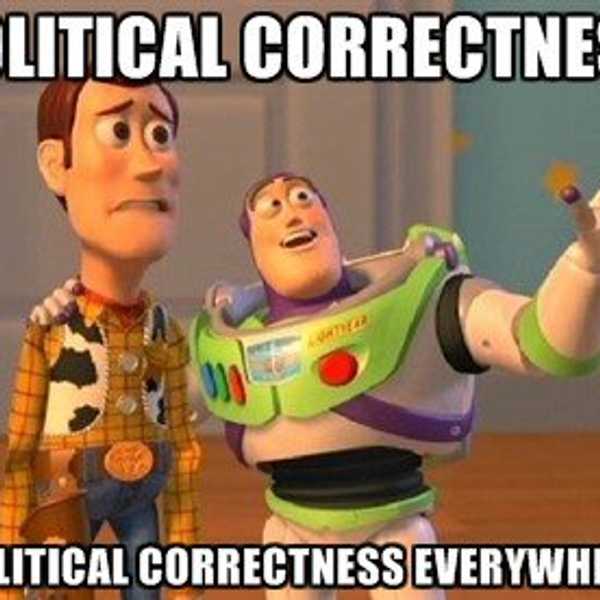

Over the course of this past week, I’ve had quite a few experiences fell under a rather interesting theme of “political correctness” - or at the very least, the culture of political correctness. For those who are unfamiliar, to be politically correct essentially means to believe that one should avoid language or behavior that may offend or marginalize specific groups of people. In other words, this is the idea that as a society, we need to stop ourselves from saying anything that one might find particularly racist, sexist, homophobic, transphobic, ableist, classist … the list goes on, really. Simply put, it aims to remove these “micro-aggressive” tendencies from our everyday life, in hopes of a less racist, less sexist, less homophobic (and so on and so forth) kind of society as a result.
Though this sounds like a very left-wing progressive concept, it is this ideology that seems to be dividing even like-minded liberal individuals into two camps: (1) those who are pro-PC and PC Culture who tend to call out those who are not acting accordingly as being racist, sexist, homophobic, etc. and (2) those who might roll their eyes at pro-PC individuals as extremist or (as I witness it quite often referred to) “Social Justice Warrior Bullshit”. Based on what I’ve experienced on the internet and in person, it seems to be that when the two come across each other in debate or conversation - or believe that such is the case - frustration ensues.
And this frustration has created a rather uncomfortable situation for me. I mean, really, how much more awkward can it be if I make a sarcastic joke about the gender binary, and not only am I being offensive for not taking the issue seriously enough, I’m also dismissed as another annoying SJW.
While I’m sure that between these two extremes is an entire spectrum of people who may feel more or less one way than another, allow me to be the first to say that I have incredibly mixed feelings. And because I don’t want anyone to misunderstand and think that I believe anything I don’t, let me explain why.
I think my first experience with PC was in 5th grade when someone told me that “African American” was more appropriate to say than “Black”, only to be told by my Dominican friend that he hated being called “African American” because not all Black people identified as African. Many years later, in high school, I made a joke about “Tiger Parenting” Asians and was reminded by my white friend that not all Asians were education obsessed.
Both my friends’ statements were true (and I can use my own parents to attest for the second), but I found my first friend’s point to be a lot more reasonable and acceptable to me than my second friend’s point. Though I agree that joking about racial stereotypes can definitely be discriminating and offensive at times, I felt that my second friend had taken the context from what I was saying. Many Asian countries have a completely different educational culture than the West. The grading system can be much more competitive. Schooling is often seen as the only means to become successful. And the expectations from parents for their children to not only do well - but to be the best - can at times be excruciatingly demanding. So yes, though not every single individual amongst the billions of the those who make up the population of every single Asian country as well as every immigrant family of Asian descent across the world may share these ideas, the family dynamic which we call “Tiger Parenting” is certainly a phenomenon embedded within the realities of the region’s culture - and though I was mocking it, I was also acknowledging it. It was a matter of cultural recognition. And I felt that to suggest otherwise almost dismissed this reality-deserving-of-mockery in favor of one that sounded less negative, and more “politically correct” - which sounded quite unsettling.
Don’t get me wrong here. I hate offensive judgmental stereotypes just as much as the next liberal. And that is why I love the intention of “Social Justice” that lies behind PC - that maybe we should all try to be a little less racist, sexist, homophobic and what have you. “Don’t be an asshole”, I used to say, believing it to be a simple yet wonderful mantra for life. So trying not to enable these discriminatory practices? Sounds pretty awesome to me. But then came the question - how far does PC go before we become these fabled “assholes”? How far before we’re replacing “self-control” with censored emotions? At what point does it stop being the end of micro-aggression and start being dismissive in its own right? And if it does become dismissive of the cultures that it originally sought to protect, then who is it really helping?
Though there are a few I could talk about, if I could mention just one issue with PC and its surrounding culture that I had to disagree with the most - it would be the idea that their system of “oppressor” and “oppressed” tends to be acted on as if it were universal. When I said earlier that PC intended to remove racism, sexism, homophobia and so on, one must understand that the culture of PC stems from a perspective that recognizes an institutionalized social hierarchy in which straight, white, neurotypical and able-bodied cisgender males are seen as the privileged oppressors to those who are marginalized for being otherwise. Though I agree that such things like institutionalized privilege and unequal opportunity do exist, I don’t feel that in every single case the one who may be the more privileged must be the only one in the wrong.
Slavoj Zizek is a Slovenian social philosopher who has written various books and cultural critiques, such as The Year of Dreaming Dangerously. He’s held lectures at NYU, and just last year, a video of him was posted on Big Think where he discusses his thoughts towards PC. In it, he talks about how PC undermines actual issues, how it attempts to control how individuals feel, how people can become closer through sharing and appreciating each other’s obscenities, and how PC comes off as fake acceptance. I’m not gonna lie, if you’re relatively familiar with his work, he comes off as kind of a crazy guy. But I think he makes quite a few good points here. And seeing how long this article has already become, I’m going to focus on this one particular thing that he says: “The message was [in talking about Native Americans]: the most racist thing is to patronizingly elevate us (…) No, the fundamental right is to be evil also. If we can be evil why shouldn’t they be evil”.
This is where I particularly disagree with how PC Culture has seemed to work in my experience. Though yes, racism and sexism and homophobia exist in American society with straight white males certainly receiving the better end of it, that doesn’t mean that the negative realities of what it means to be Non-White, LGBT+, Female or Otherwise have to be elevated into images that aren’t real. In fact, that denial of actual cultural context becomes a bit racist in itself. In Zizek’s example, he mentioned how, in talking to Native Americans, they were aware that statistically, they had killed more buffalo and burned more forests than the colonists ever did. And yet, their culture is uplifted into a beautiful, primitive, one-with-nature way of life, as if it had no faults and no evils of its own, as if to make up for their marginalization. In accordance with PC, this image becomes the appropriate way to falsify a culture. Is it better than the demonized version that preceded it? Totally. But it is still a fake image. It just makes us feel better.
I must say though, that all of this is not to say that the ideas behind political correctness are bad and horrible and shouldn’t matter. And I do think that as a First-World culture that used to pride itself in its diversity and its opportunities, we need some kind of “Social Justice” (or even better, a removal of the social barriers that make us need it - but I digress) and PC seems like a great way to get the conversation started.
In any case, as a society, we need to start taking responsibility for our flaws, just like any individual group of people. There is not enough representation in the media. Rape culture is very real, and unfortunately prevalent. LGBT+ individuals are still bullied and harassed to the point of suicide. The poor are looked down on as greedy moochers for wanting to live comfortably.
And sure, you can say that Asian culture looks down on showbusiness and that’s why there’s nobody who looks like me on an American screen; that you were also incredibly drunk and honestly had absolutely no idea what was going on that night; that LGBT+ people aren’t all innocent and free from moral responsibility; and that there are poor people who really do take advantage of welfare.
But you cannot say that the marginalized are the sole cause of their own marginalization.
Imperialized populations were often treated as sub-human beings by their rulers because they didn't see them as "civilized". If inner-city culture doesn’t have enough focus on education, it's arguably in part because the Plessy v Ferguson decision set the framework for poor quality Black schools in the decades to come. Women are paid less than men for the same job because some jerk decided that we were worth less than them. And if anyone’s keeping anything out of the media, it’s the media itself.
Just because no group or individual is perfect, that doesn’t mean that no one’s guilty. And yet sometimes it seems as though sharing blame is out of the question either.
Finally, what can I say about how I really feel about Political Correctness? And its aim to remove offense from our language?
For starters, my feelings are still very much mixed.
I appreciate the conversation that PC starts. It is one that wants to disassemble old stigmas in an attempt to be more informed. But like everything, it has a time and a place, and everyday conversation doesn't always have to be one of them. I don't think it's right to assume offense on anybody, to assume victimization, or to assume a reality or an image that might not be there - all the while telling someone that they shouldn't say something that's "offensive" only based on those assumptions. No, I don't believe that outright racist remarks are ever okay. But also, who would wanna live in a world where sarcasm and irony were killed in the crossfire?
And as tedious as it sounds, in terms of figuring what is and is not offensive or appropriate, I really do believe that such matters should be taken on a case by case basis. Whereas PC Culture has this tendency to draw universal lines between the is and is not - Context matters. All of the context. You could be dismissing the entire reality of a situation for a stupid joke and not even realize what you’ve actually said, or how your audience might respond to it. And that being said - Audience matters. While I might find something offensive, someone else not too different from me might find the same thing funny, or not care, or care even more. And none of us would have been able to control how we felt.
Overall, maybe it's time we started having more open conversations about these things - why something might be offensive, why it doesn't have to be, etc - rather than just dismissing each other.
So if I do get offended by something you say, if you're friendly, maybe take it into consideration next time and we'll have a nice chat about it. Or at the very least, don’t get mad if I tell you to f*ck off.