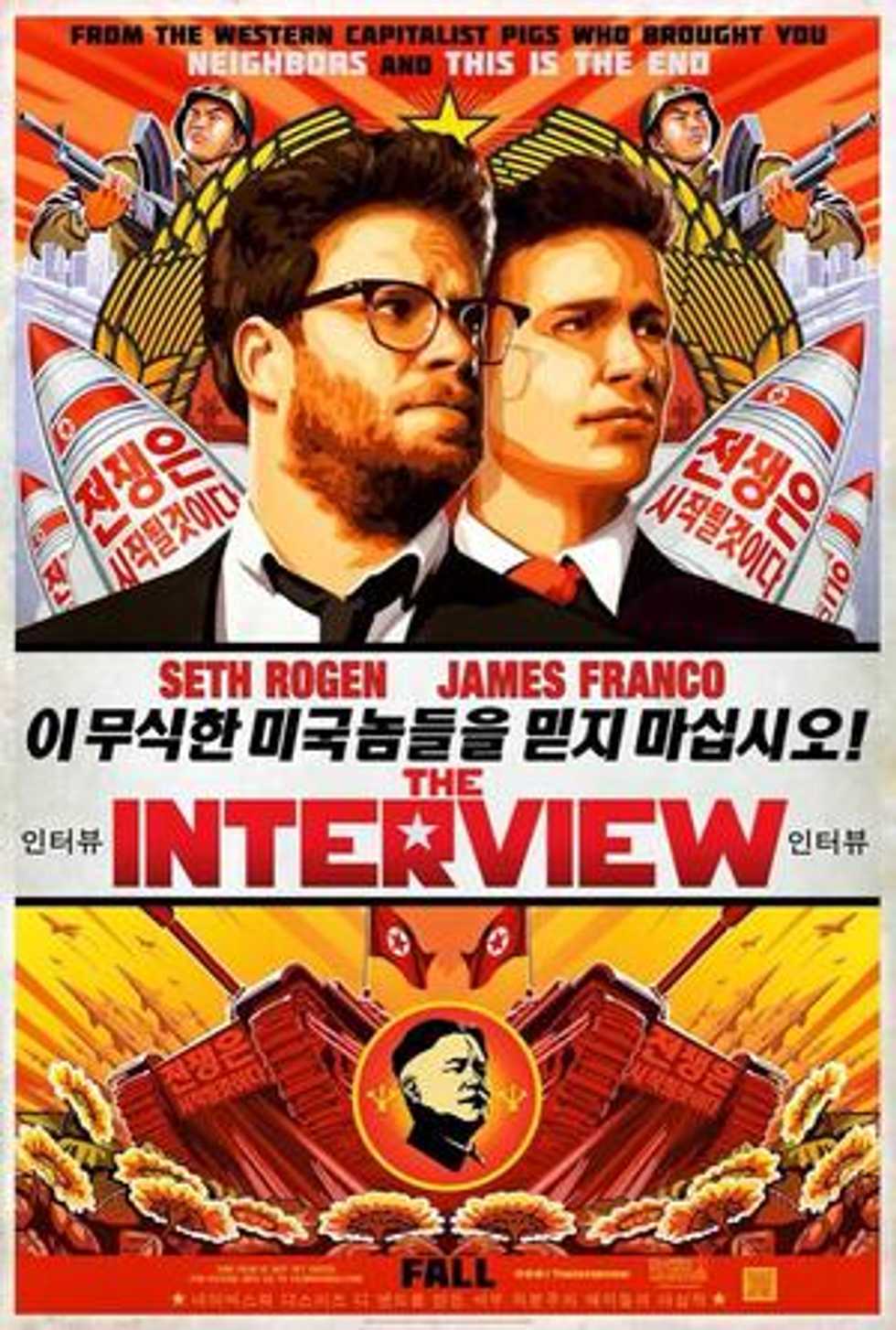
There's been a lot of scrutiny regarding the movie The Interview lately — not about the actual movie itself, really, but about Sony's decision to cancel its wide release which was originally scheduled for Christmas Day.
For those that aren't in the know, let me fill you in … Seth Rogen and Evan Goldberg (the writers of Superbad) set out to direct a movie about a fictional assassination of North Korean dictator Kim Jung-un. The film, starring Rogen and James Franco, was met with some mild controversy upon the premiere of its first trailer, which prompted North Korea to issue a statement about how the release of the film was blatant terrorism, would not be tolerated, would be met with merciless retaliation, yadda yadda yadda … another empty threat from the powerless little guys to the East, right?
Wrong. Sony Pictures, the financial backers and would-be distributors of the movie, was hacked not too long ago. The hacker group, "The Guardians of Peace" (which the FBI has now confirmed has ties to North Korea), acquired 100 terabytes of data and began leaking some very personal information about the company, as well as statements threatening acts of terrorism (including references to 9/11), should the film be released.
The major theater chains refused to show the movie upon learning this. One thing led to another and Sony eventually decided to cancel the release altogether. That's right … the entirely filmed, edited, completed film (which has already been reviewed and seen by critics and attendees of its heavily-guarded premiere) got cancelled, just like that.
Sony has since come around and changed its mind, and seeing The Interview is now very possible; it has been released on several streaming services and in some theaters. And I think that that was the right thing to do in the end.
But people are still mad. Many have condemned Sony's actions — in essence, the studio kneeled to North Korea and let them know that their wish is America's command. In what some are calling the first major act of "cyber-terrorism" directed toward the US, we almost lost the battle, and many fear that this could set a dangerous precedent of things to come. Will the initial response of Sony Pictures portray America as a cowering nation with its tail between its knees, and make us more vulnerable to threats of this nature in the future?
The answer to that question remains to be seen. But for the past couple of weeks, the media has been firing on all cylinders condemning the actions of Sony, berating the studio for so-called stupidity, carelessness and cowardice in their first response.
And yet, I see where Sony was coming from.
Yes, Sony did give in to a third-world country that has threatened nuclear attack since the dawn of time. What they did was cowardly and I did not personally agree with the decision. However, I can see the logic in their decision, and by no means do I think it was one that was stupid or threatening to the well-being of our country.
First of all, let's look at the facts. Sony Pictures is a movie studio. Not a government organization. Not an intelligence bureau. Not an entity that is any way tied to the leaders of the United States. At the end of the day, they are a company who's sole purpose is to make a profit while providing the masses with entertainment.
So is the rest of the world going to belittle the superpower known as the US of A because one business that happens to reside here made a decision regarding a hack? They shouldn't. The government didn't order the cancellation of the film. Nobody in Washington D.C. did anything to stop the release of the movie. It was entirely up to the discretion of one company. If anything, the faces of our country had more of a say in the movie's release rather than its cancellation.
Now let's take a look at the situation the studio was in: they had dumped a good amount of money (an estimated $44 million) into the movie's budget and gave it an opening of Christmas Day. For those that don't know, Christmas Day is one of the biggest days for film releases — in a movie season littered with award-baiting bio-pics and controversial dramas, December 25th is a day where the big, mass-appealing blockbusters can come out and almost be guaranteed financial success. It's basically the July 4th of winter, so you know a studio will only release its pre-summer cream of the crop on this day and have lots of faith in it. That being said, to cancel a movie slated for release on that day--that's a big decision. It was not made carelessly.
And there were other factors behind the decision to pull. The big movie theater chains (AMC and Regal, for instance) had already stated that they were not going to show the movie. Those chains represent a huge portion of the market. The four nearest movie theaters to my home in Orlando, FL are each owned by one of the major chains that refused to show the film. If you think about the percentage of movie theaters that are owned by these companies (and it's huge), you begin to realize that the movie's box office numbers would have been severely compromised from Sony's point of view. The movie may as well have been cancelled from that moment.
Also, realize that we live in a world where everything that happens is blamed on someone. It's a sad truth, but a truth nonetheless; it's why McDonald's can get sued for serving a woman hot coffee that she spilled onto her own lap. Had something happened upon the movie's release, who would have been held responsible? Sony. I'm not saying that that's right, but it's the truth in our sue-happy society. Think about the shooting in Aurora when The Dark Knight Rises premiered — it was a terrible tragedy that reflects the measures crazy people will go to leave a mark. Now imagine something like that happening at a showing of The Interview … all of a sudden, people have someone to blame, because Sony had the warnings, knew of the threats, and released the movie anyway. I can guarantee that someone, somewhere, would come around arguing for criminal negligence and irresponsibility and all of a sudden, Sony becomes responsible for a terrible event. The decision to pull the movie became one of insurance; ANYTHING that may happen during this film's theatrical run will have repercussions ten times more severe than that of any other action comedy because of its background, and Sony (as a publicly-traded company) must have realized this and rightfully wanted to avoid the risk at the time.
So what we had was a major studio whose secret information had been hacked, a movie that had spurred threats of attacks, a huge percentage of movie theaters refusing to show the film, and an enormous liability in the case of an accident. What would you have done as the CEO of a company with all of that on your hands?
I get that the move to pull the movie showed weakness, but I'm not in charge of a major movie studio. I don't have 100 terabytes of my personal information floating around. I am not responsible for releasing a piece of media that has garnered threats to people's lives.
At the end of the day, I think that Sony's initial decision was a lot of things, but stupid was not one of them, despite having heard that word thrown around so many times in association with this whole controversy. Sony Pictures should not be obligated to be responsible for people's lives. They should not have to be responsible for a threat against the country. The people running Sony Pictures are not diplomats; they are not intelligence agents; they are not tied to the politics or safety of our country in any way. They are businessmen. They are out to make money and do so by entertaining people without risk. The American government did not respond to our first cyber-terrorism battle … a motion picture studio did. It's a lot easier to decide if what they did was right or wrong from the outside looking in. At the end of the day, this is a company who got in way over their heads and decided to take a bath of upwards of $44 million to avoid any risk.
So when I'm watching The Interview later, I won't take it for granted. I won't be mad that Sony gave North Korea a power trip for a few days. As a matter of fact, I applaud them, because as cowardly as their handling of the situation was at the beginning of the month, it was logical. For them to turn it around and release the movie after all of the controversy must have taken a good amount of guts, and I don't think any less of the company now.