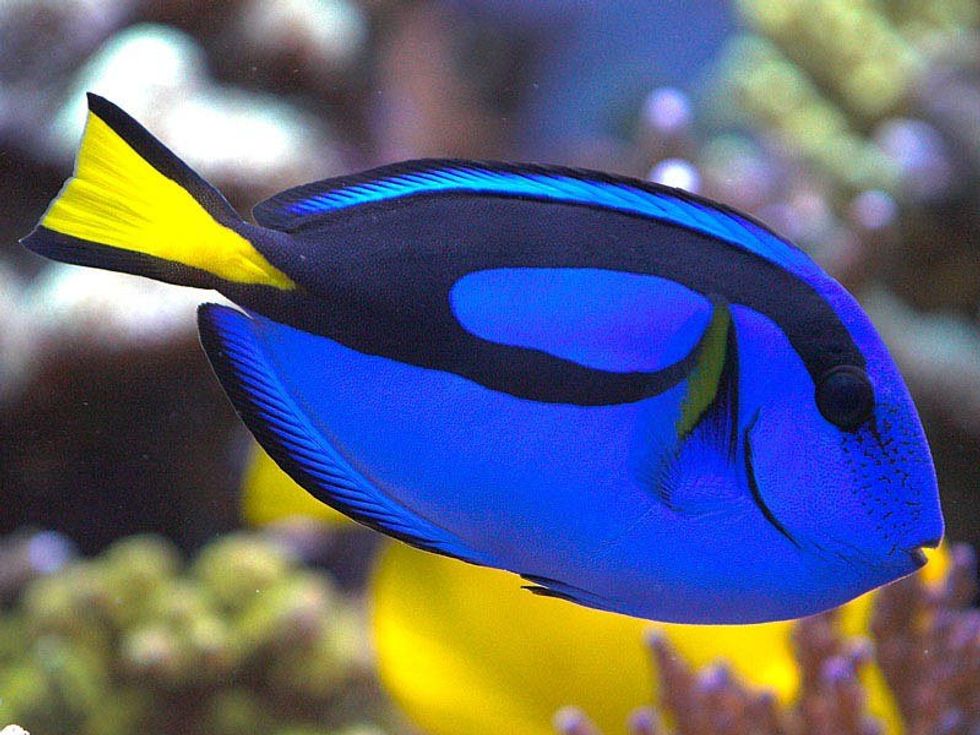
There is a great chance that 13 years after it's release you have at one point or another watched Finding Nemo. Despite it being a smashing success, as it is the most purchased DVD of all time, among other accolades, it also came with detrimental consequences for the environment, as it spurred at 40 percent increase in the purchase of tropical fish. Although Finding Nemo unintentionally brought hard-hitting effects for wild life, it's much anticipated sequel has the potential to catalyze the destruction of the Pacific Blue Tang, Dory herself.
Why, some may ask, is it a big deal to buy tropical fish. It can't be any harder than maintaining a gold fish right? Wrong. The first point I would like to make is that tropical fish are not as hearty as the common sunny or pond fish. They are delicate and normally come from an environment, such as the coral reefs, in which they help maintain an equilibrium that is necessary for them and for their environment to survive. For example, the Pacific Blue Tang, aka our beloved Dory contributes to the maintenance of coral reefs by eating algae off them, hence feeding themselves and upkeeping their homes. When someone decides to take a tropical fish for themselves they are responsible for contributing to the decline of the coral reefs as it is very likely that the fish came from the wild as many are hard to breed in captivity, which is the case with the Blue Tang. When tropical fish are captured it is often aided by squirting a cyanide mixture into the fish's face to stun them, making it easier to catch. While cyanide may make the lives of those illegally capturing fish peachy, it comes with severe consequence for coral reefs as, "A square meter of reef is destroyed for every live fish caught using cyanide..." Just as we are watching the sickening slaughter of our world's rain forest, the capturing of tropical fish come with the indirect action of rendering coral reefs, "marine deserts."
Tropical fish require care and maintenance that a goldfish does not. They need to be in warm temperatures usually between 68°F and 76°F and cannot be living in regular bottled or tap water but rather salt water, and with certain added chemical, depending on the breeder's advice and the species need. Most tropical fish also require places to hide and explore, an oxygen pump to aerate the tank, and a quite environment . The criteria I listed is only the tip of the ice-berg for tropical fish care and as imagined caring for these fish is not only tricky but expensive and time consuming. Due to the difficulties of keeping any wild animal in captivity, the abandonment and mismanagement rate is high. For example, after the release of Teenage Mutant Ninja Turtles, "90 percent of purchased turtles were estimated to have died in the United States alone."
When looking forward to the effects that Finding Dory will have on the Blue Tang it is not a stretch to predict that a similar trend to that seen in turtles will arise with Dory. I make this claim because not only is Dory a tropical fish, she is a fish that as an adult will span around 12 inches meaning that anyone who owns a Blue Tang would need a tank that holds at least 36 gallons of water since,"One general guideline is that you should provide three gallons of water for every ne inch of fish" Of course, there are some people who will give the Blue Tang the time and care they need to survive in captivity, but for the most part Dory will be taken home by well meaning families with little knowledge of what is best for her, resulting in her death a few hours after purchase.
If you have ever taken a biology or ecology course you have probably heard the term flagship species which is, "....a species selected to act as an ambassador, icon or symbol for a defined habitat, issue, campaign or environmental cause." In a broader, sense it is a species that we as humans become emotionally attached to and feel the need to save, often because we are captivated by their beauty or undeniable cuteness. For this reason the panda is used in the logo of the WWF and not a cockroach. A flagship species is in some ways a double edge sword, they help to raise awareness and up the conservation for many endangered species, but they also cause people to put on their blinders to the less aesthetically pleasing or cute creatures.
Although Finding Dory draws viewers with the promise of beautifully animated fish, it also depicts some lesser loved creatures and uses its box office powers for good by sending the implicit message that all creatures are worth our time and efforts for conservation. How would Marlin and Nemo have found Dory in the pipes if they were not chatting with the crusty clam in the tidal pool or did not hitch a ride with Becky, the disheveled loon? How would Dory have saved her fellow fish from going to Cleveland, if it were not for the aid of Gloria the whale shark, and how would she have made it to the open ocean exhibit if Hank and septapus was not around? All of these helpers depicted in Finding Dory are not exactly beloved creatures, but by Disney and Pixar doing what they do best, manipulating out emotions, they are using their powers for good.
This article is about many things, being wary about the fish you buy as pets, conserving the Blue Tang, and recognizing the value in creatures we often overlook. On a final note, I would like to suggest ways that we can, with minimal effort, help to conserve our oceans. When going to the super market we can bring our own reusable bags, we can stay away from plastic water bottles and vie to purchase ones that we can use time and time again, and if you are someone who enjoys keeping fish as pets you can download the Tank Watch App which tells you which fish are good to buy (aka not from the wild) and which you want to stay away from. Another thing that you can avoid doing is buying drinks that are packaged in the plastic six pack rings. Just as these rings are detrimental to creatures of land, they also negatively affect sea creatures. This is a very poignant point made in Finding Dory when for an uncomfortable amount of time a distraught Dory was swimming around with a tattered six pack that settled on her head. There are many take aways that I hope readers can gain from the article but if nothing else remember that tropical fish are our friends, not pets.