
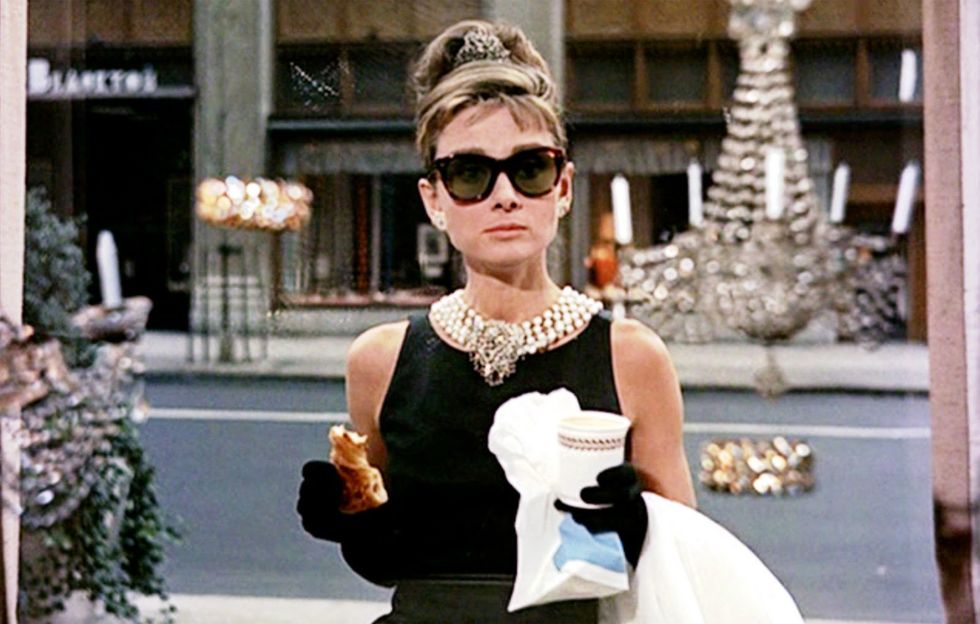
My favorite novella in the entire universe is Breakfast at Tiffany's. I finished it so quickly about three years ago and I was just so swept away by the magic that exuded from the novel. Naturally, I was excited when I found out that the film adaptation of my new favorite book was on Netflix. However, I was disappointed after seeing it.
As unpleasant as it may be for some to hear, the main character, Holly Golightly is, more or less, a prostitute. No, that's not particularly the kind of job someone would aspire to have. I understand this. But, in the movie, the narrator (called Fred) is also made to be a prostitute, although he was not originally one in the book. The reason that Fred was made to be a prostitute, as specifically stated by the directors of the film, is because the directors felt that it would distract from the inappropriateness of Holly's same job. Is it reasonable to consider this job "inappropriate"? Understandably so. The idea that it is more acceptable to blatantly express that a male is a prostitute than it is to suggest that a female is one is extremely sexist on so many levels. It's yet another thing that society says men can do, but for women it is "unladylike.” Not only is it suggesting that it is acceptable only for men to do something, but by using Fred's job as a way of somewhat justifying Holly's job is as if saying that women cannot rightfully do something unless a man first approves of it.
Adding onto my point about the blatant sexism in this adaptation, there is such an unsatisfying ending. Throughout the entire duration of the novel, Holly is characterized as a free spirit who will not let anyone claim her as his own. This idea is important because it sends women the message that they are not property, nobody owns them, and that it is not only okay, but also very important, to be independent of men. What makes this theme even more significant and valuable is that it was incorporated into a book written in the 1940s, a time when women were unimaginably oppressed, even more so than they are today. Something that really conveyed this idea was the ending. After having Fred pine after Holly for so long and claim that she owes herself to him, Holly just up and leaves and pursues a path she thinks she will be her happiest self in. However, in the film adaptation, after Fred is completely disrespectful and sexist towards her, Holly does not venture off and remain independent and happy. Even though he is a prostitute himself, he shames her for being one. Yet, she gallops into his arms and finally gives him the grand kiss he thought he deserved. By changing a scene that is so important to the grand scheme of things, and by not allowing Holly to give one final representation of her independence, the filmmakers are suggesting to the world that men own women and that every free spirited and independent woman exists merely because a man has not yet come along to put her in her place. This horrible interpretation of such a moving scene takes away from the original message conveyed in the novel and weakens the purpose of the text.
Additionally, there were extremely racist decisions made in the making of this film. As described in the book, Holly's upstairs neighbor Mr. Yunioshi is Asian. But, you know who plays Mr. Yunioshi? Mickey Rooney, a very, very Caucasian man. This role was given to a white man--yet another thing taken from a minority and given to a white person. To make this poor casting decision is to further erase people of color from the movie industry. It is stating that a white man was better at playing an Asian man than an actual Asian man was. Furthermore, Rooney’s character does not even play anyone of substance. He is portrayed as a stereotypical Asian character and serves only as a device to establish Holly’s relationship with the world, as opposed to an actual character of substance. People of color are people, not sidekicks, not plot devices, and not stereotypes. They deserve to play strong characters.
Though the novella itself is problematic for a lack of diverse characters, among other things, the adaptation of Breakfast at Tiffany’s worsens the already present issues. Hopefully, we can learn from these mistakes and make movies with characters that are better representative of actual people and that do not contain sexist themes.

















