
Films and books provide consumers with the opportunity to experience stories that are extraordinary in how while their worlds differ from our own, yet they still mirror our society in a way that people find relatable. Yet, minority representation, or lack thereof, within these popular forms of media still presents an issue. With America containing a hodgepodge of people all from diverse ethnic and cultural backgrounds, you would expect more entertainment media to capitalize on and reflect this with more colorful casts.
Hollywood is the most well-known offender when it comes to portraying ethnic and gender diversity, with several studies and reports seeming to repeat themselves. It's often argued that Hollywood's predominant use of white male actors is to attract the caucasian audience, which still makes up the majority in the U.S. However, the numbers haven't been matching up for years. In a 2013 study by the University of Southern California examining 500 top-grossing U.S. films released between 2007 and 2012, around 76 percent of all speaking characters were white, yet, whites only made up around 56 percent of the ticket sales. In fact, 26 percent of tickets were purchased by Hispanics, who made up around four percent of ethnic representation on screen--making them the most underrepresented group.
The presence of race-bending just adds to Hollywood's problem here. I found the 2013 movie, "47 Ronin," particularly disappointing. Initially, I was excited to see a movie done in the style of Chūshingura, or works of fiction influenced by the actual historical events involving the revenge of the forty-seven Ronin (I'm a fan of many things samurai).

This movie was a great opportunity to bring talented Japanese actors to the States and really pique Western interest in Japanese culture while giving some more diversity to Hollywood cinema. Instead, the well-known tale of the forty-seven samurai was given a Hollywood interpretation. This spin enabled them to put Keanu Reeves in the main role as a half-Japanese, half-British outcast, rather than making the leader of the Ronin (Hiroyuki Sanada) the star.
This is not to say that the presence of diversity is completely absent in entertainment media. One of my favorite things to discuss (as a comic book fan) is Marvel's approach to diversity within their comics. Timeless superheroes are being given new looks to give Marvel's cast more color. Miles Morales, a Black Hispanic Spider-Man, made his first appearance in 2011 and appeared in "Ultimate Comics: Spider-Man". This past June, it was announced that X-23, Laura Kinney, who is a female-clone of the original Wolverine, will don the costume as the "All-New Wolverine." In an even more recent announcement, Amadeus Cho, a Korean-American who made his first appearance in Marvel Comics in 2006, was revealed to be a new Hulk in the upcoming series, "The Totally Awesome Hulk."
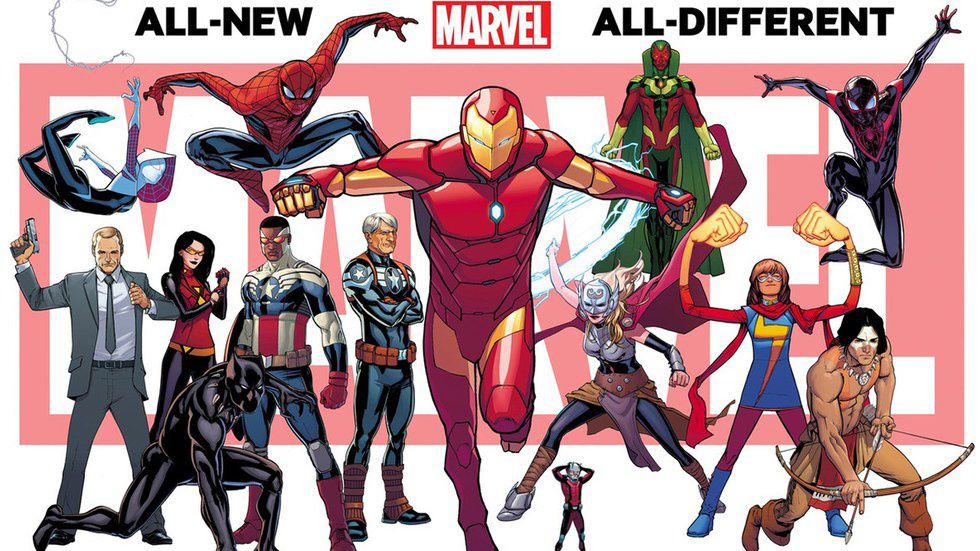
Mixed reactions often come from fans after seeing some iconic characters depicted with a new look. However, the choice to change these characters, who have already made names for themselves, gives a greater and more immediate effect than if lesser-known heroes were to be created with varying ethnic backgrounds.
Lastly, I want to mention a film called "Seoul Searching," which made its way to the big screen earlier this year. I saw the film this summer with a friend at an Asian-American film festival and found it to be a breath of fresh air. The film is reminiscent of 80's coming of age films (which makes sense since the film's setting is in the 80's; note "The Breakfast Club" poses below) and takes place in summer camp for "gyopo," or foreign Korean teenagers.

The most enticing thing about the film for me was the diverse Korean cast, even if many of their roles did seem to just fill in some popular character tropes. Even so, the film utilizes a unique approach in portraying an Asian cast, with characters ranging from a troublemaker kid from L.A. to a more groomed Korean kid from Germany. As these Asian youths explore and discover their cultural identity, their characters are developed through very emotional (albeit sometimes melodramatic), and even comedic scenes. The film was very satisfying and emphasized how characters are more than just their ethnic makeup.
We've come a long way since the time when "Black TV" was a separate entity from "White TV," but there is still room for improvement. Based on statistics alone, the television industry would actually benefit financially by adding more ethnically diverse characters. It is soothing to see, however, the effort some groups and corporations are putting towards increasing minority representation in our media. Whether it's comic books or television, there's a certain spice that characters reflecting our true society gives making the experience of watching them all the more entertaining.

















