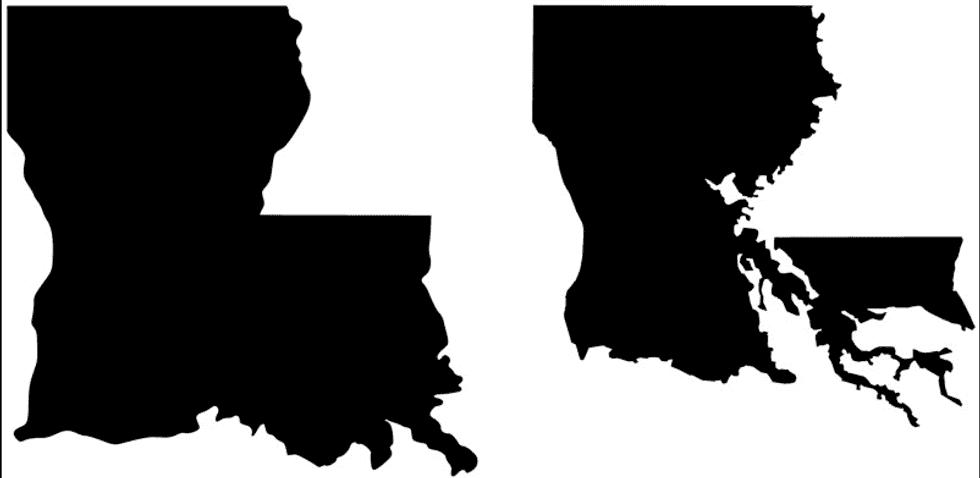
With all the weather talks going on right now around the world regarding melting polar ice caps and plant extinction, it is perhaps more tangible to examine this topic on a local scale. Louisiana is experiencing erosion that is startling in the lack of media coverage being attributed to it. Dry land is sinking at a rate of 25 to 35 square miles per year. As the Gulf of Mexico creeps closer and closer to washing out Southeastern Louisiana, taking homes and memories with it, are we to simply sit and watch the waves roll in?
One can only hope for the contrary, seeing the relatively hopeless struggle against the ceaseless force of nature.
With less than 40 years until the projected washout time, homeowners say goodbye to the clapboard structures they once possessed, moving to higher ground. There has been a substantial decrease in the population of peninsular parishes: between 2000 and 2010, the population of St. Bernard Parish experienced a -31,332% change. This eastern parish wedged between the Gulf to the East and South and Lake Borgne to the North has experienced a correlating loss of land over this same time period. Erosion will not only cause loss of homes and businesses, if the projected million-acre loss of land is confirmed in 2050, but it will impact the multitudinous oil companies and food manufacturing industries located in the area. Such a blow would wreak terror on the local economies and affect trade on a national and international level.
Not only humans are being affected by this loss of land. Migratory birds, amphibians, and various forms of plant life will also be affected if there is no land or marshes on which they can stabilize their ecosystem. The rapid decrease of land will compromise their habitats and render them unable to participate in the fluidity of a healthy subtropical ecosystem.
Having the demographic response to these changes on the landscape in mind, we may turn to causes of this major environmental event. The institution of such economies as energy and agriculture have strained the land, stripping it of resources that it can use to naturally defend itself. Through the use of electric machinery and the stress that human life has placed on the land, peaking especially in the last 100 years, the wetlands have lost the tools to be able to restore itself. This weakness and strain prevents the land from regenerating at the rate at which it is disappearing. Human influence can perhaps best be exemplified in the 2010 oil spill, in which 210 million gallons of oil was released into the Gulf Coastline. This severe environmental fluke is still facing repercussions. Natural disasters have also contributed to the dismal state of the wetlands today. Through the paired strength of Hurricane Katrina and Hurricane Rita, the latter passing through a similar area less than a month following the former, the coastal area of Southern Louisiana lost 217 square miles of wetlands. These numbers provide a harrowing look into the future, one that seems to be experiencing ever more volatile natural catastrophes.
What is there to do?
Although this sounds like a deep well from which there is no ladder, things are being done to combat the rapid decline of wetland in coastal Louisiana. Aside from the diligent work of scientists and researchers, programs have begun to seek solutions to address this problem. Christmas trees are collected every year and brought to the weak land in hopes of stalling erosion and binding with the remaining earth. Public works have advocated for changes and pioneered awareness efforts in coastal towns and cities. From here, the only hope is to support the effort through physical or financial aid and to be aware of your chemical footprint. Together there is hope to reverse the imbalance and strengthen our wetlands.