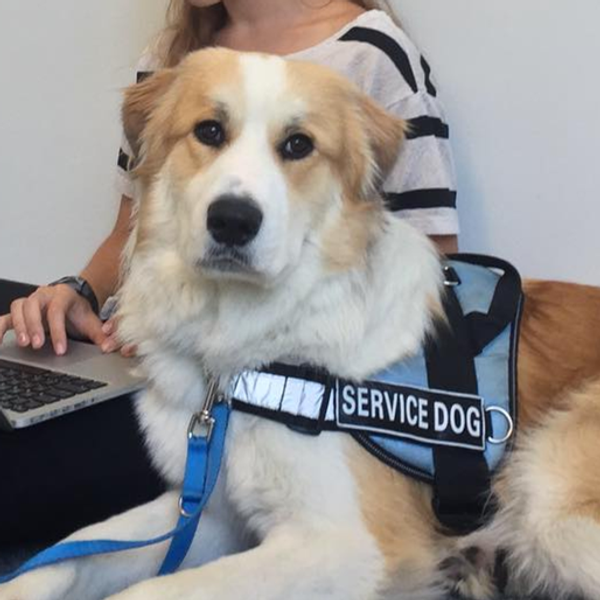

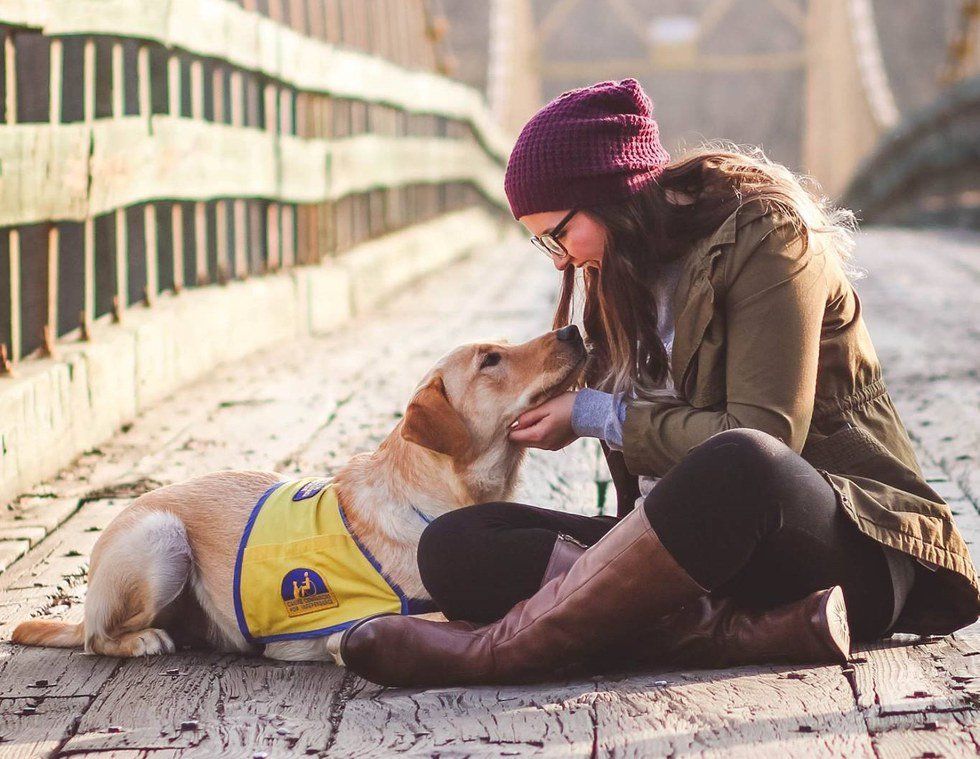
Everyone, meet Micaela and Gibson! Just over a year ago, Micaela adopted Gibson from Canine Companions for Independence, and she has been raising him to be a service dog ever since. I had the privilege of interviewing Micaela to get an inside look at what raising a service dog is like, and how it has changed her own life.

So tell me what exactly puppy raising is, just to kind of give us a background here.
Sure! So puppy raising is raising and training a dog that the company (Canine Companions for Independence) has bred to be a fully trained service dog. It's a long process; the puppy raisers will train the puppies for about 18 months before giving them back to the company and then on to their new owners. Since CCI gives their dogs completely free of charge to the people who need them, it's the puppy raisers who take on a lot of responsibility for training and teaching them before they go to their new owners. They also take on all of the financial responsibilities, such as vet bills, approved dog food, professional training classes, etc. That way, the person receiving the dog doesn't have to pay for anything, and the dog is ready to help them.

As a college student, how difficult was it to get a service dog, let alone have him live with you in campus housing (where there is a traditional "no pets" rule)?
It wasn't easy to get him for sure. CCI makes sure their dogs are going to people who will train them well and are able to take on this sort of responsibility. The puppy has to be the only dog in the house, and the owner basically has to show they are able to raise him the way he needs to be raised.
Once I was approved to receive him, I had to jump through several hoops with my university's housing department, just so he'd be able to live with me in university housing. I eventually had to show them the Arkansas law that says you basically cannot refuse service to someone with a service dog or service dog in training. CCI doesn't really like us to pull the law card because it can cause someone to have a negative connotation of us or puppy raisers in general. But it was the only way I'd be able to stay in my dorm with him. That law kind of got their attention, and once they were on board with it, I didn't have any issues.
So I see you take Gibson with a lot of places in public with you. Is that part of his training?
Yes! So part of training a service dog is to get used to them being in public with their owners. They have to learn to keep their attention on their owner even in a distracting environment. So since he will basically go everywhere with his new owner, I need to teach him to stay focused in a variety of environments. We started small; the first place I took him was Dollar Tree when he was four months old. We were only in there for about five minutes, but it was a big deal. I had him sit in there and lie down.
From there, we went to Wal-Mart and places like that. Once he got used to being in stores, we moved to restaurants. This was more challenging because, in restaurants, there's all of this open food and different smells that could distract him. My trainer helped me a lot with this; she suggested we sit in a booth so he could sit under the table easily and stuff like that. But I was so nervous at first bringing him out in public because he wasn't always perfectly behaved in public. At first, he'd get up a lot if I had him sit with me in class, and he'd whimper when he got bored. Sometimes he'd throw a fit, and it was just an awkward stage we had to get through. Once we got through that rough phase of his training, he's been so calm and great in public. I take him with me everywhere, as much as I can.

Have you had any trouble with people in public not understanding what he's for, or not knowing how to react to the both of you?
Most places I go, people are pretty perceptive. They see his vest, and they either think he's my service dog, or they read his vest and see that he's in training. A lot of people look at us and smile. I've had a few people be rude or off-setting about it. One time, somebody on campus yelled, "What's up with the dog??" So sometimes just weird stuff like that.
I've also had some issues with people wanting to pet him. And that's just a lack of etiquette or public knowledge about service dogs. I don't think it's common knowledge that you're not supposed to pet service dogs or service dogs in training. When someone reaches out to pet him or try to talk to him, it distracts him from his purpose, which is keeping his focus on me and/or his potential owner and their needs. It got to the point that I bought an attachment for his leash that says, "Please do not pet," but some people still do it, and I have to politely ask them not to.

When I tell people I know someone who is raising a service dog, I get a lot of, "Oh wow!"s, like people are impressed and think it's a wonderful thing to do. But almost immediately after they express their excitement for you, they then follow up with, "Oh but I could never do that myself, I'd get too attached to the dog!" How have you kind of prepared yourself for potentially getting attached to him, even though he will only be with you for 18 months?
Oh, that is a huge part of raising Gibson. I think I first knew that when I first applied for receiving him; my family warned me I might get attached and not want him to go or something. And Gibson and I spend a lot of time together, more than a regular person-dog pair does. Because most people don't take their dog to the movies, or spend hours per day teaching them new commands.
So I think spending so much time together in order to socialize him and train him, that probably doesn't help with the attachment thing. Honestly, I am really attached to him, especially because he is my first dog. But I just have to keep reminding myself that someone else needs him more than I do. Like he's going to make a huge difference in someone's life, and I am so proud of him. So I know it's going to be hard, but it's going to be worth it because he's going to make someone's life so much better and increase their independence, and I had a hand in doing that for them.