The unexpected consequence of landing a ticket to the premier of Batman v Superman is that I’ve had to sit and think about the film. It's one extra week to have my rage slowly boil over from what I had witnessed. But there are countless places you can go to hear people complain about this movie. I wanted to write about one of the most infuriating aspects of DC’s latest film: the treatment of Superman.
It has become abundantly clear that Zack Synder not only doesn’t get Superman, but hates him. Superman is never once asked to answer for the destruction of Metropolis in the last film. A vision of his father tells him that try to help anyone will have horrible unforeseen consequences (then you realize that the previous film never once challenged Pa Kent on his belief that it would have been better to let children drown than use his powers). When he finally does begin saving people—in a brief montage—it is presented more as a burden. The imagery constantly reminds us the “Superman is like Jesus! He suffers for you!” And all of this is before we get to the treatment of Superman’s supporting cast. Lois Lane and Ma Kent are battered and beaten for the sake of drama while Jimmy Olsen is killed.
People say Superman is a difficult character to write. People say that he is too powerful a character, but there are countless characters as strong as him and plenty of impossible challenges that push him to his limits. Some argue he’s too unrelatable, but he’s a farm boy from Kansas making his way in the big city. What’s more American than that? What they really mean is that it is hard to write a character who is completely good. Much like Captain America, it is hard for modern writers to wrap their heads around a character as earnest and sincere in their heroism as Superman. So instead, they make him tortured by his powers, or make him burdened by his responsibilities, or play up the alien aspects or make him a metaphor for Jesus.
But in writer’s haste to make Superman more believable, more ‘grounded,’ they lose sight of what makes him human. Snyder constantly references The Dark Knight Returns and The Death of Superman as inspirations for his film: two gritty, morbid, and cruel comics that haven’t aged well. But there is one moment that always sticks with me that defines Superman, one moment that captures the heart of what the character is.
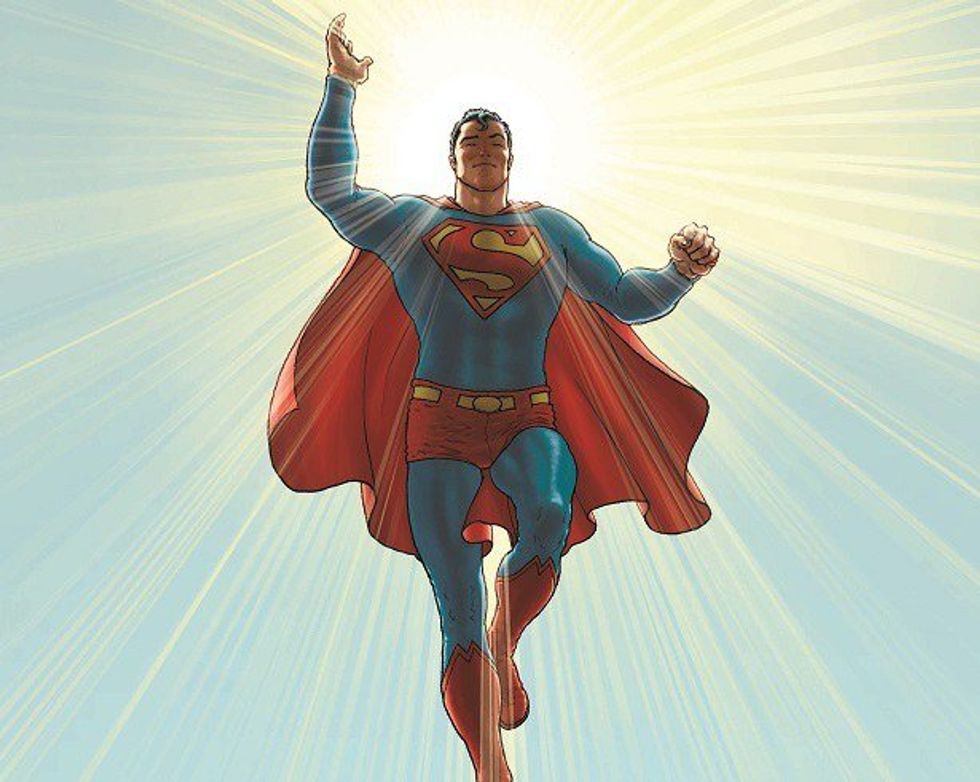
2006’s All-Star Superman has been referred to as a sort of Anti-Thesis to the soulless, angry machismo of The Man of Steel. It beautifully captures the empathy and compassion that defines Superman in the modern world. In issue #10, Superman overhears a doctor yelling to a patient on the phone, begging them to stay on the line. As it turns out, that patient is a suicidal teenage, standing on the edge of a building. As she prepares to fall, Superman appears behind her, reassuring her that everything is going to be okay. The two embrace as the scene ends.
After seeing this page roughly five hundred times, I have come to the conclusion that it is physically impossible for me not to get emotional from this scene. It’s simple, but massive in its emotional weight. It captures Superman at his most human, and humanity at its most vulnerable. But what makes it a defining moment for what Superman is comes from two realizations that dawned on me while watching this latest incarnation of Superman.
It’s easy to forget during this moment that Superman is on the edge of death. All-Star Superman is a comic about Superman only having a year to live, and trying to finish a series of tasks in that short window. But even as he is dealing with issues of cosmic importance, he stops to help this girl. Even as millions of lives depend on him, he takes a moment to make sure that this life won’t be lost. Because saving people isn’t a burden for Superman, it is a noble duty. As he yells later in the comic “I can save everyone.” And he means everyone. And sometimes he doesn’t even need his powers.
Superman could end this issue without a single word. He could drag her kicking and screaming safety to ground and that would be the end of it. But Superman doesn’t need to use his powers. He is such a powerful presence, such a reassuring force, that all he needs to do is say that everything will be okay, and someone literally moments from ending their life believes him. No moment better captures the fact that if you take away his powers, and Clark Kent is still powerful. Even if he can’t fly over head or lift cars, he is still inspiring.
Zack Snyder himself admits to struggling with Superman: “Even when we were working on Man of Steel, I was like, Gosh, what are we going to do with this guy?” That quote alone reveals that deep down, Snyder is wrong for this material. You can make him as operatic as you like, you can drown your film in as much Jesus imagery and martyrdom as you want, but that will never capture what Superman is. Your $450 million film will never understand what a single comic sheet does, that deep down, Superman is just a man whose empathy and compassion are inspirational.
As Marlon Brandon states in 1977’s Superman: “For their capacity for good, I have sent them you.” Superman was never about being an alien or having incredible powers, it was about a man being given the freedom and opportunity to be anything he wanted, and choosing to use that freedom to save the world. That is what Superman is, a reminder that we all have the choice to help our fellow man, and if we push just a little harder, we can save the world. Even if we can't save millions of lives, we might still convince one hopeless teenager that they are stronger than they realize.