
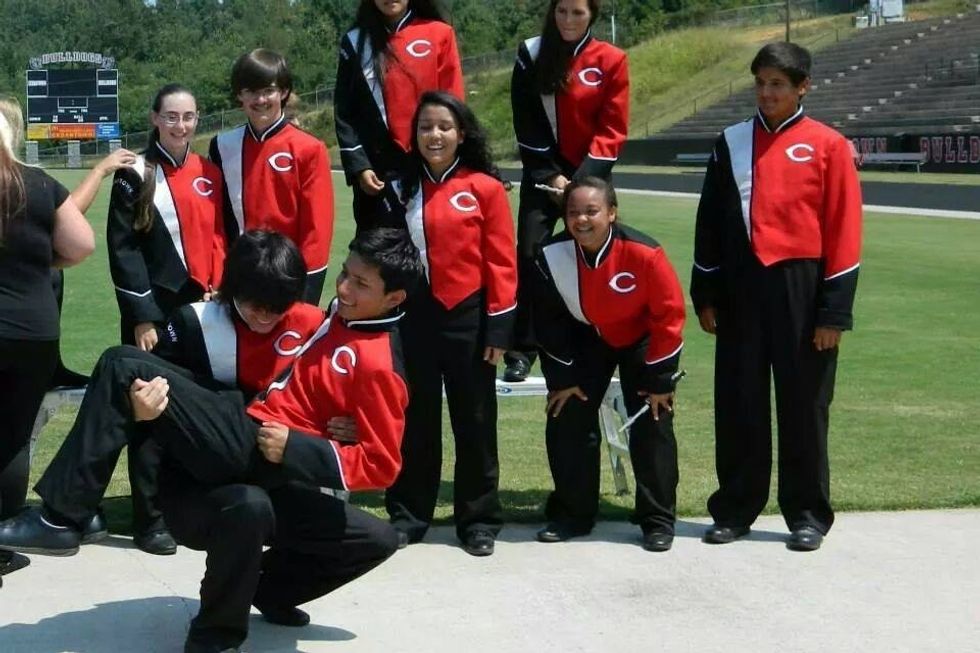
Marching band has become a huge part of my life for the last couple of years. As many of you know, every year we sacrifice one or two months of our summer before school starts to put together a half-time show for the upcoming football season. We spend that time on learning new drill, learning the basics of how to march, and learning new show music that we are required to have memorized for the whole season. Not many people realize that marching band has taught me so many life lessons as a member of a marching band. Some of these experiences has helped me shape the person I am today and without it, I would not be as successful as I am.
Looking out for others
Setting up drill in sweltering heat made us mindful, not only for our need, but also for the need of others. Still to this day, every year we have several people from the whole band that get sick or faint from heat exhaustion. After seeing this for the first time, I learned to check up on everyone to make sure they were okay. In my senior year as section leader, I learned to keep watch over my section’s health and well-being and made sure to give them frequent water breaks, let them sit and relax, and to cool off either in the shade or in the band room. Watching the other leaders in action gave me an idea of what to do and what not to do when I was in charge.
Responsibility
Arrive late to band camp or without your instrument, and you’ll be forced to run laps, do push-ups, or any other consequences the band director or the section leader gives you. Slack from preparation and deadline for memorization of your music and skill, you or the section could be the reason that you lose points at competition. The absence or tardiness of one can affect a number of players, who are liable to miss their marks or musical cues without your guide. This can cause added work to your band director or section leader if he or she spent time re-teaching the drills or music that you missed. This peer pressure may be overwhelming, but it is the single greatest motivator to bringing a newcomer into your section.
Self-esteem
Having a group of friends that share the same interests and experiences, as well as disappointments, gives each member a support system in which to grow and develop. Performing regularly to packed stadiums weekly helps overcome performance anxieties. As a personal development, I was a quiet and shy person growing up. In eighth grade, I sat in concert band with several other clarinet players trying to figure out whether any sound was coming out of my instrument. By playing clarinet in concert band and in marching band is where it started the process of coming out of my shell. In many ways this helped me shape my personality by defining a new role within this band. With self-improvement came opportunities; with opportunities came self-improvement.
Leadership
Within a marching band there are many leadership opportunities – section leaders, band captains, and drum majors are the most common. As a section leader, I was responsible to lead rehearsals and to teach my section their drill. Since the students didn’t see me as leader, I learned to instruct in a way to keep them motivated. Later on, I helped some of the students in my section improve their individual playing skills.
Performance Skills
Playing in the marching band has helped me become a better musician. From rehearsing everyday day after school got me into a routine of daily playing and practicing. Marching band competitions showed accuracy, memorization, endurance, coordination and projection to the top row of the football stadium.