
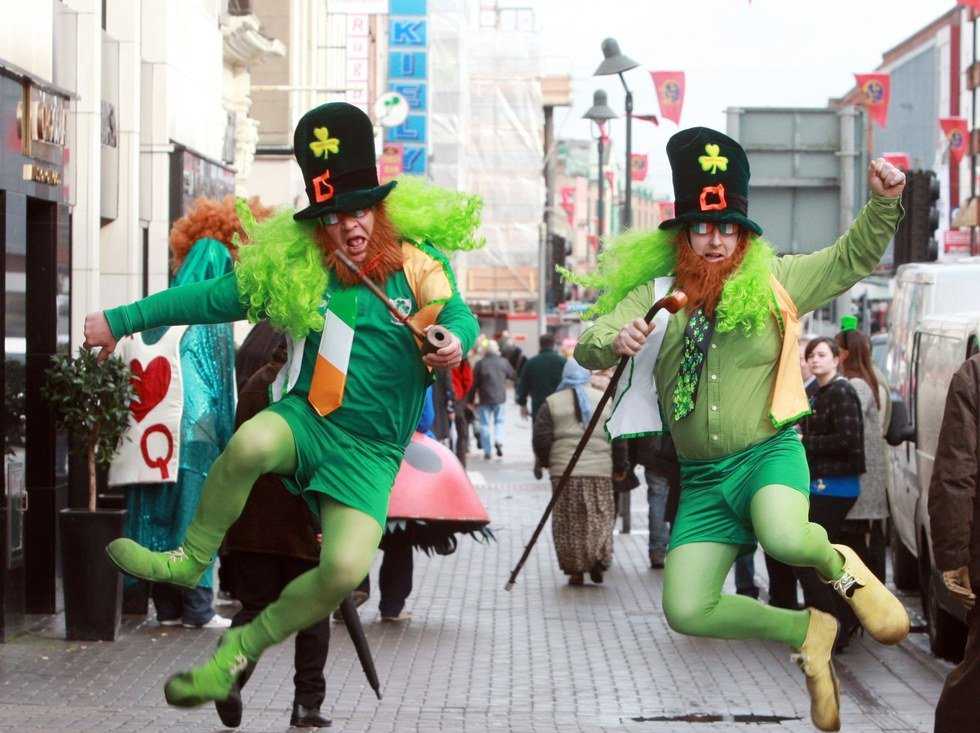
We all know the typical things that make up a St. Patrick's Day celebration today: parades filled with a sea of emerald, people sporting shamrocks on their shirts and hats, alcoholic beverages turned green, the entire works. In San Antonio, Texas, they even go so far as to turn the San Antonio River green for the festivities. Talk about dedication!

But how did St. Patrick’s Day originate? After a little bit of research, this is the information I’ve managed to pull together about the holiday:
In essence, the day was originally intended as a way to celebrate Saint Patrick, the patron saint of Ireland. St. Patrick actually was not Irish by birth; he was born in the 4th century A.D. in Roman Britain. He was captured and enslaved as a young adult, during which time he visited Ireland for the first time.
After he escaped from slavery, he joined a Catholic monastery, and eventually became a bishop. Legend has it that he received a dream from God that led him to return to Ireland and serve as a missionary in the northern and western regions of the country. His work mainly consisted of converting the Gaelic Irish, the majority of which were originally pagans, to Roman Catholicism. There is also a popular belief that he “drove the snakes out of Ireland.”
Saint Patrick spent 20 years teaching the religion he was passionate about. He built schools and churches and monasteries, and he continued to convert people, even after being imprisoned by the Celtic Druids several times. Saint Patrick died on March 17, 461 A.D., and this date was later chosen as the day to honor his work for the country of Ireland. It was celebrated solely in Europe until around the seventeenth century when Irish immigrants began to bring the holiday to the United States. Of course, it has changed quite a bit since then. What began as a religious holiday has now become more of a secular holiday, focused on celebrating Irish culture as a whole.
What about the shamrock? Apparently, Saint Patrick used the shamrock, or the three-leaf clover, as a way of explaining the Holy Trinity (the Father, Son and Holy Spirit). Now, of course, the shamrock is simply associated with being Irish.
And why do you get pinched if you don’t wear green? According to several websites, in the past, many of the Irish believed that if you wore green, then you were invisible to leprechauns. Leprechauns are relatively harmless, but they are known for their tendency to play tricks, including pinching people. So, people pinch others for not wearing green on St. Patrick’s Day, to remind them that leprechauns can see and play tricks on them. A little counterproductive, if you ask me.
So now that you know a little bit more about how St. Patrick’s Day got its start, enjoy the festivities, and watch out for leprechauns!