



Texting, tweeting, iMessage, BlackBerry messenger, Facebook chat. What do these forms of communication all have in common? These relatively new mediums are fundamentally changing the contextual cues people pick up on. Punctuation and emoticons mean more than you think.
In an age when millennials are setting the trends and even influencing politics, communication is everything. Speaking from experience, I am on my iPhone more than I would like to admit. Half of the time, though, I am sending screenshots of various conversations to my BFF to make sure I am interpreting the information appropriately. I often wonder if my friend meant something totally different than the actual text of their message because of their punctuation or emoticon use.
A study conducted in 2015 by Binghamton University concludes that “text messages that end with a period are perceived to be less sincere than messages that do not.” Celia Klin, an associate professor of psychology and associate dean at Binghamton University, and a research team further gathers that “a text response with an exclamation mark is interpreted as more, rather than less, sincere.” Texting and chat-like mediums are impactful channels of communication in today’s age and punctuation means more than you may give it credit for. Stop punctuation—periods, exclamation marks, question marks, etc.—greatly influences the meaning and tone of texts and chat conversations.
Do you overthink messages because of punctuation like I do? What is your most frequent punctuation mark or emoji and what does it say about you?
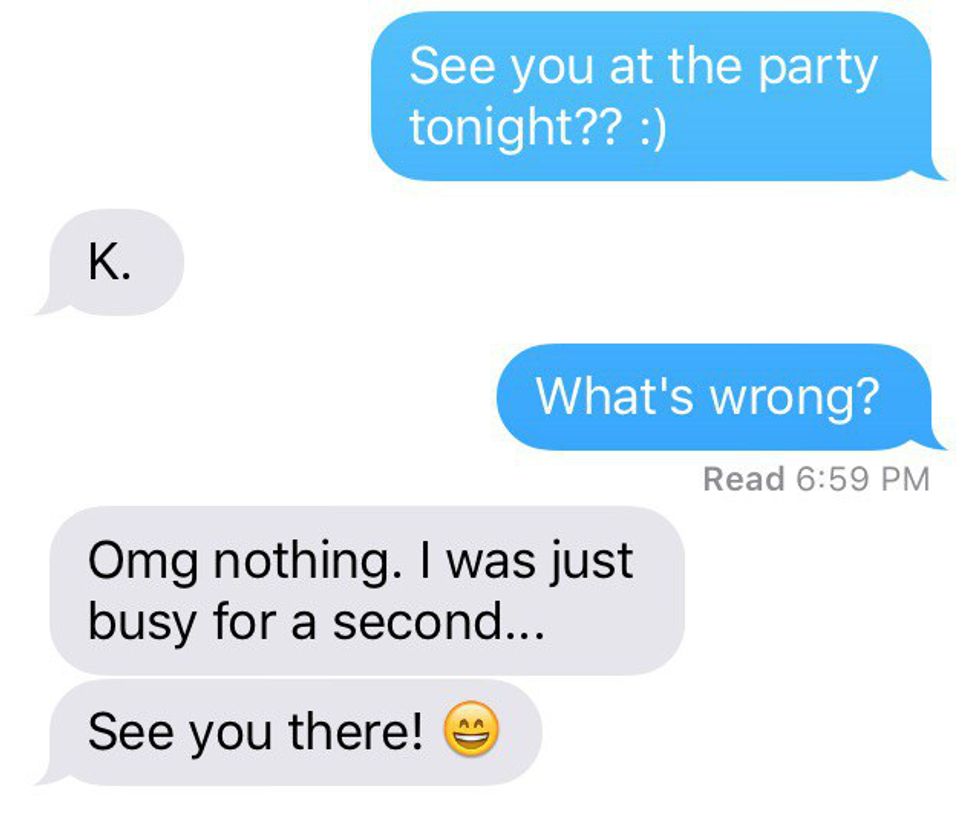
According to Klin’s study, punctuation in text messages is more influential than most people would like admit. The rapidity of chat-like forms of communication aim to mimic actual conversation. However, texting and chatting does not allow for all of the social and contextual cues of conversation. Nonverbal communication, pauses in speech, and voice inflection are lost with texting. Most of the time, punctuation and emoticons fills in these gaps.
Binghamton University’s study claims that “emoticons, deliberate misspellings that mimic speech sounds and… punctuation” all add meaning to text messages. Just like punctuation, emoji use greatly impacts the meaning, connotation, and/or tone of the text message. Emoticons can intensify meaning, clarify a text, or render the actual text of the message sarcastic or ironic. I have to admit that I use emojis in almost every message!
For me, there is a definite difference between the following forms: Okay, Okay!, OKAY, Ok., kk, and k. How often have you thought someone was mad at you because they said “k” instead of “okay?" Texting punctuation is very intentional and purposeful for me. I am quite certain my close friends know I am in a terrible mood when I reply with sort answers ending in a period.
We may not even be aware of our punctuation in texting or chatting situations, but I urge you to think more carefully about the messages you convey. Because texting is such a new medium, we all have to be a little more sensitive about the information we express and think about how it may be received. Ultimately, we need to be aware of the purpose of punctuation, period!

















