Recently, I watched the movie, "The Soloist." It is the moving story of LA Times columnist Steve Lopez and his relationship with a schizophrenic violinist, Nathaniel Ayers Jr. -- one-time Julliard student. Based on the true story, this movie depicts the dramatic relationship between the two. It delves into the nature of true friendship -- the dynamic between wanting to control another person and respecting, or rather, loving his freedom. It is a heartwarming tale, but also a very real one.
I loved it. I though it was great. I could not get over how beautiful it was. And so, I went online to see what other reviews had said. Perhaps their insights could allow me to understand the movie even more. I was surprised to find relatively average scores on IMDb, Rotten Tomatoes, and Metacritic. Most of them gave a similar reason: strong performances by the lead roles, Robert Downey Jr. and Jamie Foxx, but a weak and unfocused narrative hindered the movie from "hitting its mark" as Rotten Tomatoes puts it. Now, I'll admit that the movie did seem to drag on at times, but this problem felt negligible.
This difference in opinions is not without reason. It can be summed up in one word, a name actually: Beethoven.
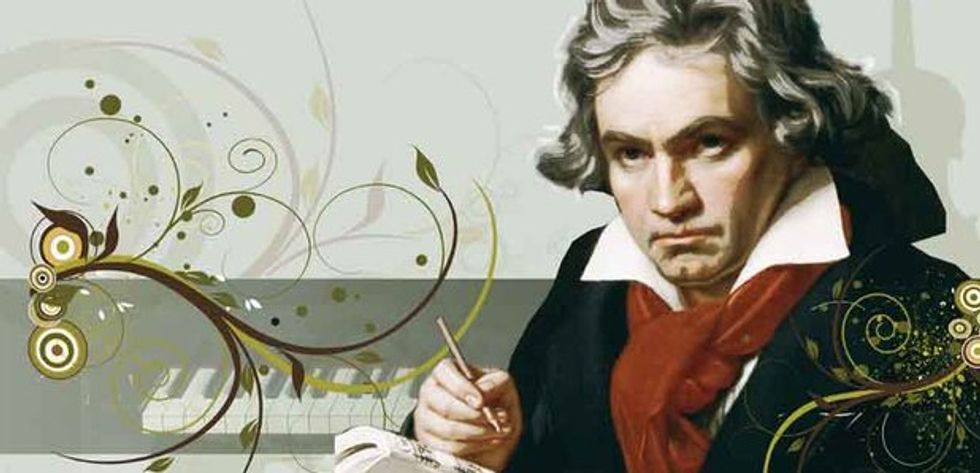
In the scene where Lopez and Ayers first meet, it is under a statue of Beethoven. Ayers, in his schizophrenic musings, wonders how a man like Beethoven could come to be the leader of Los Angeles. In a flashback to when Nathaniel first started playing the cello, he is humming the theme to Beethoven's 3rd Symphony, "Eroica." Later in the movie, Lopez and Ayers get a private audience to see Los Angeles Philharmonic perform that same piece. While listening, Ayers exclaims, "He's here. Beethoven!" And in a scene of surreal genius, everything becomes dark around Ayers and as he closes his eyes, the screen goes completely black. As the music begins, explosions of colors rage across the screen, highlighting the raw emotion and drama that Beethoven so vividly captured. It was in this scene that I understood that this movie was really about Beethoven.
I am no classical music expert. I have listened to a good amount, but I know most of what I know indirectly through my father and older brother, professional musicians themselves. I remember one time my father showed me Beethoven's 5th symphony. Sitting in our living room, I asked him where Beethoven "gets this stuff from." My father had just bit into an apple, and with his mouth full, but still excited to answer to the question, simply pointed to his heart, then reached his hands out to the sky (apple still in hand), pointed back to his heart, and then pointed to his brain.
Other than being very funny to watch, it was true. My father was right! (For once). Beethoven understood his need for beauty. He understood where it came from. And he understood how to show that need in his music. My father's lesson was a difficult one to grasp at first, but after "The Soloist" gave me a Beethoven appreciation lesson, he is all I can listen to. Other things just don't compare. Yes, Adele has sold millions of copies of her new album in just a few days, but Ludwig van Beethoven has lasted nearly 200 years (and for most of that time there was no such thing as recorded music).
What Beethoven does, in short, is capture the raw facets of life -- joy, sorrow, anger, intensity, passion, beauty -- and lays them down in front of you. Take Eroica for example. It begins with two accented, victorious, heroic shouts -- E-flat major chords. Then, after a short pause, the strings begin to waltz back and forth, joyously growing and shrinking in volume and intensity. This is the first phrase -- the motif -- of the piece, representing the beginning of a journey. Beethoven then goes on to explore every creative possibility with every instrument in the orchestra, mixing and matching them, and creating a wonderful diversity that is still unified. It is driven by the unexpected -- an accented note here, a change of ideas there, but always returning to the motif, always returning home. It is a story of conflict and resolution. It is life.
Anyway, this is all just to say that Beethoven's music says something profoundly true about what it means to be human, what it means to be passionate, and what it means to understand God, the Infinite, the Mystery, the great Something (with a capital "S") that's out there and we all strive toward.
Just listen to Ludwig, and you'll understand what I am talking about.
* * * * * *
Interested in learning more?
For a great TED talk on the power of classical music, click here.
"The Soloist" can be found on Amazon Video here.
Also check out Steve Lopez's book of the same name.
And if you enjoyed my father's description of the source of Beethoven's inspiration, he recommends Herbert van Karajan and the Berlin Philharmonic's recordings of Beethoven's work.