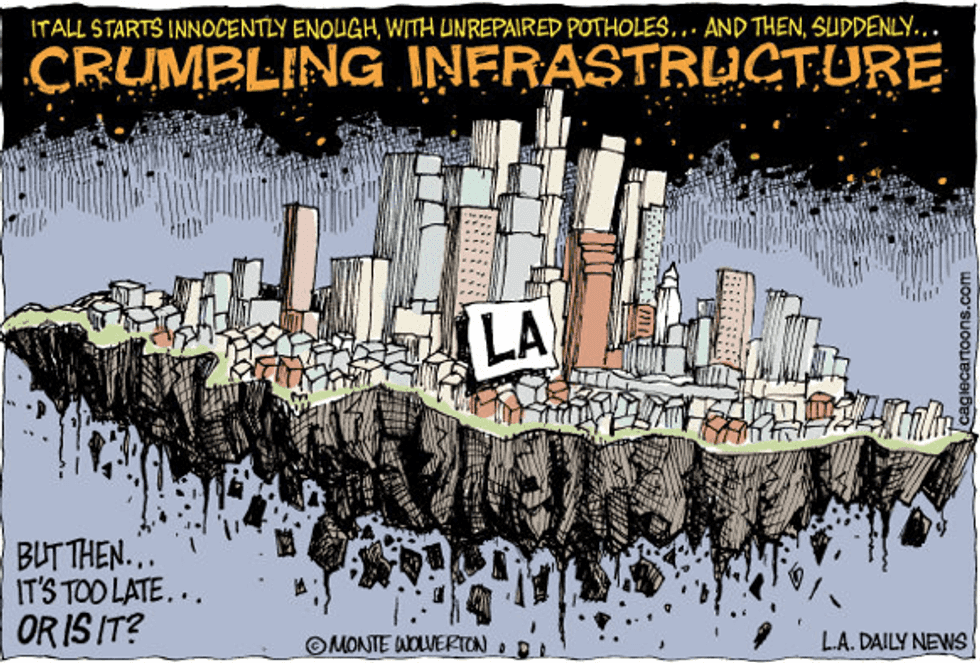
In recent months, the list of domestic tribulations seems be to piling up.
Thousands of unaccompanied immigrant children crossing our southern border, gross negligence at Veteran Affairs hospitals and the U.S.A’s World Cup loss to Belgium, just to name a few. As mid-elections are only a few months away, the American public can expect to be beat over the head with these talking points from Republicans and Democrats alike. However, one issue I fear may not receive the attention it deserves is one that is most visible to constituencies across the nation.
Our national infrastructure is drastically deteriorating and has reached sub-par conditions. The American Society of Civil Engineers has shown significant concern that infrastructures like our roads, bridges, highways, tunnels, airports and energy grids, cannot adequately support future economic growth. The concern is so great, that the organization assigned a D grade to our overall infrastructure . If the grade alone isn’t enough to send shivers down your spin, perhaps some perspective can re-prioritize this reality.
Since 1990, demand for electricity has increased by about 25% but construction of new transmission has decreased by 30% . Decreases in supply and increase in demand means higher prices, much higher. Over 25% of America’s bridges are deficient, and 25% of our bus and rail assets are in marginal or poor condition. In 2009, the amount of waste due to congestion equaled 4.8 billion hours and 3.9 billion gallons of gasoline, costing $115 billion in lost fuel and productivity. And with perhaps the most eye-opening figure, the American Society of Civil Engineers estimates that it would require $2.2 trillion over the next five years to bring our overall infrastructure up to par. That is a tremendous amount of money in a very short span of time, and in this political climate, it is highly unlikely to be appropriated. So how did this happen?
One potential answer is inadequate or poorly appropriated funds. Infrastructure projects are often under-estimated and taxpayers are stuck with the resulting cost runoffs ranging from $17 million, like the state of Indiana in 2001, to $305 million from 2007 to 2010 in California . Yet one of the most frustrating aspects of money in infrastructure is the enormous restorative potential investments in highway and other constructions projects can have. The Third Way economic center estimated that every $1 billion in highway investment supports 30,000 jobs, and that every dollar invested in infrastructure increased GDP by $1.59. There are few fields in the United States that can offer that type of return on economic growth. Infrastructure is how fast and efficiently we move people, goods, power, and ideas. If America is to remain a competitive global player, it is essential we present ourselves as such.
In a recent survey, 90% of business executives around the world indicated that the quality and availability of infrastructure plays a key role in determining where they do business. In a very real way, investing in our roads, bridges, energy grids, and everything that keeps our homes warm and lit and our sidewalks paved, can be seen as investing in ourselves.
With these types of tangible benefits, why is it unlikely we as voters will hear much on infrastructure from our leaders? Unfortunately, I don’t have an answer. An educated guess would be the taboo against government spending looms large over our elected officials. The consequences of using taxpayer’s dollars without an immediate return on that public investment are too unnerving for a re-election orientated Congress. Yet our Congress appears to be in a continuous re-election orientation, on a never-ending campaign season. During which tough decisions are neglected in favor of chauvinistic fluff speeches which insults true patriotism and gives our democracy a bad name. One can only hope we might be spared of such in the coming months, but hope may not be enough. In order for the political will to catch up with the dire need for infrastructure overhaul perhaps the best tool is a well informed electorate, which is often the best weapon against political apathy.