
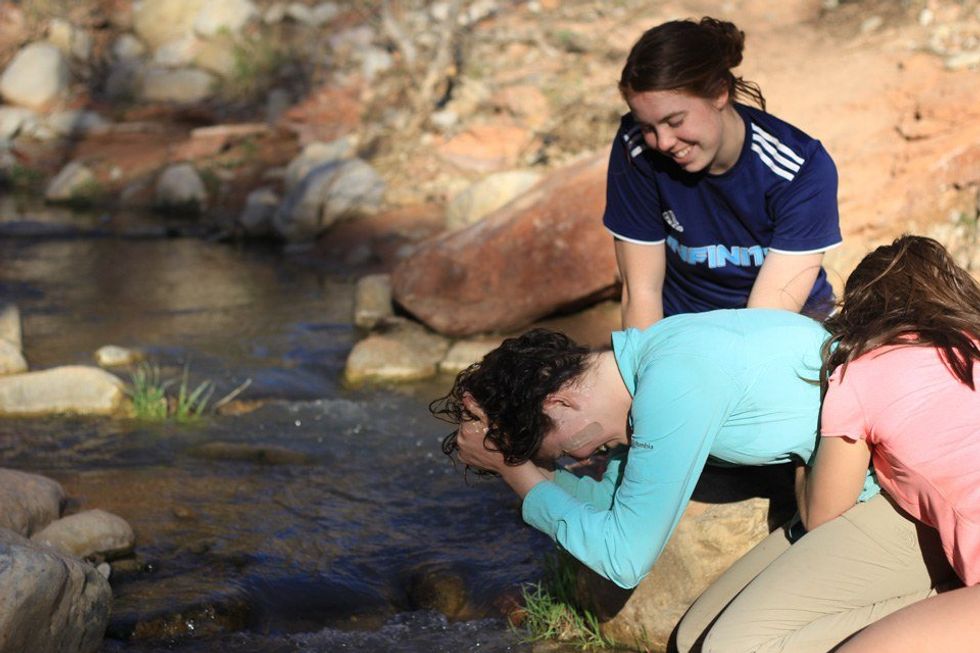
The look in his eyes said it all: tenderness, gratefulness, and brotherly love pooled together in a single moment. I had never before seen a look quite like that.
My friends and I were on a backpacking trip in Zion National Park that had taken some interesting turns. On this particular day, in order to renew our spirits and center ourselves on what truly matters, one of my friends gave a devotional from John 15 on Jesus washing the disciple's feet. In response to the passage, he encouraged us to do as Jesus did and wash each other’s feet.
I never really washed someone’s feet before. When it was my turn to wash my friend’s feet, I knelt before him. As I soaked his feet in the river’s cooled water and scrubbed away the grime from days of backcountry living, I experienced true servanthood. In these moments, I was able to set aside my own thoughts and desires in order to focus on my partner’s feet. This experience allowed me to more fully understand the selfless character of Jesus.
As I grow older, I fall more and more in love with this story of Jesus. Despite his awareness of what was to come Jesus lowered himself and became a servant to his disciples. I think that this model of servant-hood is now, more than ever, essential to our lives as Kingdom seekers.
* * *
Our world is covered in endless layers of dirt and filth. Dishonesty and hate are resounding gongs of this election season. Young children are diagnosed with cancer daily. Racism is deeply woven into our society. Depression is real. Individuals are harassed physically, mentally and sexually. These things—and many others—make up the nastiness of our lives and our world.
Perhaps understanding the concept of washing one another’s feet would help us cope with the messes in our world and the messes in our lives. Although washing feet, both literally and metaphorically, is not a solution to the filth of our lives, it can still be an appropriate response.
To be completely honest, feet are pretty gross, right? Even so, it is in this grossness that we, like Jesus, lower ourselves and serve others. When we engage with the grubbiness of our neighbor’s lives, we will better understand and love our neighbor. We are not to run away or ignore messiness; rather, we are called to engage with it and clean it up.
Not only does washing one another’s feet open the door to our innate messiness, it is also a sacred, communal act. When you wash someone’s feet and have your feet washed by someone else, your inherent equality is emphasized. In John 15, Peter was completely appalled when Jesus began to wash his feet because foot washing was typically a servant’s duty. “You shall never wash my feet” (John 15:8). To display Christ’s love, we are all to be as servants to each other. We should be willing to endure the dirt and pain of life.
Perhaps the best part is that because feet washing is communal, you do not have to wash your own feet! When we surround ourselves with people and communities who have a desire to enter into our personal filth, we can move toward the love that we are intended to give.
In reflection of our Zion foot-washing experience, my good friend Kyle Bradshaw wrote,“We washed each other’s feet in the river as a way of showing each other ‘the full extent of our love’ just as Jesus did for us.”
This is so true. In order to grapple with the dirt on our feet, we must lower our hearts and hands in love. With this kind of love and care, we can more fully experience the character of Jesus, who had the most faithful and humble of hearts.