I have always found the villains of stories far more interesting than the heroes. I always enjoy getting the role of the antagonist in a play; not only because, let’s face it, pretending to be evil is so much fun, but also because I found it more challenging and engaging to understand their way of thinking, to map the maniacal machinations of their malevolent minds (alliteration is fun). I’m not saying that heroes don’t also have a complex array of goals and emotions driving them, but very often their actions are motivated simply by right and wrong. Villains, on the other hand, frequently take actions that are blatantly unethical, so either they are at a point where right and wrong don’t matter to them, or their sense of morality is so twisted around that they are convinced that what they are doing is right. Examining exactly how they got to that point is one of my favorite pastimes. Today, I’m taking a look at the main antagonist of J.K. Rowling’s beloved fiction series Harry Potter, a dark wizard named Tom Riddle, otherwise known as Lord Voldemort.
Like a good deal of my generation, I’m sure, I grew up reading the Harry Potter books. They were actually the first novels that I read entirely on my own, without any help from my parents. I loved all the characters, but I never really thought about why Voldemort did what he did. Until recently, I always considered him as something of a generic villain, serving no purpose except as the embodiment of all evil. When I started to think about it, however, I realized he actually does have a substantial amount of characterization and development that motivate his actions.
In my defense, most of his backstory isn’t revealed until The Half-Blood Prince. Before that, he’s pretty much just the jerk who tried to kill Harry as a baby. Over the course of several conveniently comprehensive magical jaunts through memory lane, Dumbledore shows Harry some of Voldemort’s past. The youngest version of Voldemort that we see is in the scene where he first meets Albus Dumbledore. Although it is early in his development, we can still see several traits that continue to define him for the rest of his life.
The first and foremost trait we can observe is his desire for distinction. Growing up in an orphanage, among dozens of other children in the same situation as him, no doubt Tom Riddle grew to despise his anonymity. He even dislikes his own name, viewing it as common. Not only does he share it with lots of other people, it wasn’t even his in the first place; he was named after his father. Dumbledore notes this as indicative of Riddle’s “contempt for anything that tied him to other people, anything that made him ordinary” (Half-Blood Prince, 277). Even as a child, Riddle yearned for something to make him stand out. When Dumbledore reveals to him the true nature of his unusual abilities, he says to himself, almost in exultation, “I knew I was different… I knew I was special. Always, I knew there was something” (271). But not even this is enough to satisfy him. Scarcely has he absorbed this information before he begins looking for further things to set him apart from others. He tells Dumbledore of his ability to speak to snakes, and demands to know if it’s something other wizards can do. As Dumbledore put it, “Even then, he wished to be different, separate, notorious” (277).
It is also clear from his behavior that it does not matter to him if people viewed him in a negative light, as long as they saw him as superior. Dumbledore states that he was alarmed by Riddle’s “obvious instincts for cruelty, secrecy, and domination” (276). Perhaps this is tied to the trait that Dumbledore identified as Voldemort’s greatest weakness, his incapacity for love. Although it has been hinted that Voldemort is unable to feel love because he is the product of a union coerced through magic, it is also not unreasonable to say that growing up in a crowded orphanage could have made it difficult for him to form personal connections with others. In any case, Tom Riddle clearly sought to instill powerful emotions in others that would earn him their respect. Since he was unable to contemplate love, perhaps he focused on a different powerful emotion, fear.
Of course, the most obvious way Riddle saw to instill fear in others was to accumulate power for himself. Perhaps this is why, when Dumbledore finds him, his abilities are more developed than most wizards his age. They gave him power over others, so he consciously sought to develop them and increase his influence. His endless thirst for power may also stem from his own consuming fear of death. Voldemort views death, not only as a form of weakness, but as one of the defining aspects of being human, being mundane. He tells Dumbledore that he doubts his mother was a wizard, because if she was she would have been able to prevent herself from dying using her magic. Perhaps he views his mother’s death as the cause of all his suffering, the event that doomed him to grow up as just another face in the crowd.
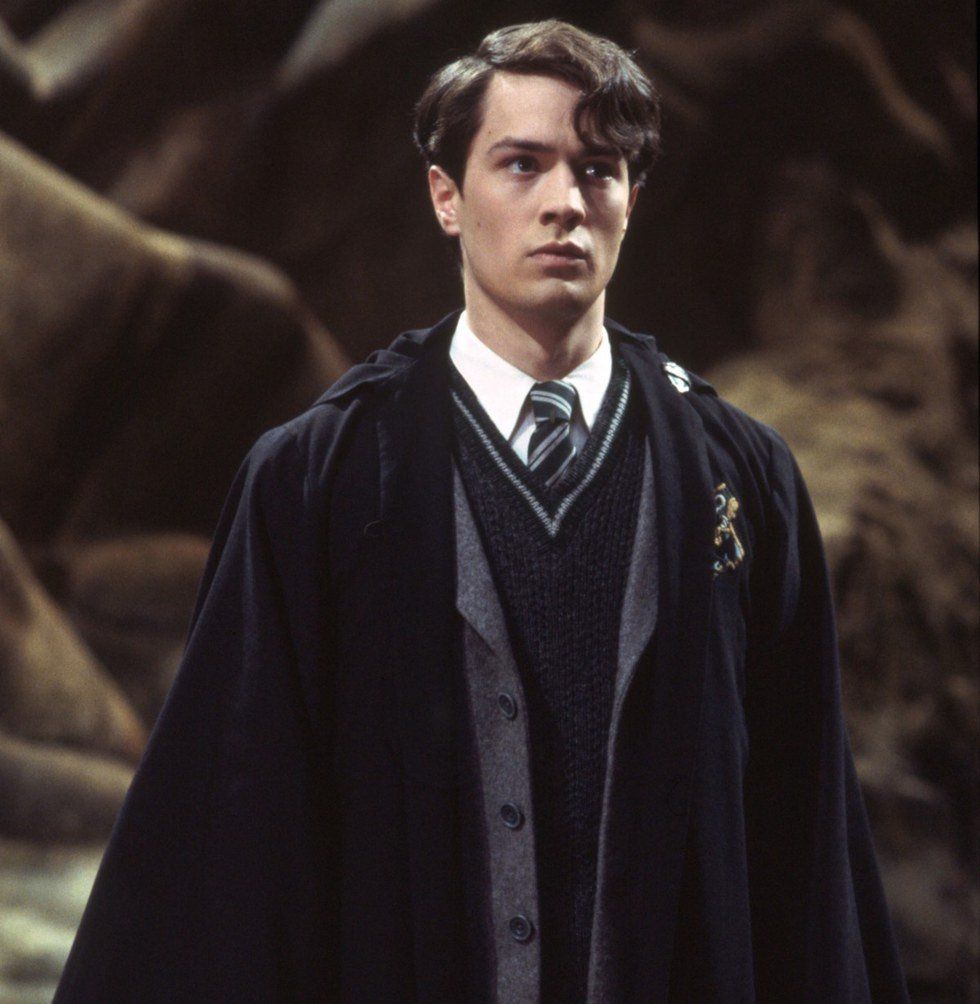
When he arrived at Hogwarts, Riddle’s cunning, charisma, and ambition no doubt made him an exemplary fit for Slytherin House. Once there, he strived to become an ideal student, well-mannered, well-behaved, and hard-working. It is conceivable that by living and working with his peers and receiving support and respect for his accomplishments, his malice and avarice may have dispersed over time. However, shortly after arriving at Hogwarts he made a discovery that only served to separate him further from his fellow wizards; he was Slytherin’s heir. This was doubtlessly of enormous significance to him. Having grown up an orphan with no family or heritage, Riddle now discovered that he was descended from one of the greatest wizards of all time.
I believe this to be the fundamental moment that shaped Tom Riddle into Lord Voldemort. Slytherin’s doctrine of ostracizing Muggles and Muggleborn cemented the beliefs that Riddle had long held himself, that the wizarding race is inherently superior to the rest of humanity. Not only did this set him on the path to becoming the most powerful dark wizard in history, it also gave him a way to attract followers. He wasn’t the only one who believed wizards should be the world’s dominant race. Some joined him because they shared his ideas, some because they were attracted to his power, and some because they had no choice. And once he had his army, he set out on his quest for immortality and world domination.
Finally, I arrive at a question that I ask whenever I examine a villain. Is there any chance of redemption for Tom Riddle? Personally, and I hate to say it, but I don’t think so. Some villains are turned to the dark side by their misguided ways, or are pushed there by circumstances beyond their control. Riddle, however, chose his path at every turn, fully conscious of the implications and consequences of his decisions. No one taught him that love was a weakness, he decided it himself. No one forced him to seek out a way to escape death, he did it of his own volition. His heritage may have provided him with the perfect opportunity to fulfill his wishes, but they were definitely his wishes all along.