

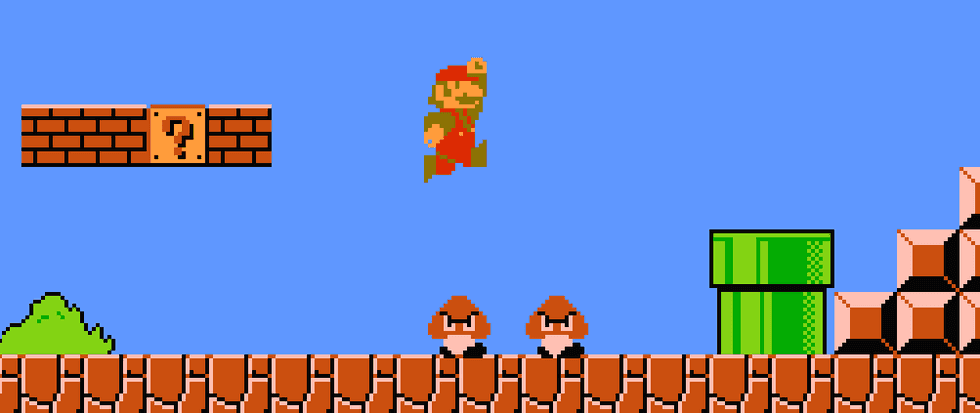
Anyone who knows me well knows that at any given moment I would rather be playing video games in my underwear, shoveling Cheerios directly from the box into my mouth while my glasses sit slightly askew on my nose. Now, this may seem a little lazy or sloppy, but I actually do the exact same thing when I'm reading literature and science textbooks or watching a film.
The thing is, video games are very similar to reading and film in more ways than one. In fact, I like to call video games "virtual literature"—i.e., a term given to video games in which the player is essentially playing through an intricate story line. Ever since I was younger, I have always wished I could be the protagonist of my favorite novels (God knows how many times I wanted to exact revenge upon playground bullies a la Edmond Dantès). With video games, though, you actually can be the protagonist.
I've probably played everything under the Sun. "Assassin's Creed." "Portal." "Professor Layton." "Bioshock." "Borderlands." "Silent Hill." And, of course, Hello Kitty's notorious raindrop-catching game for the PC. However, my favorites and the ones that I find myself replaying on my bad days are always the ones with the deepest story lines. Something that feels like I'm making my way through a film, or pretending I am my own main character.
Think about those sorts of games for a moment, and how these games are able to evoke an emotional reaction from the player. Do films and literature not do the exact same thing? Do you not weep during the most emotional parts of Oscar-winning movies, or when your favorite character perishes in the novel you're reading? Why is this any different from tearing up when all of the turrets sing "Carra Mia Addio" as you exit Aperture Science Laboratories at the end of "Portal 2?" Why is this considered "geeky" or "nerdy," when I am simply appreciating a beautifully crafted story line in the form of which I am the main character?
"Video games rot your brain!"
Anyone who has played the Professor Layton series for more than five minutes knows that this is a blatant lie. Video games are slightly misunderstood, and maybe it's the fact that people scream at the screen when they play them or all the mashing of buttons or being faced with a happy boy prancing around with a baguette. People think this is "stupid," or akin to staying in your mother's basement for the rest of your life. Well, Salvador Dalí stayed with his parents until his father finally kicked him out at age 28, and people consider him to be an artistic genius.
And you know, maybe people judge video gamers by elitist standards, but why can't they be geniuses as well? Roman Polanski is considered a directing genius and he fled the United States so he would not have to face charges on pedophilia. But authors aren't like that—they're geniuses! James Joyce, who fathered an incredible number of illegitimate children during the 1920s, wrote a book with symbolic defecation in it (I am, in fact, talking about "Ulysses").
So why can't video gamers, and video game designers, people who, according to popular and ignorant belief, spend hours in front of a computer all day, brushing Cheeto dust off on their three-weeks-worn-too-small shirt, be geniuses in their own right? If we romanticize the writers and artists of the past, why is it considered "geeky" or "nerdy" to romanticize the writers and artists of video games? This sounds to me like a double standard placed upon society by none other than society itself.
"Only kids understand video games."
Perhaps one can make the argument that video games do not reach a very broad audience, and simply do not translate well to older generations. Well, actually, no—one can't. Video games reach people of all ages, from youths to elders. And while it does take a while for the older folks to get a hang of the controls, some of the best times I've had playing games have been when all of my family is around, whether it's all of us panicking over "Silent Hill," or my father, sister and me playing "Super Mario 64" on weekend mornings, figuring out clues together to receive stars.
I even have fond memories of my grandfather and I playing "Harry Potter and the Chamber of Secrets" together. Isn't it incredible how wide of an age range that video games can reach? With easy controls and interesting gameplay, a video game can intrigue anybody; it just takes a little lesson or two to nail it.
"Video Games are just flashing lights on a screen!"
Countless hours of art and design go into simply the first step of creating a video game. Character designs, and backgrounds, pixel art, specific texts, voice acting, environment reactions. And what about those games where they feed off of your hesitations in the game, or your choices in the game affect the outcome of the game as a whole? ("Undertale," anyone?) To me, that seems a lot more than flashing lights.
Considering original watercolour drawings, unique lighting projects, unheard-of plots, and even new pieces of technology are used in every single game out there, it is hard to boil that down to just "flashing lights on a screen." If that's what video games are, then Victor Hugo's "Les Misérables" is just a stringing together of different letters from the alphabet, and "Casablanca" is also just flashing lights on a screen (actually, quite literally, as a movie screen sheet would have actually been used to project moving, flashing lights). The point is, this is a gross understatement of the amount of work and talent that goes into creating video games, and I know that this same amount of work and talent is often praised in other art forms.
But am I being too quick to judge people who do not consider video games an art form? Are video games simply too new of a storytelling platform to be recognized as such? Is it because painting, writing, and filmmaking have been around for so much longer, even though video games happen to combine all three of these elements into one storytelling platform? Perhaps so—but I can tell you right now, that's not going to stop me from destroying my friends at "Mario Party 7."