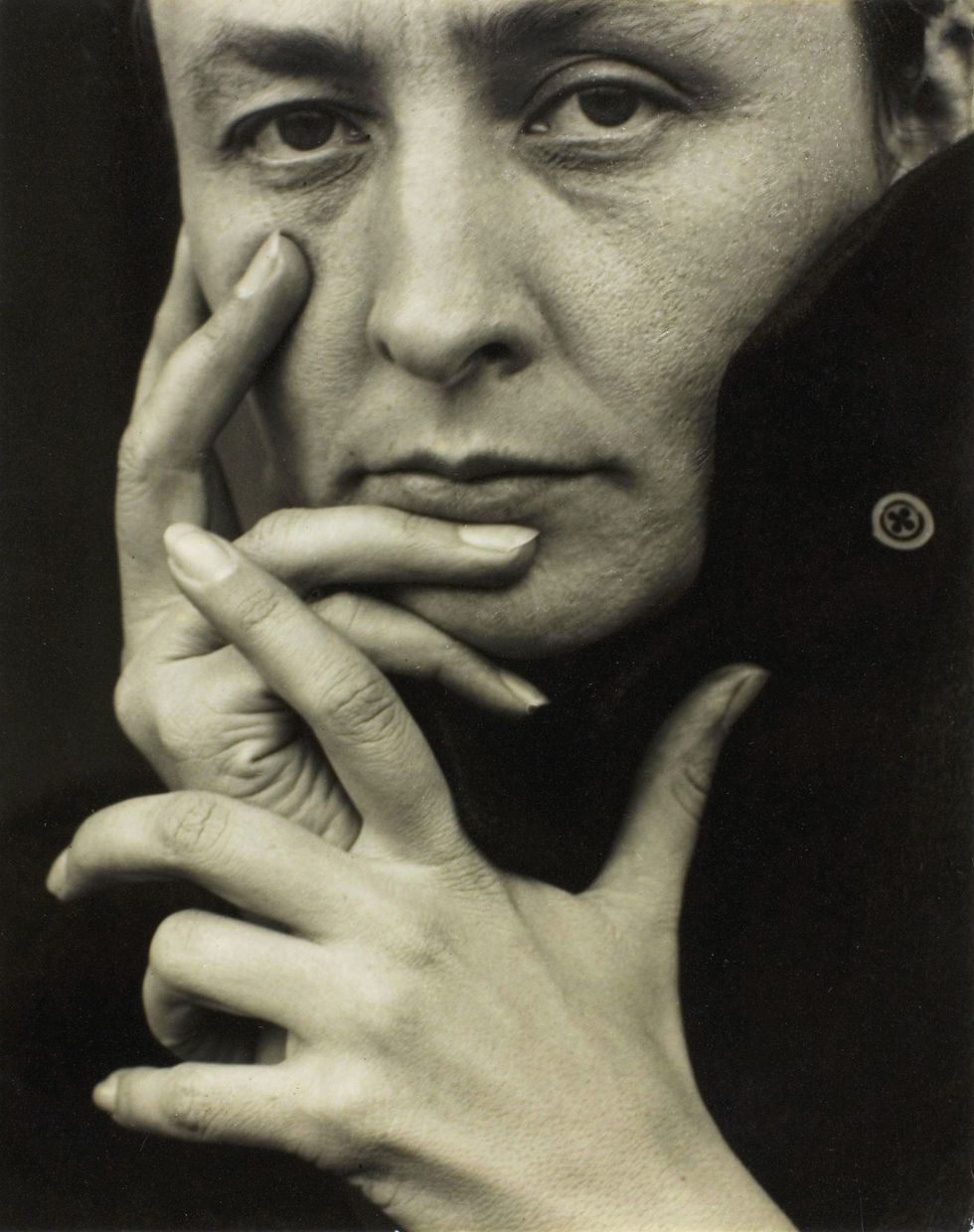
In the summer of 1912, a 35-year-old aspiring artist named Georgia O’Keeffe enrolled in a summer art course at the University of Virginia. Her purpose – to study the design philosophies of the artist Arthur Wesley Dow under the tutelage of painter Alon Bement – concealed a deeper motivation: to restart her flagging artistic career that had begun many years before in Chicago.
Georgia O’Keeffe was born the Wisconsin small town of Sun Prairie in 1887, the child of Irish-American dairy farmers. At the age of ten, O’Keefe decided to become an artist, beginning lessons first with a local artist and later with nuns at her high school. From the beginning, O’Keeffe displayed little interest in traditional artwork, preferring to create two-dimensional scenes of nature.
Many of these early compositions – a lighthouse under the stars, countless paintings of cherry blossoms – display the emphasis on nature that came to characterize much of O’Keeffe’s later artwork. At the Chatham Episcopal Institute in Virginia, O’Keeffe continued to develop her interest in European techniques such as pointillism and Art Nouveau, while continuing to draw inspiration from American artists such as Charles Dana Gibson.
After graduating in 1903, O’Keeffe continued her education at the Art Institute of Chicago under the Dutch American professor John Vanderpoel. Chicago at the time was a center of the Arts and Crafts Movement, an artistic trend emphasizing the decorative arts. Although O’Keeffe was successful as a student – her 1908 painting Dead Rabbit with Copper Pot brought her considerable recognition – her education was cut short by financial difficulties, as her mother was diagnosed with tuberculosis and her father became bankrupt.
After a stint in Chicago as a commercial artist, O’Keeffe joined her family in Charlottesville, where for some time she gave up her dreams of artistry. Her interest in abstraction and other non-conventional art forms put her outside the mainstream of the American art world, making employment difficult.
Yet when O’Keeffe enrolled in Alon Bement’s course on Arthur Wesley Dow in the summer of 1912, her engagement with the world of painting was renewed. Dow taught that art should be a personal expression of the individual, rather than a mere copy of reality – a radical idea in the early twentieth century. Dow’s philosophy embodied the Modernist art movement in which O’Keeffe would one day come to play a key role, and rejuvenated her interest in watercolor painting.
O’Keeffe’s notebooks from 1912-1914 record many her compositions from this period, which mark a growing turn towards abstraction. Drawing on Dow’s theories, O’Keeffe rejected acute realism in favor of stylized compositions in which landscape features could be rearranged as artistic designs. In one painting of a building in the Academical Village, hedges are arranged in neat formations to create an impression of symmetry – a vision derived from the artist rather than the actual scene.
In addition to experimenting with new methods of painting, O’Keeffe was beginning to create her own pigments – a discovery made by researchers at Santa Fe’s Georgia O’Keeffe Museum in preparation for an exhibit on her time with the University in 2016.
Following the end of her summer course, O’Keefe taught high school for two years before returning to the University for further study. The elegant architecture of the Grounds and the natural beauty of the surrounding Blue Ridge Mountains were a frequent subject of O’Keeffe’s burgeoning talent.
In 1914 O’Keeffe left Charlottesville for New York, where she would at last meet Dow and begin the long upward arc of her expansive artistic career. Although she would reach the peak of her fame for her depictions of the New Mexican desert – its flowers and cattle skulls against the backdrop of the southwestern sky – her beginnings as an artist lie in a long summer at the University of Virginia in the year of 1912.