


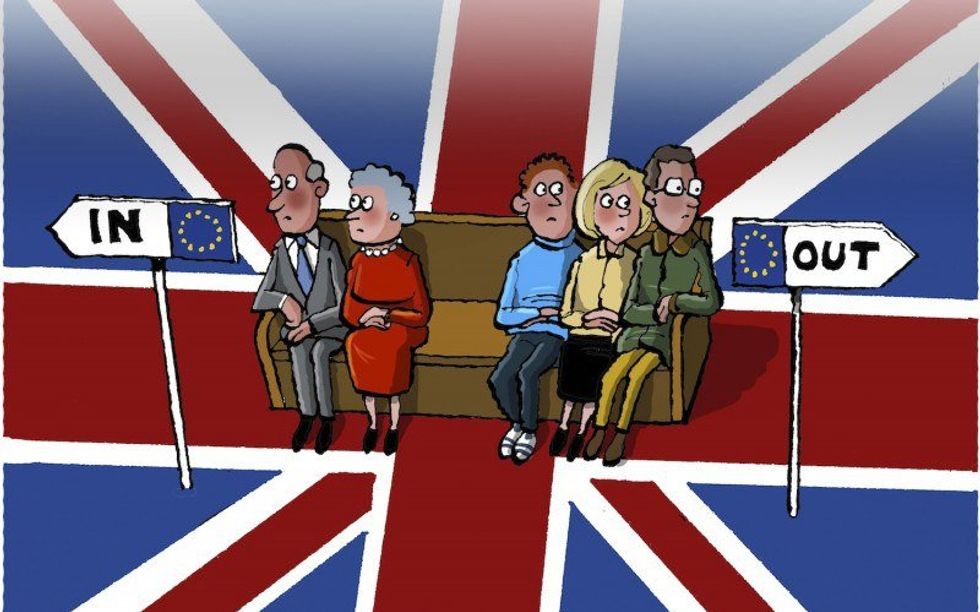
Next Thursday, the United Kingdom will hold a referendum to decide whether or not it will leave the European Union. That’s right, a country that still has a queen is holding a vote. And along with British and Irish citizens, those that live in the United Kingdom but are originally from the Commomwealth of Nations (a collection of states formerly ruled by the British) will also get to vote. But why does the United Kingdom want to leave the European Union? Was it something the latter said?
Well to understand why the United Kingdom wants to leave the European Union, it would help to actually know what the European Union is. According to the EU’s official website, “The European Union is a unique economic and political union between 28 European countries that together cover much of the continent.” Now I know what you’re thinking, “Wow Matt, the European Union is a union of European countries? What a shocking revelation.” But hey to be fair, is there anything more American than being completely oblivious to other countries’ issues? Anyway, the foundation of what would become the European Union was laid after the Second World War, which makes sense considering it turned most of the continent into rubble. Originally called the European Coal and Steel Community (ECSC), the organization’s original goal was to unify European countries economically, therefore making conflict between them more unlikely, since they would depend on each other for resources. Five years after the ECSC’s creation, it and the European Atomic Energy Community (EAEC) would both become part of the European Economic Community (EEC). In 1993, the EEC was renamed the European Community (finally a name without a damn abbreviation) and fully absorbed into the European Union in 2009.
So if the European Union is all about bringing its members closer together like an overenthusiastic youth group leader, why does the United Kingdom want out? Well like that one kid in a youth group whose parents forced them to go, the United Kingdom is worried about losing its autonomy. For example, almost all European Union member countries are bound by the Schengen Agreement. Basically, the Schengen Agreement allows free movement throughout almost all of the European Union member countries. This means no need for things like border patrol or passport checks in these countries. But like many pieces of legislation, there are exceptions. Only 26 of the 28 European Union member countries are bound by the Schengen Agreement, as the United Kingdom and the Republic of Ireland have opted out. And with the growing refugee crisis, the European Union’s “free movement” is being put to the test. This is not the only time the United Kingdom has gone against the grain in terms of European Union policies, either. Along with Denmark, the United Kingdom has also opted out of adopting the Euro as its currency. And while these are only two examples of the United Kingdom’s complicated relationship with the European Union, they seem to suggest that the approaching referendum was a long time coming.














