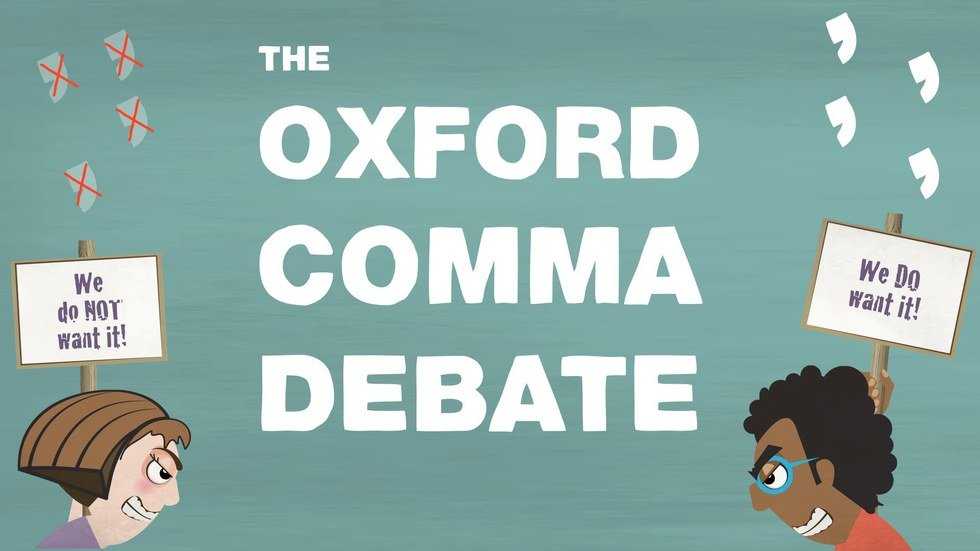
The biggest reason to study history is to figure out what happened in the past, analyze the causes and effects of the situation and strive to make sure all the bad things in history (i.e. the rise to power of a dictator) never happens again. Being a history major for sure has its perks, but it also, like all other majors, has its faults: The use of the Oxford comma.
The use of the Oxford comma, in my opinion is essential to the clear communication and understanding of any historical writing. In high school, I was taught that when writing a history paper you must assume no one knows anything about what you are talking about. For example, if I were to write a paper about John F. Kennedy I would have to say that he was the President of the United States from 1961-1963. So when we write a paper, it is essential that there is clear communication of the topic and arguments. That being said, the oxford comma helps with that goal of clear communications. Say for example you have one sentence, "I would like to thank Joe, my mom and yoga instructor." Without the Oxford comma that sentence sounds like it is actually Joe who is your mom and yoga instructor (not saying Joe wouldn't make a great mom and yoga instructor). The use of the Oxford comma turns that confusing mess into "I would like to thank Joe, my mom, and my yoga instructor." Clear, and ready to explain the next point. The reason that this is such a big struggle is because people are really starting to crack down on the usage of the Oxford comma. I mean, even when writing for the Odyssey, we are told to avoid using it. It is especially difficult because in the English language there are 10,000 things that could get you to not understand the sentence, and like I said, in history you have to be a clear as possible so that there is no question in your paper.
Being clear in your work is so important to make sure that when you argue something, you are arguing exactly what you set out to argue. To leave you with that thought, here is another example as to why the Oxford comma is important. "In 1945 Joseph Stalin, the prime minister of the UK and woman's Olympic soccer coach discussed matters that could change the world forever." This makes the sentence seem like Joseph Stalin was not only the UK prime minister but also the Woman's Olympic soccer coach. Both statements are incorrect. So, the use of the Oxford comma would switch this mess into a clearer explanation "In 1945 Joseph Stalin, the prime minister of the UK, and woman's Olympic soccer coach discussed matters that could change the world forever."
History has changed the world and warped it to be the way it is. We as students and historians learn from that and then begin the all important discussion as to why and how to compare and re-evaluate the occurrences to later understand them better. I heavily suggest to not let the lack of Oxford comma confuse your argument.
LONG LIVE THE OXFORD COMMA!