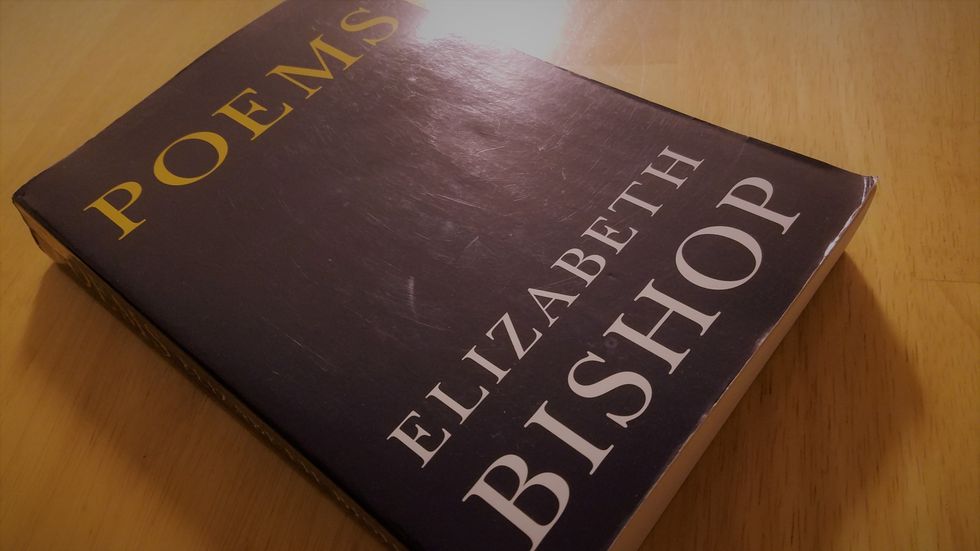
If this is your first time reading Elizabeth Bishop's work, it may be not unlike a hot cup of strong, black coffee. You realize from the first stanza that it is much darker and more bitter than anticipated, and you look for the sugar and cream. Then you notice Bishop isn't looking to offer any, so you proceed to sip slowly until the raw drink ––almost naked–– begins to warm you up. Every sip after that, you pick up on the subtle notes of chocolates and caramels.
Sure, you may go back to that frapp, but it is when you understand the honesty, intricacy, and blatancy of coffee, black that you begin to taste its richness.
7. A Miracle for Breakfast
From Bishop's first book, North & South, "A Miracle for Breakfast" is a poem regarding two parties clearly divided in status ––one on a balcony looking down at the others on the ground–– and is narrated by a member of the lower status. It touches upon master-slave morality by displaying the narrator's cynicism and wariness to all that is above her and her consideration of what constitutes "a miracle."
The poem places the word "miracle" within human hands and capabilities, which shows how much the narrator values certain human acts. The nonchalance with which Bishop uses the word that is usually tangled up with the supernatural and godly deeds is ironic and feels funny at first, but then you begin to find out more about the narrator.
6. Breakfast Song
"Breakfast Song" is quite possibly the sweetest yet most heartbreaking of Bishop's poems. The poem starts out like a serenade; full of loving words addressed directly to her lover. The love poem then unexpectedly takes the other road at the fork, and suddenly you're met with a seismic wave of consciousness about her fears and anxiety.
She unveils her strongest emotions on both ends of the spectrum. She leaves herself open and vulnerable but does not recoil. She remains drained and downtrodden, waiting for an answer to her call for help. The kicker is that Bishop wrote this for no one but her lover to see.
5. One Art
Famous for being written in the strict villanelle form, "One Art" is much more introspective than the previous two, focusing on and asking what qualifies as being or becoming an "art." You get to learn a bit more about the hardships Bishop endured and the wry attitude with which she faces the world.
Note: The villanelle is an uncommon fixed verse form. It confines the poet to 19 lines: five tercets with a repeating ABA rhyme scheme followed by a quatrain with ABAA rhyming. Late nineteenth century villanelles, which was when they were the most popular, were written about the pastoral aka #countrylyfe. Knowing this and Bishop's general ironic tone, her choice to write about "the art of losing" in a form strongly associated with the art of growing and life becomes clear.
4. In the Waiting Room
If you wanted to read about the darkest times of Elizabeth in her own terms and her own voice, then "In the Waiting Room" will do that for you. This poem will answer most looming questions about her upbringing and her childhood.
That is, if you can look beneath her words as she describes the drab waiting room and discern her tone in time before you hear her aunt scream from inside the doctor's office.
3. Pink Dog
Though definitely not one of her coveted or adored poems, "Pink Dog" is one of her most sprightly poems in that her words pop like the first mouthful of soda. Written during her fabled stay in Brazil, the poem is a reflection of her detachment from the seemingly welcome, beautiful, and vibrant community of Rio de Janeiro.
2. Crusoe in England
One of my favorite dramatic monologues, "Crusoe in England" revisits Robinson Crusoe after his return to England from surviving in a deserted island for twenty-eight years. Now an old man, Crusoe recalls his time on the island, focusing on several key moments.
Crusoe thinks about his relationship with Friday and his strenuous life on the island, especially his tools and objects which now look shabby and destitute. Looking at all of the mementos on the tall shelves of his London home, he feels regretful, old, and lifeless.
Honorable Mentions:
Seven-Sided Poem
Bishop's translation of the Portuguese poem (of the same name) by Carlos Drummond de Andrade.
The Man-Moth
A cool mixture of Surrealism and childhood imagination to conjure up an uneasy character.
Sonnet
Creatively named "Sonnet," this poem takes the Petrarchan form and has fun with it. I want to believe that while Bishop was experimenting with different meters and forms, she decided she'll goof and write something that would break the untouchable Petrarchan sonnet form. Beyond the iconoclastic form, the poem is nice too!
1. The Fish
If you ever wanted to read an extended double entendre about sapphic erotica conveyed through a detailed reporting of a fish immediately after being caught, then you're using the Internet for all the wrong reasons. Though very open to interpretation as often poems are, "The Fish" in its core is a story about a fish that the narrator catches.
After referring to the fish in the first line, Bishop calls the fish "he" for the rest of the poem until the final line, where she returns to using "the fish." The two shifts in pronoun also mark the start and end of the poem's ultrarealistic visual details about the fish. The narrator's mention of even the smallest details conveys the sheer proximity to the fish, which in turn creates sexual tension between her and "him" arising from the narrator's empathy and her willingness to sensualize the fish's agony.