

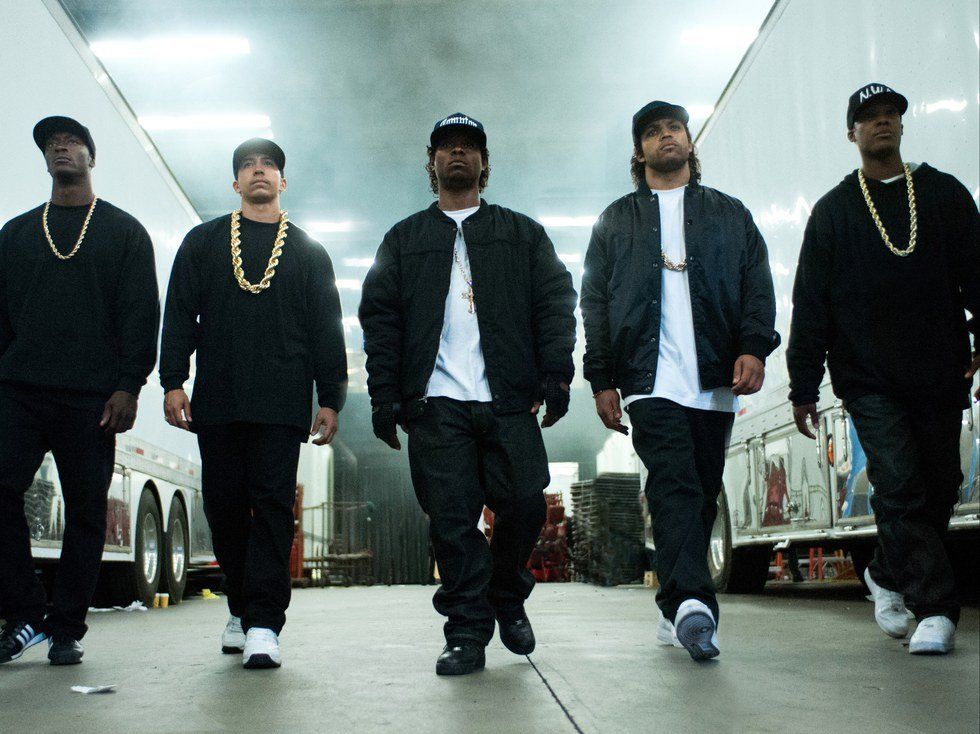
Straight Outta Compton has been one of the most successful movies of the summer, more than doubling its production budget in its opening weekend. The movie has been praised for its intense and honest look at the early lives of the influential rap group NWA. Scott Foundas calls the movie "intensely human and personal in its characterization and attention to detail," while John Defore wrote that Straight Outta Compton "does for the most part fulfill its mission, breathing life into the origin story of a group whose influence is still being felt."
Straight Outta Compton portrays a powerful piece of hip-hop history and brings issues such as police harassment and racism to the masses, but one of the movie's largest fault has come to light. The movie completely ignores Dr. Dre's violent and abusive past with women. Since the movie's domination at the box office, multiple women have come forward to speak about the violence they faced at the hands of Dr. Dre.
In a Gawker article published last week, Dee Barnes, a rapper and television host, spoke in depth about her experience with Dr. Dre. Barnes explains that Dre was angry about a segment on her hip hop show Pump it Up and confronted her at a nightclub in 1991. She says that she's glad her abuse wasn't depicted in the movie, as she believes that "the truth is too ugly for a general audience," but she wishes that the event would have been mentioned or acknowledged. She calls Straight Outta Compton a "revisionist history," leaving out a score of women who worked with NWA and were important to their history.
Barnes brings up Dre's girlfriend of six years, Michel'le, a constant victim of Dre's abuse who was also left out of the film. Michel'le describes herself as a "quiet girlfriend who got beat on and told to sit down and shut up." While Michel'le is glad that she wasn't portrayed as a character, and calls to mind the fact the Straight Outta Compton was more Ice Cube's story than Dre's, it is undeniably problematic that the long-term violence was ignored.
Michelle says that "her part has no value," but I beg to disagree. No woman should ever be made to feel that they are of such little value, and it is important that NWA's misogyny be recognized as a part of the group's history.
Barnes writes that "There is a direct connection between the oppression of black men and the violence perpetrated by black men against black women. It is a cycle of victimization and reenactment of violence that is rooted in racism and perpetuated by patriarchy."
NWA's violence against women is an important part of the group's history. Just as the violence that NWA and other young black men experienced at the hands of the police, the violence that they showed to the women in their lives is a part of their story. In the wake of Barnes and Michel'le's stories coming out, Dre has released a public apology. He stated "I apologize to the women I've hurt. I deeply regret what I did and know that it has forever impacted all of our lives."
Dre's apologies are a step in the right direction. The statement was one of the first times that he has publicly recognized the allegations and criminal charges against him. The statement given by Dre has been widely circulated, and hopefully it will open up a dialogue in which the public can openly discuss abuse and its implications in all of our lives. Domestic abuse is an issue faced by thousands of women and men today, and recognizing its existence in pop culture is integral if we are to go about fixing the problem.
















